
Mercenary Bactrian Thureophoroi
Mercenary. Hired from a regional pool, not recruited from a building.
Class: spearmen · Category: infantry · Men per unit: 40
Description
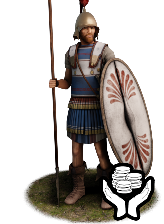
The Thureophoroi were flexible infantry, not only adept as skirmishers and ambushers, but also able to form a tighter formation and serve in the main battle line. Their principal weapon was the javelin, and they went into battle with a bundle of these, but they also carried spears and swords as secondary weapons. Thureophoroi carried the oval thureos, from which they derived their name. The thureos was modelled after the standard Celtic shield, which the Greeks encountered during the Galatian invasion of Greece and Asia Minor in 280-275 BC. After these events, the Thureos became popular among especially Greeks and Illyrians, but its use later spread as far as Nabataea (Trophy Tomb of Maghar al Nassara, ca. 100 BC). The shield was usually painted white, with a spined boss and central handgrip. Some Thureophoroi wore armour, usually the standard Hellenistic linen cuirass (Linothorax) with pteryges, and some wore cloaks. Various helmets completed their defensive equipment.
Thureophoroi were used to support skirmishers, to protect the vulnerable flanks of the phalanx, and to screen heavier troops in difficult country or on the march. Though capable of fighting hand-to-hand, they could not long stand up to a pike-phalanx.
Historical background
At the centre of the scholarly debate on Thureophoroi has always been the question if they evolved from Peltasts or Hoplites. While authors like Gabriele Esposito (Armies 2019, repeated mentions), Duncan Head (Armies 1982, 113) or Simon Elliot (Greeks at War 2021, 21) interpret them as light skirmishers who used their pace and agility to their advantage, others like Richard Taylor (Hoplite Phalanx 2021, 472) Edward Anson (Land Warfare 2021, 51) or Myke Cole (The Bronze Lie 2021, 351) assume that they replaced the traditional Hoplite and offered more flexibility as the main heavy infantry of Greek armies. The question cannot ultimately be resolved, but Serrati (World at War 2017, 186) is right in pointing at their double function: since Thureophoroi were able to fight both as mobile spearmen who defended the flanks of the phalanx and as skirmishers who could support quick attacks, they were an extremely valuable asset on the battlefield.
If you are playing as Parthia, you will be able to unlock Thureophoroi as your factional mercenaries. These are based on a terracotta from Nineveh which can be found in the British Museum and shows a Thureophoros in markedly Iranian dress. Other terracotta figures from Seleukeia on the Tigris may also show Parthian Thureophoroi. Though all of these could also date to the late Seleucid period, there is no reason to believe why some of the professional Greek soldiers settled in the Near East would not have fought for Parthia when it took over these regions. Many Greeks lived under Arsacid rule and the kings did not hesitate to adopt Seleucid titles and to use Greek letters on their coins (cf. Dabrowa, Hellenistic elements 2017). They communicated with the many Hellenic cities in their realm in Greek and their correspondence with Roman emperors, too, was in Greek (Millar, Government and Diplomacy 2004, 215). Some Parthian Greeks are in fact well known, such as Isidore of Charax (1st century BC): hailing from the Greek city of Charax, formerly called Antiocheia in Susiana, he wrote a work called "Parthian stations" in which he described the size and character of the Parthian territories for a Greek and possibly Roman audience (Schroff, Parthian Stations 1914). Against this background, it is very likely that the autonomous Greek cities in the empire will have retained their own units of Thureophoroi; while those who served as mercenaries for the Seleucids will surely have found employment under their new Arsacid masters as well.
Stats
| Rank in roster | ||
|---|---|---|
| Men per unit | 40 | ███······· 30% |
| Attack | 15 | ███████··· 72% |
| Charge bonus | 7 | ███······· 29% |
| Defence | 37 | ██████···· 64% |
| · armour | 7 | ████······ 42% |
| · defence skill | 25 | ███████··· 74% |
| · shield | 5 | ██████···· 57% |
| Morale | 11 | ████······ 39% |
| Discipline | Normal | |
| Training | Trained | |
| Recruitment cost | 2,578 dn | ███████··· 73% |
| Upkeep per turn | 629 dn | █████····· 48% |
| Turns to recruit | 2 |
Weapons
| Primary | Secondary | Primary | Secondary | Primary | Secondary | Primary | Secondary | ||||
|---|---|---|---|---|---|---|---|---|---|---|---|
| Attack | 15 | 11 | Charge bonus | 7 | 9 | Type | thrown · blade | melee · blade | Damage | piercing | piercing |
| Projectile | javelin | — | Range | 50 | — | Ammunition | 2 | — | Properties | Used just before charging into combat | Light spear (braced against cavalry charges from the front) · +8 attack against cavalry |
Defence
| Primary | Secondary | Primary | Secondary | Primary | Secondary | Primary | Secondary | ||||
|---|---|---|---|---|---|---|---|---|---|---|---|
| Total | 37 | — | Armour | 7 | — | Defence skill | 25 | — | Shield | 5 | — |
Condition and terrain
| Hit points | 1 | Ground: scrub / sand / forest / snow | 0 / -1 / -1 / -1 | Charge distance | 30 | Formations | Square |
Technical stats
| Time between blows (primary / secondary) | 2.5 s / 2.5 s | Extra fatigue in hot climates | -2 | Collision mass per man (1.0 is normal) | 1.05 | Spacing between men: close / loose | 1 × 1.2 m / 2 × 2.4 m |
| Default ranks | 5 |
In battle: Can sap · Very good stamina
Where to hire it
No mercenary pool on the campaign map offers this unit, so it cannot be hired.