
Mercenary Cilician Brigands

Mercenary. Hired from a regional pool, not recruited from a building.
Class: light · Category: infantry · Men per unit: 60
Description
”Everything has a price… even your life.”
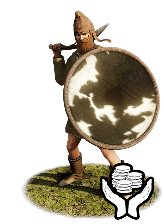
Warbands control the treacherous mountains of western Kilikia. They are equipped similarly to Cilician Pirates, with both big and smaller shields made of oxhide and long exomis boots. Some of them wear Pilos helmets, while others shine thanks to looted bronze muscle cuirasses. One noticeable difference to other Cilician units is these men’s use of long sleeves on their eastern tunics, which allow them to survive in the harsh, cold mountains. Their victims are intimidated thanks to fearsome machaira swords. In your army, this unit will be used primarily to bolster the numbers as light infantry.
Historical background
Greeks did not differentiate between piracy and brigandage. The Greek word πειρατής (peirates), in written form, came into use in the early third century BC, and was a synonym for the older word leistes or ‘plunderers’ (De Souza, Piracy in the Graeco - Roman World (2012), p. 3). It is, thus, likely that both activities were interchangeable: at one time, the warlords of Kilikia plundered the countryside; at another, they turned their ambitions towards the sea.
Political conflicts enabled piracy. In 197 BC, the Seleucids took possession of the Ptolemaic holdings in Kilikia, Lykia, and Karia (Montesanti, FINES Bordering Practices and Natural Features in Livy (2014), p. 333). Only nine years later, the Treaty of Apameia between the Roman Republic and Antiochos III of the Seleucid Empire was signed. It stripped Antiochos of most of these newly won territories, establishing the area around the River Kalýkadnos (the river where Frederick Barbarossa would drown in 1190 AD) and its delta (the Sarpedon promontory) as the new border (historians debate the exact border; see: Montesanti (2014), pp. 329-331). This border is of interest as it lies further to the west than the Lamos River or the town of Soli, which were traditionally used to differentiate between Kilikia Tracheia and Kilikia Pedia. The treaty brought most of the natural harbours of Kilikia under the sovereignty of the extended Kingdom of Pergamon. The semi-independent theocracy of Olba, however, remained under Seleucid authority. It is in this remote border region that many independent warlords established themselves.
Plutarch (Life of Pompey, 28) emphasises that those pirates had bases near the mountains: “[...] the most numerous and powerful had bestowed their families and treasures and useless folk in forts and strong citadels near the Taurus mountains”. Fairchild (‘The Jewish Communities in Eastern Rough Cilicia’, in: Journal of Ancient Judaism 5-2 (2014), pp. 214-215) claims that the pirates gradually established their bases inland with fortresses, watchtowers, and rock-cut dwellings, mainly in the aforementioned border region around Olba. The locals, however, also constructed watchtowers to warn against intruders such as the pirates, who were increasingly involved in robbery and theft on land, too.
There was debate among the locals on how to handle this threat. They were forced to choose between fighting, fleeing, or paying tribute. Even the priest-kings of Olba were eventually overthrown by the pirates (Durukan, ‘The Connection of Eastern and Central Cilicia with Piracy’, in: Adalya 12 (2009), pp. 77-102) . The people of Syedra, in desperation, around 100 BC turned to the Klarian oracle in Ionia. The oracle replied as follows to their question whether or not they should cooperate with the pirates: “take up the fierce battle”, because the town would be cursed if it opted to pay tribute to the pirates. As De Souza argues, ‘the oracle shows the response of a small community to the Romans' anti-piracy stance and illustrates the considerable variation in attitudes to Rome and piracy which existed in the region prior to Pompey's celebrated campaign of 67 BC’ (De Souza, ‘Romans and pirates in a late Hellenistic oracle from Pamphylia’, in: Classical Quarterly 47-3 (1997), pp. 477-481).
Two renowned enslaved Kilikian bandits were Athenion of Kilikia and a certain Kleon (Grunewald, Bandits in the Roman Empire (2014), pp. 59-64). The latter was, according to Diodorus Siculus (XXXIV/XXXV.2.43), "[...], a Cilician from near Mount Taurus, who was inured to robberies from a boy and had been appointed to look after the horses in their pastures in Sicily, used to attack travellers on the highways and committed various heinous murders. This man, hearing of the good fortune of Eunus [a renegade slave turned king] and his followers, persuaded some of the neighbouring slaves to join with him in a sudden revolt. They overran the city of Akragas and all the neighbouring country round about". Next, he served as a general in the slave army during the First Servile War. Athenion of Kilikia, a general during the Second Servile War in Sicily, was also stereotyped as a herdsman from Kilikia (Florus III.19). In Roman eyes, this meant the same as being a bandit (Grunewald (2014), pp. 35-36). He made a name for himself, and his demise came only when he was defeated by consul Manius Aquillius. Roman sources romantically state that the consul and the slave-king fought a duel, of course won by the consul (Diodorus Siculus, XXXVI, 10).
Cilician Pirates were, thus, not only a problem for the Romans and Greeks, but also for the local population of Anatolia in the form of brigands. Empires could co-opt this rabble into their armies. A considerable number of Kilikians fought as light-armed troops for the Seleucids against the Ptolemies at the Battle of Raphia in 217 BC (Polyb. V.79.3). This illustrates that even before the full occupation of Kilikia, the Seleucids could levy forces there. And 51 years later, 3,000 Kilikians participated at the Daphne victory parade equipped as light infantry, wearing gold crowns, perhaps as a symbol of their distinctive service (Polyb. XXX.25.4).
Stats
| Rank in roster | ||
|---|---|---|
| Men per unit | 60 | █████████· 87% |
| Attack | 6 | █········· 3% |
| Charge bonus | 5 | ███······· 26% |
| Defence | 23 | ███······· 25% |
| · armour | 4 | ███······· 33% |
| · defence skill | 14 | ██········ 18% |
| · shield | 5 | ██████···· 57% |
| Morale | 7 | █········· 10% |
| Discipline | Impetuous (may charge without orders) | |
| Training | Untrained | |
| Upkeep per turn | 551 dn | ███······· 29% |
Weapons
| Primary | Secondary | Primary | Secondary | Primary | Secondary | Primary | Secondary | ||||
|---|---|---|---|---|---|---|---|---|---|---|---|
| Attack | 6 | — | Charge bonus | 5 | — | Type | melee · blade | — | Damage | slashing | — |
Defence
| Primary | Secondary | Primary | Secondary | Primary | Secondary | Primary | Secondary | ||||
|---|---|---|---|---|---|---|---|---|---|---|---|
| Total | 23 | — | Armour | 4 | — | Defence skill | 14 | — | Shield | 5 | — |
Condition and terrain
| Hit points | 1 | Ground: scrub / sand / forest / snow | 0 / -1 / 0 / -1 | Charge distance | 30 | Formations | Square |
Technical stats
| Time between blows (primary / secondary) | 2.5 s / — | Extra fatigue in hot climates | 1 | Collision mass per man (1.0 is normal) | 1.02 | Spacing between men: close / loose | 1 × 1.2 m / 2 × 2.4 m |
| Default ranks | 5 |
In battle: Can sap · Very good stamina
Where to hire it
Mercenaries are hired from a regional pool, not recruited from a building. This unit is offered by 1 pool covering 5 regions, at 2,475 dn to hire and 0 experience.
Mercenary pool: Kilikia Tracheia
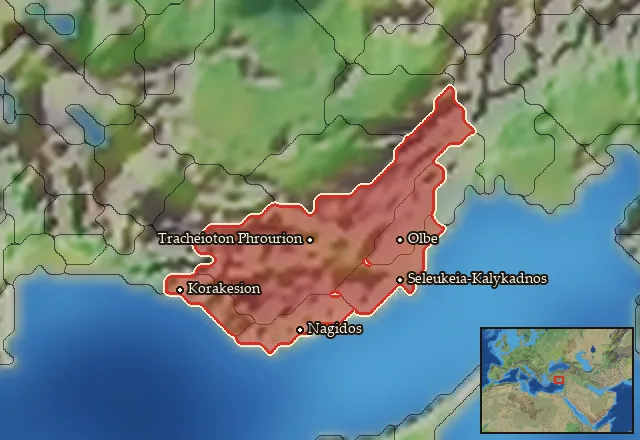
At least one of those pools sells to any faction that has an army in range, with no faction restriction.
The 5 regions where this unit appears in a mercenary pool
Anatolike Tracheiotis · Boreia Tracheiotis · Hesperos Tracheiotis · Notia Tracheiotis · Tracheiotis