
Mercenary Issaian Hoplites


Mercenary. Hired from a regional pool, not recruited from a building.
Class: spearmen · Category: infantry · Men per unit: 40
Description
These Hoplites are the citizens of Issa, the greatest Greek city of the Adriatic. A colony of Syracuse on a Dalmatian island, Issa has become a respected naval power in its own right. It controls much of the trade in the central Adriatic, as well as the production of Greek terracotta and fine wares. To defend their wealth, the people of Issa often go to war. Like many other Hellenes, they customarily fight as hoplites: the large, round aspis shields afford great protection, while the wooden spear with its iron head can pierce both bodies and armour. The Issaians prefer Illyrian or Pseudo-Corinthian helmets, which are also popular in Italy, some with crests or plumes. Unlike other hoplites, however, they have done away with body armour – only wearing exomis or chiton tunics – and armed themselves with javelins, instead. Faster and more agile than other hoplites, the Issaians are thus better suited for battles on the small, rocky islands or in the steep bays and hills of the Adriatic.
Historical background
Issa was founded by Dionysios I (r. 405-367 BC), tyrant of Syracuse, as a basis for Syracusan operations in the Adriatic around 385 BC (cf. Diod. 15.13.3, 14.2; Stroheker, Dionysios (1958), pp. 123-124; Ps-Scymn. 413-414). The settlement was built on a slope that overlooked the northern part of the island now named Vis. As a naval port, it will have been equipped with military facilities from early on, and a massive stone wall was erected around the Syracusan city (Mohorovičić, Architecture in Croatia (1994), p. 42). The walls enclosed an area of 10 ha, in which several thousands of people lived, while the whole island was dotted with farms and villages (Zaninović, M., Issa, in: The Princeton Encyclopedia of Classical Sites (1976), p. 417). Issa was a polis, but it was dependent on its mother city and ruled by an eparchos, a local governor (Fischer-Hansen/Wilkes, The Adriatic (2004), p. 332). Soon after its foundation, the eparchos and his forces answered a call for help from the Parians on nearby Pharos (Hvar). Illyrians, possibly Dalmatians or their ancestors, were attacking the island. The Syracusan fleet from Issa sailed to their help and won a decisive victory (Diod. 15.14.1-2).
After the death of Dionysios I in 367 BC, his son Dionysios II inherited his massive empire that stretched across the Adriatic, the Tyrrhenian Sea, southern Italy, and Sicily (cf. Stroheker (1958) for a detailed reconstruction). Dionysios II proved an unpopular ruler, however, and in 357 BC, he was challenged by Dion, his late father's brother-in-law (Plut. Life of Dion 22-23). The civil war would go on for over a decade and the arche, the overseas dominion of Syracuse, fell apart. In this period, Issa, too, gained its independence, and became an autonomous polis, ruled by a moderate aristocracy that gave some power to the demos (cf. SIG 141; Fischer-Hansen/Wilkes (2004), p. 332). With its position in the central Adriatic, it was able to make much revenue from trade, as is attested by the excessive amount of imported ceramics found in its necropolis, most prominently from southern Italy (Zaninović (1976), p. 417). At the same time, it produced much terracotta itself, which was exported to all of the Adriatic islands and into the Illyrian hinterland, where they were the most common form of ceramic from the 4th to the 1st century BC (Maja Miše, ‘Transformation and Integration. A Millennia of Political, Social, and Cultural Shifts in the Eastern Adriatic’. Lecture at: Workshop "Current Research on Illyria and Epirus", Trier 2024). Other exports included wine (Miše 2024) and honey (Jelinčić Vučković et al., Dalmatian Beekeeping (2021), p. 130). Having initially overstruck Syracusan coins, the Issaians began minting their own bronze coins around 344 BC, which found much use throughout Illyria (Fischer-Hansen/Wilkes (2004), p. 332).
The economic power of Issa is attested by its foundation of a colony on Melaina Korkyra (“the black Korkyra” (= Corfu), modern Korčula) in the early 3rd century BC. The so-called Lumbarda Psephisma records how the colonists fortified the place (at the modern village of Lumbarda) and mentions the names of all the citizens who participated (SIG 141). Probably shortly thereafter, trade posts and fortresses on the coast of the Dalmatian mainland followed. These were the famous Salona (now Split, cf. Fellmeth, Ulrich, s.v. Salona, in: DNP Online), Epetion (Polyb. 32.9.1) and Tragourion (Strab. 7.5.5C315). Together, they formed a “commonwealth” under Issa’s leadership (Džino, Illyricum in Roman Politics (2010), p. 50). Since all major trade routes between Magna Graecia and the Dalmatian hinterland went through Issa – and no other Adriatic island – from the beginning of the 3rd century BC, the commonwealth developed into a major commercial power (Derow, Kleemporos (1973), pp. 125-126). The Mazin coin hoard from Dalmatia shows that they even exported early Roman bronze coins, probably for their material value (id., 126).
Such wealth attracted predators, the first of which was king Agron of Illyria (r. ca 250-231/230 BC). From Polybios’ Histories (2.8.5) we can infer that Issa and its commonwealth were part of his realm. Agron was the first ever king who controlled the seaboard of southern and mid-Illyria and he was therefore more powerful than any previous ruler in the area. We know nothing about his rise and how he secured the acknowledgment of the Issaians. But after his death, his wife and successor Teuta apparently angered her Greek subjects. When the Dardanians incited a revolt in the kingdom in 229 BC, Issa and its colonies revolted, too (Polyb. 2.6.4, 8.4-5). While Teuta’s troops and those of her ally Skerdilaidas, lord of the Labatae in modern-day Montenegro, quickly put down the rebels on the mainland, Salona, and Black Korkyra, Issa held out longer (Polyb. 2.6.4-6, 8.5). According to the Alexandrian historian Appian (ca. 90/95-160/165 AD), the Issaians implored the help of Rome. Their envoy, Kleemporos, was joined by Italic merchants who had been attacked by Illyrian pirates, or, better, privateers (App. Illyr. 7, Polyb. Polyb. 2.8.1-3, cf. Polyb. 2.8.8). When the Romans investigated the case, one of their envoys and possibly Kleemporos were killed by Teuta’s men (for a comparison of the various versions in the sources see: Gieseke, The Illyrians in the Histories of Polybios (2023), pp. 24-28). In the following First Roman-Illyrian War, Teuta was defeated and Issa and her colonies freed. Amicitia (“friendship”) was established between the Issaian cities and Rome (2.11.12) and the Romans entrusted control of the Dalmatian coasts to their new allies (Džino (2010), p. 51). That the Romans were so committed to Issa may be a result of the two cities’ Syracusan connection. Since the early days of the First Punic War, Hiero II of Syracuse (r. 269-215 BC) had become Rome’s most important ally. As Syracuse was the mother city of Issa, the king may have asked the Romans to intervene on his behalf (Waterfield, Taken at the Flood (2014), p. 10; cf. Derow (1973), p. 125).
The bond between Rome and Issa was strong and the Issaians continued in their role as governors of coastal Dalmatia for the next decades. In 198 BC, the Issaian fleet supported the Romans in the Second Roman-Macedonian War in Greece (Liv. 32.21.26-27), and a few years later its troops landed in Lycia to help the legions in a battle against the Seleucids (Liv. 37.16.7-8). In 172 BC, king Genthios of Illyria, the grandson of Skerdilaidas, threatened Issa like Agron had once done, and again the Senate sent troops to the East – a move that led to the Third Roman-Macedonian War. Fifteen years later, the Dalmatians were causing trouble and once again, Rome was ready to protect its ally and did not annex any land after its victory (Vollmer, Symploke (1990), p. 49). Thanks to its privileged position, Issa was able to extend its territory, likely incorporating Olyntha and the Hyllei beyond Tragourion (Boršić/Džino/Radić Rossi, Liburnians and Illyrian Lembs (2021), p. 21). The new territories were also used for viticulture, and Issaian wine was one of the most sought-after products in the metropoles of the Hellenistic world. Agatharchides of Knidos, a Greco-Carian secretary at the Ptolemaic court in Alexandria, claimed wine from Issa was "[...] superior to every other wine whatsoever [...]" (Agatharchides apud Athen. I.28d). Accordingly, the amphorae produced on the island were decorated with Dionysian motifs (Miše, Gnathia and related Hellenistic ware (2015), p. 62). At some point in the 2nd century BC, disaster struck. Just after leaving the port of Issa, a trade fleet full of wine sunk in the bay of the island, with a sudden storm scuttling the ships (Zaninović, The Economy of Roman Dalmatia (1974), p. 799). Such catastrophes were part of ancient seafaring, however, and did not significantly weaken the Issaian economy, which remained one of the most robust in the Adriatic and beyond well into the 1st century BC.
The golden age of Issa, like so many others, came to an end during the Roman civil wars. In 48 BC, both Issa and the Dalmatians sided with Pompey against Caesar, impressed by the naval successes of Pompey in the East (Caes. bell. civ. 3.9.1). When Caesar gained the upper hand, Issa was besieged and forced to give up its commonwealth in 47 BC. Salona, which had previously rebelled against its mother city, was now given the role of capital of Dalmatia (Džino (2010), p. 91). Thus ended the independence of Issa after almost exactly 300 years.
Like in other Greek poleis, the citizens of Issa seem to have fought as hoplites. When they fought on the Roman side in the 190s, they are differentiated from the Smyrnaean skirmishers besides them (Liv. 37.16.7-8). On its coinage, which starts in the 4th century BC, Pseudo-Corinthian helmets appear (see, e.g.: BMC1; Stari Grad coll.1; Brunšmid Dalmatiens 11-12; Imhoof Klagenfurt 45). In 1986, the Greek archaeologist Petros Dintsis showed that these were indeed not abolished, like the proper Corinthian helmets, but used well into the mid-Hellenistic period (Dintsis, Hellenistische Helme (1986), pp. 90-95). We have therefore fitted out the Issaian Hoplites with Pseudo-Corinthian and Illyrian helmets – the latter are kind of obvious. Cloaks signify the wealth of Issa, the spear is the primary weapon of these warriors, as of all hoplites. Since no body armour is attested in Illyria in the Hellenistic period (see our Illyrian units), the Issaians also do not need such heavy equipment, and like the Syracusan Hoplites, they have learned to use javelins (see description of Syracusan Hoplites). Finally, their sword of choice is a curved machaira, which is most similar to the famous Illyrian sica.
Stats
| Rank in roster | ||
|---|---|---|
| Men per unit | 40 | ███······· 30% |
| Attack | 14 | ███████··· 65% |
| Charge bonus | 10 | ████······ 35% |
| Defence | 34 | ██████···· 55% |
| · armour | 3 | ██········ 21% |
| · defence skill | 26 | ████████·· 78% |
| · shield | 5 | ██████···· 57% |
| Morale | 10 | ███······· 29% |
| Discipline | Low | |
| Training | Highly trained | |
| Upkeep per turn | 559 dn | ███······· 31% |
Weapons
| Primary | Secondary | Primary | Secondary | Primary | Secondary | Primary | Secondary | ||||
|---|---|---|---|---|---|---|---|---|---|---|---|
| Attack | 14 | 9 | Charge bonus | 10 | 12 | Type | thrown · blade | melee · blade | Damage | piercing | piercing |
| Projectile | javelin | — | Range | 50 | — | Ammunition | 2 | — | Properties | Used just before charging into combat | Light spear (braced against cavalry charges from the front) · +8 attack against cavalry |
Defence
| Primary | Secondary | Primary | Secondary | Primary | Secondary | Primary | Secondary | ||||
|---|---|---|---|---|---|---|---|---|---|---|---|
| Total | 34 | — | Armour | 3 | — | Defence skill | 26 | — | Shield | 5 | — |
Condition and terrain
| Hit points | 1 | Ground: scrub / sand / forest / snow | 0 / -1 / -1 / -1 | Charge distance | 30 | Formations | Square |
Technical stats
| Time between blows (primary / secondary) | 2.5 s / 2.5 s | Extra fatigue in hot climates | 0 | Collision mass per man (1.0 is normal) | 0.97 | Spacing between men: close / loose | 1 × 1.05 m / 2 × 2.4 m |
| Default ranks | 5 |
In battle: Can sap · Very good stamina
Where to hire it
Mercenaries are hired from a regional pool, not recruited from a building. This unit is offered by 1 pool covering 11 regions, at 3,020 dn to hire and 0 experience.
Mercenary pool: Dalmatia
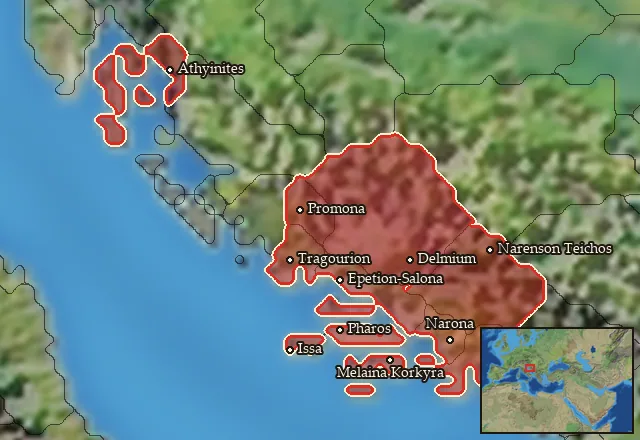
At least one of those pools sells to any faction that has an army in range, with no faction restriction.
The 11 regions where this unit appears in a mercenary pool
Daorsia · Delmatia · Ditionia · Epetia-Salonitis · Issa · Liburnonesoi · Mania · Melaina Korkyra · Narensia · Seniensia · Tragouria