
Mercenary Kian Archers

Mercenary. Hired from a regional pool, not recruited from a building.
Class: missile · Category: infantry · Men per unit: 40
Description
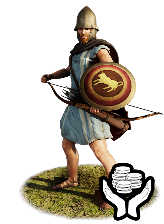
Mercenary Kian archers are semi-strong archers (toxotai). With their composite bows, they outrange basic Greek archers. To defend themselves, they carry small bronze pelte shields. The carrying of shields combined with large daggers and strong helmets gives them some durability when caught in a melee, but the lack of linothorax armour makes them less durable skirmishers than Cretan archers. They wear the regional bronze Bithynian helmets that shade the eyes while firing arrows. Kian archers can open the battle and decimate unarmoured opponents, preferably from the high ground. Afterwards, they can fall back and hide between the shields of the hoplites.
Historical background
The Kians, citizens of the city state of Kios, seem to have been proud of their naval and archery skills. Coins from the period depict Herakles on the obverse and a bow in its case on the reverse, suggesting the significance of archers within these communities (Mionnet Supp V, 1450, BMC 1961,0301.70). Many others show a ship prow. Kian Archers were almost certainly employed in naval warfare, as evidenced by the depiction of bows and bow cases on ships on some coins. There they would fight with limited numbers on the stern of the ships, as a bodyguard for the vulnerable captain, picking off enemy marines or covering their own soldiers while (dis)embarking (Eur. IT 1364). To allow mobility on the battlefield, they only wear Graeco-Thracian style exomis tunics, Macedonian-style chlamys cloaks and Thracian boots (embades). For protection, they use small pelte shields and two types of local bronze Bithynian helmets.
The first helmet represented a novel design, likely merging elements of the later Hellenistic Pilos helmet with the older Boiotian style. It retained the Boiotian helmet's wide, crimped brim, which was effective for providing maximum visibility while shielding the eyes from the sun and deflecting downward strikes. This was combined with the distinctively high-arching bowl and peak characteristic of the late Pilos type. However, unlike other late Hellenistic Pilos helmets, the bowl culminates in a slender peak. The second helmet is a regional variant of the Konos helmet (Esposito, Carthaginian Armies of the Punic Wars (2023), p.37).
Historical sources indicate that Kios, a strategical port at the eastern side of the Propontis, was part of the Northern League, an anti-Seleucid alliance formed in the aftermath of Seleukos I's victory over Lysimachos at the Battle of Koroupedion in 281 BC (Jones, the decree of Ilion (1993), p. 91). This league comprised various communities and kingdoms along the southern coast of the Black Sea, including Byzantion, Kios, Herakleia Pontike, and the kingdom of Bithynia, with Sinope and Pontos possibly acting as external partners (Tober, Herakles is stronger (2022), p. 204; Kaye, Attalids (2023), p. 188). It also included Chalkedon, which was probably a dependent ally of Byzantion (Strobel, DNP online, s.v. Kalchedon), Tieion, and Kieros, who were likely protectorates of Herakleia (Memnon 9.4). The Kian Archers likely played a role in defending the autonomy of these allied states against external threats. The Ptolemaic dynasty also helped these states to diplomatically position themselves between the Macedonians and the Seleucids.
Kios, a colony founded in the 7th century BC by Miletos, retained close links with its founder city. Miletos could probably call upon its services during a conflict. When in 228 BC, the Kianians had for several years failed to offer the obliged silver bowl at the Milesian temple of Apollo, they requested to officially waver those contributions. The Milesians rejected this request, but gave several Kians citizenship instead (I.Milet 3.141). This inscription makes it clear that they remained dependent on Miletos. The impoverishment of Kios in the late 3rd century, while being a trade hub at the end of the silk road, is remarkable. The road to decline started in 278 BC when Nicomedes I, the ruler of Bithynia, invited the Galatians to help him secure his throne. Nicomedes I was engaged in a civil war against his brother and needed this force. The Galataians, however, soon started to extract tributes from the cities in the region (Liv. 38 16). Antiochos I first checked them in 275 BC ((SH 723 = BNJ 163 T 1 Simonides of Magnesia; App. Syr. 65.343; Lukian, Zeuxis 9). Furthermore, when Nikomedes I of Bithynia died around 254 BC, he appointed Byzantion, Herakleia, and Kios as well as the Antigonids and Seleucids as the guardians of his minor sons (Memnon 14, 1; Arr. F 29). Byzantion and Herakleia definitely intervened in the following civil wars, but so may have Kios. These constant wars further destroyed the area and trade around Kios. Attalos of Pergamon stopped paying tribute in the early 230s and defeated a force of Galatians. The Galatians still retained most of their power and kept raiding for some decades. The Bithynian king and ruler of Kios, Ziailas, eventually became involved in this war, but was killed by the Galatians around 230 BC (Iust. XXVII 2.3). The city seems to have suffered, since it could not readily offer the obliged silver bowl to Miletos two years later.
Following those hardships, a demagogue named Molpagoras of Kios took control of the city. Polybios writes:
"There was a certain man at Kios named Molpagoras, a ready speaker and of considerable ability in affairs, but at heart a mere demagogue and selfish intriguer. By flattering the mob, and putting them against the richer citizens, he either got them put to death right out, or drove them into exile and distributed their confiscated goods among the common people, and thus rapidly secured for himself a position of despotic power. The miseries which befell the Kians were not so much owing to Fortune or the aggressions of their neighbours, as to their own folly and perverse policy. For by steadily promoting their worst men, and punishing all who were opposed to these, that they might divide their property among themselves, they seemed as it were to court the disasters into which they fell.” – (Plb. 15.21)
Seeing that Kios was weakened, in 202 BC Philip V of Macedon launched a campaign to conquer it and the surrounding areas for Prusias I of Bithynia, his brother-in-law. The city fell after a combined land and sea attack and was raised to the ground (Strabo, 12, 4.3; Post, Bithynian Army (2022), p.11; Polyb. 15.21-23).) This marked the end of the Northern League. Prusias then refounded the city and named it after himself. In the Roman era, the city reverted to its old name. The conquest of Kios by Philip V had wider repercussions in the region. Philip, despite the pleadings of several ambassadors, plundered the city and enslaved its population. Polybius notes:
"For it happened that just when his [Philip V] ambassador was defending his master before the Rhodians in the theatre,—enlarging on "the magnanimity of Philip", and announcing that "though already in a manner master of Kios, he conceded its safety to the wishes of the Rhodian people; and did so because he desired to refute the calumnies of his enemies, and to establish the honesty of his intentions in the eyes of Rhodes,"—just then a man entered the Prytaneum [seat of the executive] who had newly arrived on the island, and brought the news of the enslavement of the Kians and the cruelty which Philip had exercised upon them. The Prytanis [executive] came into the theatre to announce this news, while the ambassador was absolutely in the middle of his speech. The Rhodians could scarcely make up their minds to believe a report which involved such monstrous treachery […] the people of Rhodes from that day forth regarded Philip as their enemy, and made their preparations with that view" (Plb. 15.23).
Stats
| Rank in roster | ||
|---|---|---|
| Men per unit | 40 | ███······· 30% |
| Attack | 10 | ██········ 19% |
| Charge bonus | 3 | ██········ 16% |
| Defence | 20 | ██········ 18% |
| · armour | 3 | ██········ 21% |
| · defence skill | 14 | ██········ 17% |
| · shield | 3 | ████······ 37% |
| Morale | 8 | ██········ 19% |
| Discipline | Normal | |
| Training | Trained | |
| Recruitment cost | 2,330 dn | ██████···· 62% |
| Upkeep per turn | 568 dn | ███······· 33% |
| Turns to recruit | 3 |
Weapons
| Primary | Secondary | Primary | Secondary | Primary | Secondary | Primary | Secondary | ||||
|---|---|---|---|---|---|---|---|---|---|---|---|
| Attack | 10 | 6 | Charge bonus | 3 | 3 | Type | missile · archery | melee · blade | Damage | piercing | piercing |
| Projectile | arrow | — | Range | 170 | — | Ammunition | 25 | — |
Defence
| Primary | Secondary | Primary | Secondary | Primary | Secondary | Primary | Secondary | ||||
|---|---|---|---|---|---|---|---|---|---|---|---|
| Total | 20 | — | Armour | 3 | — | Defence skill | 14 | — | Shield | 3 | — |
Condition and terrain
| Hit points | 1 | Ground: scrub / sand / forest / snow | 0 / 0 / 0 / 0 | Charge distance | 30 | Formations | Square |
Technical stats
| Time between blows (primary / secondary) | 2.5 s / 2.5 s | Extra fatigue in hot climates | 0 | Collision mass per man (1.0 is normal) | 0.88 | Spacing between men: close / loose | 1.1 × 2.6 m / 1.98 × 4.68 m |
| Default ranks | 5 |
In battle: Very good stamina
Where to hire it
No mercenary pool on the campaign map offers this unit, so it cannot be hired.