
Mercenary Kyrenaian Hoplites
Mercenary. Hired from a regional pool, not recruited from a building.
Class: spearmen · Category: infantry · Men per unit: 40
Description
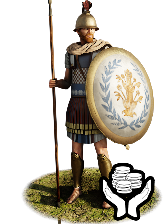
The basis of all military power in Greece once revolved around the hoplite. Operating in the close formation known as the phalanx, they made up the main body of any Greek army since the 7th century BC (Taylor, The Greek Hoplite Phalanx (2021), p. 11). These hoplites from the city of Kyrene still maintain a similar armament to these ancestors, including the dory (a 2-3m/6-9 ft spear), a backup sword, and the iconic round aspis (shield). These hoplites have not been issued standardized weaponry, instead displaying individual differences and preferences in their equipment. Their bronze helmets entail the Sidon, Ascalon, or Konos types. For body armour, they wear differently coloured and crafted linothorakes, pteryges, as well as bronze greaves as leg protection. To show off their wealth, they also wear Macedonian-style cloaks. These hoplites from Kyrene are the best classic phalanx of the whole region of Kyrenaika (eastern Libya). They will hold their own in close combat against basic infantry units, cavalry, or under frontal fire by missile troops. However, they are outclassed by professional troops, picked soldiers, or numerically superior skirmishers, and should thus be supported by other unit types in any serious battle.
Historical background
The hoplite phalanx was made up of the citizens of a polis who had the wealth to afford weapons and expensive armour, and thus either owned plots of land or worked in well-paid professions (Bardunias, Hoplites at War (2016), p. 66). The age of service ranged from entry into adulthood to 50, though the mobilisation of the entire demos, including younger ephebes or the veterans up to 60, was possible in rare occasions of crisis (Sekunda & Hook, Greek Hoplite 480-323 BC (2000), pp. 18-19). Initially, they did not receive payment, since military service was seen as a duty to the polis in exchange for political freedom, Eventually some poleis, like Athens, Pergamon, and Sparta, introduced wages at various points in time, and others followed suit. This occurred mostly after the Peloponnesian Wars, especially due to the rising importance of mercenaries, but even in this period payment could still be quite unreliable (Pritchett, The Greek State at War (1971), pp. 23-29).
Making up the main body of any Greek army, hoplites needed light infantry and cavalry to act as mobile units around them while they clashed with the main line of the enemy’s infantry. As Iphikrates puts it in Plutarch’s Pelopidas: "[…] the light-armed troops are like the hands, the cavalry like the feet, the phalanx itself is like the chest and cuirass, and the general is the head" (Plut. Pel. 2.13). That means that hoplites were easily outmatched or intimidated by light infantry or cavalry if they were not backed up by such units of their own (Konijnendijk, Classical Greek Tactics (2017)). The advent of the Macedonian sarissa phalanx, illustrated by the decisive victory of Philip II of Macedon (382-336 BC) over the Greek dory phalanx at Chaironeia in 338 BC, combined with the use of heavy shock cavalry, signalled the end of the great era of the Hoplite. Yet, they would continue to function as the basic militia force of the Greek poleis (Gehrke, "Hoplitai", in: Der Neue Pauly; Bardunias, Hoplites at War (2016), pp. 35 and 70). Not much is known about this militia from Kyrene, specifically. Their role can be reconstructed from a reading of the history of Kyrene.
Kyrene, founded around 631 BC, originated with migrants from the overpopulated Dorian island of Thera, modern Santorini (Herodotos 4.150–158, SEG IX 3, Strabo 17.3.21). Initially, the emigrants settled on the coast before establishing Kyrene near the Kyre spring, a site dedicated to Apollo. It is, hence, no surprise that in the Hellenistic period, the city's mythological founder was identified as a nymph. The ruins of the city are located on a hill just north of the modern city of Sahhat, 9km from the coast. Apollonia, located approximately 20 kilometres to the northeast (about 12 miles), functioned as its harbour (Baika, “Apollonia”, in: Blackman and Rankov (eds.), Shipsheds of the Ancient Mediterranean (2013), pp. 294-306).
Under Battos II (r. 583–560 BC), conflicts with the indigenous Libyan population and a lack of population growth led to the enlistment of additional settlers from various Greek cities. At first, this resulted in success. Battus II achieved a significant victory over the pharaoh Apries of Egypt in 570 BC, who had allied with the Libyans (Hdt. 4.159-160). During the reign of Arkesilaos II (r. 560–550 BC), the Libyans, allied with a faction that split from Kyrene, inflicted a major defeat on Kyrene and killed up to 7,000 citizen hoplites. This shows that the locals, led under Greek guidance, could overcome the phalanx. During the reign of Battos III (r. 550–530 BC), who Herodotos describes as lame and infirm, societal reforms were enacted by Demonax of Mantinea. He was appointed by the Oracle of Delphi. The citizenry was reorganised into three phyles: those from Thera and the dispossessed Libyans; Peloponnesians alongside Cretans; and Greeks from other Aegean islands. Demonax also curtailed the powers of the monarchy: the king came to occupy a mainly religious function, and presided over the newly created senate composed of the three phyles (Hdt. 4.161–162; Diod. Sic. 8.30.2). It is clear that the independent arbitrage took away some power of the traditional settler elite that had become a minority, certainly after its major defeat in battle (Watts, Stasis on the Green Mountain (2012), p. 12). The son of Battos III, Arkesilaos III, objected to the reduced powers of the king. The political upheavals never really ended.
By 525 BC, under Arkesilaos III, Kyrene submitted to the Persian king Cambyses after his conquest of Egypt. Around 440 BC the native monarchy ended with Arkesilaos IV. It seems that his reign (465-440BC) was also plagued with conflict. In 462 BC, the young king won a chariot race at the Pythian Games at Delphi, using horses raised in Kyrenaika (a trade resource). Pindar made an ode immortalising his victory but explicitly made clear that he, his maecenas, was the man that could overcome the strife with the Kyrenaian nobility (Pythian IV; 5). Apparently racing was a higher priority. The king won the chariot race at Olympia (Hornblower, The Greek World: 479-323 BC (2011), p. 65). He could not overcome the civil strife at home, however, and had to flee to Euesperides (near modern Benghazi), very probably a colony of Kyrene itself (Hornblower (2011), p. 63), and was eventually killed along with his son in 440 BC by the Kyrenaians. This ended the line of kings that had held the crown since Kyrene’s founding.
The subsequent centuries saw Kyrene embroiled in civil strife, especially during the post-Alexandrian period. Thibron, a Spartan mercenary on the run with a part of Alexander’s treasury, made an alliance with Kyrenaian exiles and tried to establish his own kingdom around 323 BC. His force of 6,000 men could not overcome the Kyrenaian hoplites, which resulted in a prolonged conflict. “[...] the Kyrenians, who were in want of food, quarrelled among themselves; and the commons, gaining the upper hand, drove out the rich [...]”. Some of the elites joined the army of Thibron; others persuaded Ptolemy for help. He sent “[...] a considerable force, both infantry and naval, with Ophellas as general”. The elites who had joined Thibron were killed when they wanted to desert to Ophellas. The democratic leaders of Kyrene, becoming alarmed at the return of the exiles, made terms with Thibron and prepared to fight against Ophellas in common with him; but Ophellas, after defeating and capturing Thibron and also gaining control of the cities, delivered both the cities and the country to Ptolemy. Thus the Kyrenians and the surrounding cities lost their freedom and were annexed to the Ptolemaic Empire (Diod. Sic. 18.19–21; Arr. Succ. fr. 1.16–19).
Over time, the Kyrenaika alternated between being a Ptolemaic province, an independent kingdom, and a republic. It seems the militias of Kyrene were not able to withstand professional Ptolemaic armies. In 313 BC, the inhabitants of Kyrene, probably fighting as hoplites, besieged the Ptolemaic garrison, but could not overcome it (Diodorus, XIX, 79). Ptolemy sent an army and the insurrection was put down. Having demonstrated their participation in all these conflicts, the well-equipped Kyrenaian hoplites in RIS remain a useful force for any player.
Stats
| Rank in roster | ||
|---|---|---|
| Men per unit | 40 | ███······· 30% |
| Attack | 9 | █········· 13% |
| Charge bonus | 13 | █████····· 52% |
| Defence | 41 | ████████·· 76% |
| · armour | 10 | █████····· 54% |
| · defence skill | 26 | ████████·· 78% |
| · shield | 5 | ██████···· 57% |
| Morale | 10 | ███······· 29% |
| Discipline | Low | |
| Training | Highly trained | |
| Recruitment cost | 2,470 dn | ███████··· 68% |
| Upkeep per turn | 603 dn | ████······ 42% |
| Turns to recruit | 2 |
Weapons
| Primary | Secondary | Primary | Secondary | Primary | Secondary | Primary | Secondary | ||||
|---|---|---|---|---|---|---|---|---|---|---|---|
| Attack | 9 | — | Charge bonus | 13 | — | Type | melee · blade | — | Damage | piercing | — |
| Properties | Light spear (braced against cavalry charges from the front) · +8 attack against cavalry | — |
Defence
| Primary | Secondary | Primary | Secondary | Primary | Secondary | Primary | Secondary | ||||
|---|---|---|---|---|---|---|---|---|---|---|---|
| Total | 41 | — | Armour | 10 | — | Defence skill | 26 | — | Shield | 5 | — |
Condition and terrain
| Hit points | 1 | Ground: scrub / sand / forest / snow | -1 / -1 / -4 / -1 | Charge distance | 30 | Formations | Square |
Technical stats
| Time between blows (primary / secondary) | 2.5 s / — | Extra fatigue in hot climates | -1 | Collision mass per man (1.0 is normal) | 1.17 | Spacing between men: close / loose | 1 × 1.05 m / 2 × 2.4 m |
| Default ranks | 5 |
In battle: Can sap · Very good stamina
Where to hire it
No mercenary pool on the campaign map offers this unit, so it cannot be hired.