
Mercenary Maeotian Mounted Archers
Mercenary. Hired from a regional pool, not recruited from a building.
Class: missile · Category: cavalry · Men per unit: 32
Description
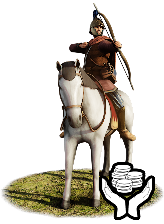
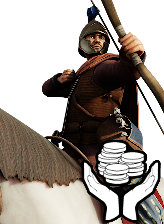
These riders hail from the wealthier parts of Maiotian society. The Maiotians live to the northeast of the Black Sea, on the coasts of Lake Maiotis and extending southwards from there. Living in the borderlands between the Black Sea with its Greek and Thracian influences and the endless steppe with its Scytho-Sarmatian culture, the Maiotians wield Scythian composite bows, but do not eschew imported Greek helmets either. While some only wear pointy caps with rims, others use Pseudo-Chalcidian, Pseudo-Illyrian, or konos helmets – all of them with cheekguards. Their long-sleeved tunics, simple belts, warm cloaks, and long trousers are similar to those of their Sindian neighbours and relatives, who live on what is now the Taman peninsula. Thanks to their sturdy horses, the Maiotians are quick and agile, and they can easily cut down unarmoured enemies with their Greek (xiphos, machaira) or Scythian (akinakes) swords. Some even possess greaves to protect their legs against blows from below. The main strength of these unshielded horse archers lies in their ranged combat capability, which allows them to outmanoeuvre and outmatch almost any opponent.
Historical background
“The Tanaïs is two thousand two hundred stadia distant from the mouth of Lake Maiotis by a direct voyage towards the north; but it is not much farther by a voyage along the coast. In the voyage along the coast, one comes first, at a distance of eight hundred stadia from Tanaïs, to the Greater Rhombites River, as it is called, where are made the greatest catches of the fish that are suitable for salting. Then, at a distance of eight hundred more, to the Lesser Rhombites and a cape, which latter also has fisheries, although they are smaller. The people who live about the Greater Rhombites have small islands as bases for their fishing; but the people who carry on the business at the Lesser Rhombites are the Maiotai themselves, for the Maiotai live along the whole of this coast; and though farmers, they are no less warlike than the nomads. They are divided into several tribes, those who live near the Tanaïs being rather ferocious, but those whose territory borders on the Bosporos being more tractable.” – Strabo (11.2.3-4C494-495).
With these words, the Pontic geographer and historian Strabo of Amaseia (ca. 63BC-25AD) introduces Lake Maiotis (the Sea of Azov) and the inhabitants of its eastern coast. The Maiotians are placed somewhere between Greeks and Scythians: farmers like the Greeks in the Bosporan Kingdom, but warriors like the nomads of the steppe. The closer to the Kingdom and Hellenic influences, the tamer and more peaceful they are – a classic theory of ancient ‘ethnological’ thought that can be found in many treatises (e.g., Caesar’s Gallic War 1.1.3-4). Archaeological research has shown that a common Maiotian culture can indeed be identified, with local differences that do not always match Strabo’s model (Chandrasekaran, Identifying the Tribes of the Eastern Black Sea Region [2013]). After the Bosporan rulers conquered much of Maiotia during the 4th century BC, they became part of their realm and more and more ‘hellenised’ (CIRB 10).
Like among the neighbouring Scythians and Sarmatians, the bow was central to the warfare of the Maiotians. The only statue of a Maiotian warrior, a Sindian from the western edge of Maiotia, is armed with a bow and a gorytos, besides wearing a Sindian cap and clothes (or perhaps a linothorax) (Medvedeva/Musin, The Imperial Archaeological Commission (1859–1917) (2019), p. 477). These Scythian style composite bows were very effective, but do not represent the end of this weapon’s development. Late in the RIS timeframe, the so-called Hunan bow from Central Asia found its way into Maiotia. Matianes, son of Zaidares (or Zaidaros), the commander of a cavalry contingent from Maiotia which fought for the Bosporan Kingdom, received a gravestone from Queen Dynamis around 10-5 BC (Yailenko, Zhenshchiny, Afrodita i zhritsa Spartokidov v novykh bosporskikh nadpisyakh (1995), pp. 220-224). He is shown as a cavalryman with the Hunan type bow, quiver/gorytos, long spear, high boots, and leather horse tail-straps. The style and the crenelated mane are more akin of the nomads further east, around and beyond the Volga (where the Aorsoi lived). Matianes' short mail coat with a cut may suggest this is the earliest illustration of a Bosporan cataphract (Goroncharovskii, Aspurgians and the Military Policy of Bosporus at the Turn of the First Century AD (2007), pp. 61-62; fig. 1).
Such cultural and military exchange was typical for the Maiotians and Sindians, who lived between the Greek and Scythian worlds. This is also reflected in their remaining weapons. Even horse archers may need to defend themselves in melee, and archaeological excavations have unearthed many straight xiphos swords, the somewhat similar Scythians akinakes daggers and, dating from the 4th century BC on, even the curved Bosporan machaira swords (Krushkol, Description of burial associations (2010); Novichikhin, Grave goods from the Rassvet necropolis (2010), p. 225). In difference to their foot archers and the Sindians, the Maiotian horsemen are slightly better armed and Hellenic linothorakes as well as rawhide scale cuirasses as those found in Scythian burial contexts are not uncommon (cf. Mielczarek (1999), p. 53; and note 204 there). Finally, pseudo-Illyric and domed (Chalcidian?) helmets, as well as konoi and piloi, which were later also used by the Sarmatians who immigrated into the area, protect the heads of these riders (Symonenko, Sarmatian age helmets (2015), p. 296). This mix of Greek and Scythian equipment makes the Maiotian horse archers a useful ranged unit which can also charge lighter units and survive in prolonged archer combat.
Stats
| Rank in roster | ||
|---|---|---|
| Men per unit | 32 | ██········ 23% |
| Attack | 12 | █████····· 48% |
| Charge bonus | 19 | ███████··· 73% |
| Defence | 22 | ██········ 23% |
| · armour | 8 | █████····· 47% |
| · defence skill | 14 | ██········ 18% |
| · shield | 0 | █········· 0% |
| Morale | 11 | ████······ 39% |
| Discipline | Normal | |
| Training | Trained | |
| Upkeep per turn | 860 dn | ████████·· 83% |
Weapons
| Primary | Secondary | Primary | Secondary | Primary | Secondary | Primary | Secondary | ||||
|---|---|---|---|---|---|---|---|---|---|---|---|
| Attack | 12 | 7 | Charge bonus | 19 | 26 | Type | missile · archery | melee · blade | Damage | piercing | slashing |
| Projectile | arrow | — | Range | 170 | — | Ammunition | 30 | — | Properties | — | Armour-piercing (counts only half the target's armour) |
Defence
| Primary | Secondary | Primary | Secondary | Primary | Secondary | Primary | Secondary | ||||
|---|---|---|---|---|---|---|---|---|---|---|---|
| Total | 22 | — | Armour | 8 | — | Defence skill | 14 | — | Shield | 0 | — |
Condition and terrain
| Hit points | 1 | Mount | medium horse | Ground: scrub / sand / forest / snow | -1 / 0 / -4 / 0 | Charge distance | 40 |
| Formations | Square |
Technical stats
| Time between blows (primary / secondary) | 2.5 s / 2.5 s | Extra fatigue in hot climates | 1 | Spacing between men: close / loose | 2.2 × 5.2 m / 3.96 × 7.28 m | Default ranks | 5 |
In battle: Can form Cantabrian circle · Very good stamina
Where to hire it
Mercenaries are hired from a regional pool, not recruited from a building. This unit is offered by 1 pool covering 2 regions, at 4,839 dn to hire and 1 experience.
Mercenary pool: Maiotia
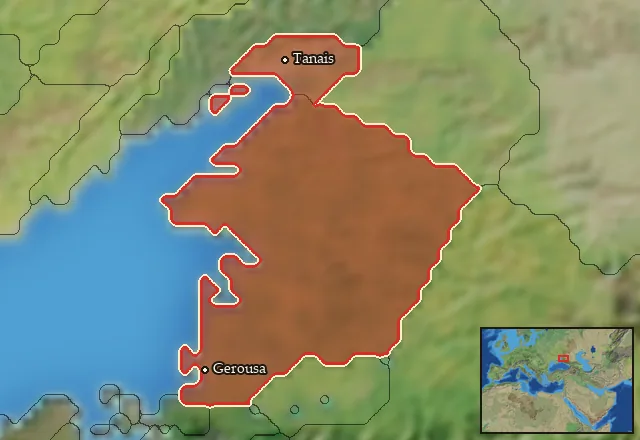
At least one of those pools sells to any faction that has an army in range, with no faction restriction.