
Mercenary Autariatai Swordsmen
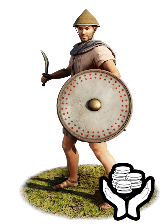

Mercenary. Hired from a regional pool, not recruited from a building.
Class: light · Category: infantry · Men per unit: 40
Description
Autariatai Swordsmen are proud fighters from a once powerful confederation of Illyrian peoples, famed for their mighty army and known as “the largest and best tribe of the Illyrians” (Strabo 7.5.11C 317-318). Although their nation has since been conquered by the Scordisci, the Autariatai retain weapons typical of their own culture, including Pecine knifes, javelins, and circular wooden shields, whilst eschewing the use of armour and helms – perhaps considering bravery more useful for their style of warfare than actual protection.
Historical background
“Illyrius had sons Encheleus, Autarieus, Dardanus, Maedus, Taulas, Perrhaebus and daughters Partho, Daortho, Dassaro and others, from whom arose the peoples of the Taulantii, Perrhaebi, Enchelei, Autariatae, Dardanians [and Maedi], Partheni, Dassaretii and Darsi.”
–(Appian, Illyricum II.4)
The term Autariatai was generally applied to the political alliance of northern tribal communities centred around the Glasinac plateaux. The Autariatai initially appear to have been considered one of the foremost ‘other’ Illyrian ethnic groups, being explicitly named in earlier Greek and Roman sources, whereas other Illyrian groups were often just referred to generically as ‘Illyrians’ (Radić et al., Liburnians and Illyrian Lembs (2021), p. 17). The Autariatai were one of the first Southern Illyrian states including the ethnic Illyrians, Dardani, Scordisci to feel the effects of ‘globalisation’ due to an increase in trade with the Greek and Hellenic states to their south (Dzino, Danijel, Deconstructing ‘Illyrians’ (2008), p. 49.) For some time until around the fourth century BC, the Autariatai were a strong regional power, able to contest and beat the superior naval power of the Ardiaei despite being greatly damaged, due to having a ‘more powerful army on land’ (Illyricum III.7). However, by the second century BC, the Autariatai were much diminished by natural disasters and invasions of Celtic migrants (Sasel Kos, Appian and Illyricum (2005), p. 123).
Strabo (Geography, 7.5.11) and Theopompus (Philippics Book II) suggest that by the mid-fourth century BC, the Autariatai were under the hegemony of the Scordisci Celts, perhaps even as early as 344 BC (Dzino, The Celts In Illyricum (2007), p. 55). This means that at the start date of RIS, the Autariatai already appear in several texts fighting alongside the Scordisci. For example, Appian (Illyr. 4) says some of them joined the Celtic expedition to Greece, but then a natural catastrophe forced them to flee into the lands of the Getae (Sasel Kos, s.v. Autariatae in: DNP Online). It is not completely certain whether the Autariatai are indeed originally located in eastern Bosnia and western Serbia, archaeological findings of the Autariatai mainly come from the big find at Glasinac (named after the Glasinac people who settled there during the Hallstatt Age and their ensuing culture) and also from tumuli in western Serbia (Papazoglu, Central Balkan (1978), pp. 458-459). These findings suggest that the Autariatai retained their typical weapons for some time, with examples found of items such as short, curved swords like the Pecine knifes, javelins, and circular wooden shields, but no body armour or helmets. Despite having already been subjugated for some time, there is further evidence of the Autariatai retaining some distinct cultural elements in mixed graves that they shared with the Scordisci, dated to the late 4th century BC (Jovanović, Necropola (1992), pp. 13-18). It is likely that this was why later author like Strabo and Appian could still separately identify the Autariatai from their Scordisci hegemons – they were not assimilated, but perhaps instead were confederated, still retaining their own style of warfare.
Stats
| Rank in roster | ||
|---|---|---|
| Men per unit | 40 | ███······· 30% |
| Attack | 15 | ███████··· 72% |
| Charge bonus | 14 | ██████···· 60% |
| Defence | 29 | ████······ 39% |
| · armour | 1 | █········· 0% |
| · defence skill | 25 | ███████··· 74% |
| · shield | 3 | ████······ 37% |
| Morale | 11 | ████······ 39% |
| Discipline | Normal | |
| Training | Untrained | |
| Recruitment cost | 2,408 dn | ███████··· 66% |
| Upkeep per turn | 587 dn | ████······ 37% |
| Turns to recruit | 2 |
Weapons
| Primary | Secondary | Primary | Secondary | Primary | Secondary | Primary | Secondary | ||||
|---|---|---|---|---|---|---|---|---|---|---|---|
| Attack | 15 | 8 | Charge bonus | 14 | 14 | Type | thrown · blade | melee · simple | Damage | piercing | piercing |
| Projectile | javelin | — | Range | 50 | — | Ammunition | 2 | — | Properties | Used just before charging into combat | — |
Defence
| Primary | Secondary | Primary | Secondary | Primary | Secondary | Primary | Secondary | ||||
|---|---|---|---|---|---|---|---|---|---|---|---|
| Total | 29 | — | Armour | 1 | — | Defence skill | 25 | — | Shield | 3 | — |
Condition and terrain
| Hit points | 1 | Ground: scrub / sand / forest / snow | 0 / 0 / 0 / 0 | Charge distance | 30 | Formations | Square |
Technical stats
| Time between blows (primary / secondary) | 2.5 s / 2.5 s | Extra fatigue in hot climates | 0 | Collision mass per man (1.0 is normal) | 0.87 | Spacing between men: close / loose | 1 × 1.2 m / 2 × 2.4 m |
| Default ranks | 5 |
In battle: Can hide in long grass · Can sap · Very good stamina
Where to hire it
No mercenary pool on the campaign map offers this unit, so it cannot be hired.