
Mercenary Bithynian Hippakontistai
Mercenary. Hired from a regional pool, not recruited from a building.
Class: missile · Category: cavalry · Men per unit: 30
Description
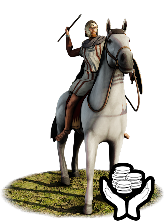
The Bithynian military encompasses Greek, Anatolian, and Thracian fighting styles, reflecting the mixed cultural heritage of the kingdom. Hippakontistai (“horse-spear/javelin-fighters”) are mostly representative of the Bithynia’s Thracian element, but such units have also formed part of Greek armies since the days of Alexander the Great. Swift riders on small, fast horses armed with javelins and long daggers, the Hippakontistai are efficient scouts and good at riding down fleeing enemies or disrupting an enemy formation. Their oval thureos shields and Chalcidian as well as Attic helmets protect them against missile fire, but their thureoi are smaller than others, and they lack body armour. This means that they are not able to survive a prolonged melee. The colourful cloaks as well as the crests on their helmets betray these riders’ possessing a certain level of wealth, while their trousers and thureos shields are testament to the Celtic influences on Bithynia. Ever since the Celtic invasion of the Balkans and the establishment of a kingdom at Tylis, as well as the crossing of the Galatians into Asia, the Celts have become permanent neighbours of the Bithynians. Why not take their trousers and use them when the winters in the Bithynian mountains are cold and long?
Historical background
When Nikomedes I succeeded his father Zipoites on the throne of Bithynia in 280 BC, he inherited a small kingdom, but one that was well established in Asia Minor. In the last 12 months before his death, the aged Zipoites had warred against the Seleucids and Herakleia Pontike, conquering the landscape of Thynis and the Greek cities of Kieros and Tieion, while also founding a new city, Zipoiton, as his prospective capital (Memn. 9.5; 12.5). By the time Zipoites died at the age of 76, Nikomedes was not a young man anymore, and had all the experience needed to run the affairs of the kingdom. It is likely that he would have been introduced to politics and war from young age, and he immediately put his skills to good use. The Seleucid threat was not gone, and an army under the command of Hermogenes of Aspendos was about to cross into Bithynia while Nikomedes was being crowned. Once the ceremony was over, Nikomedes immediately gathered his army and prepared an ambush for the Seleucids. When Hermogenes marched into Bithynian territory, he walked straight into the trap, and was killed together with his men (Memn. 9.2). Light forces like the Hippakontistai would have played a starring role in this successful ambush. Understanding the seriousness of the situation, Nikomedes pushed the old grudge aside and offered an alliance to Herakleia. The Herakleiotes, still bitter about the past war, demanded the return of parts of Thynis, Kieros, and Tieion. Surprisingly, Nikomedes granted their wish, only asking for a big sum of gold in exchange (Memn. 9.3-4).
This laid the basis for a more harmonious and cooperative relationship between Bithynia and Herakleia. Both now forged ties with Antigonos Gonatas, the outcast son of Demetrios Poliorketes, who wanted to press his claims in Thrace and Macedon against Antiochos I, the second king of the Seleucid Empire. As soon as Nikomedes announced his alliance with Antigonos, Seleucid forces were on the march against Bithynia once again. Nikomedes asked the Herakleiotes for help, who dispatched 13 triremes manned with marines. Together, they confronted the Seleucid fleet in the Hellespont, but the encounter was inconclusive as both sides were too cautious to engage the enemy by boarding attacks (Memn. 10. 1-2). While Nikomedes was delighted Herakleia had stood by him, his brother Zipoites, who had been governor of Thynis while it was in Bithynian hands, was less happy. He considered the areas given away to be far more valuable than Herakleiote military support, not least since Bithynia was already allied with Byzantion on the other side of the Bosporos (McGing, Foreign Policy of Mithridates VI (2018), p. 17). Another, unnamed brother sided with Zipoites, and soon both rose in open revolt against Nikomedes by declaring war on Herakleia (Schottky, Martin, s.v. Nikomedes (2), in: DNP online). As Zipoites had a sizable army under his command, Nikomedes once more was desperate for the support of his allies. Both Antigonos Gonatas and Byzantion were busy warring against the Celts in eastern Thrace, however, and Herakleia used its financial power to help Byzantion (Memn. 11.1). At the beginning of the new year, 279 BC, the situation got even worse, as Antigonos and Antiochos signed a peace deal. Nikomedes’ reign seemed to be destined to end as soon as it had begun.
In this critical situation, Nikomedes came up with a radical, possibly devious, perhaps visionary idea: he sent envoys to the Celts around Byzantion and offered to transport them to Asia as well as supplying them with food, water, weapons, and armour (Memn. 11.2-5). Furthermore, he established a coalition which has become known as the Northern League: Byzantion, Bithynia, Herakleia Pontike, Tieion, Chalkedon, Kieros, and Kios were its members (McGing (2018), p. 17; Kaye, The Attalids of Pergamon (2023), p. 188). Sergey Saprykin (The Pontic Kingdom and the Seleucids (2020), p. 227) has argued that Pontos, too, joined the anti-Seleucid alliance, but McGing (2018, pp. 17-18) has convincingly argued that Mithridates I Ktistes was probably more of an informal friend of the League. While he was also an enemy of Antiochos, he had a quarrel with Herakleia over Amastris, a city on the coast between the two realms, which would have prevented his formal inclusion in the Northern League (Memn. 9.4). In any case, the Galatians had already tried to reach Asia many times in the past, being well-aware of its wealth, but so far the Byzantine navy had always prevented their crossing (Memn. 11.2). Now, however, in 278/277 BC – according to Pausanias (10.23.14) – they finally landed on Asian soil. Once arrived, they joined Nikomedes’ army. After receiving reinforcements from Herakleia, he marched against Zipoites and defeated him in battle. Both rebelling brothers were captured, and the territory loyal to them ruthlessly raided to pay off the Galatians (Memn. 11.5, Liv. 38.16.7-8). At the conclusion of the campaign, Nikomedes executed both of his brothers (Memn. 12.6). He then took the Galatians, up to 20,000 warriors in number (Liv. 38.16.9), and attacked the Seleucid positions in northwestern Phrygia and northeastern Mysia, significantly expanding the Bithynian realm (Iust. 25.2, Strab. 12.3.7C543, 9C544).
The Galatians would go on and take a part of Phrygia for themselves, but that is a story for another unit description. Instead, we shall ask what kind of soldiers the army of Nikomedes I, which beat the Seleucids time and again, was composed of. Light cavalry, in traditional Thracian style, seems to have played a big role. In the forested mountains of Bithynia, they were more effective than heavier horsemen, and would have been able to participate in ambushes like the one that cost Hermogenes of Aspendos his life. Such light horsemen with javelins appear on several grave stelai from Hellenistic Bithynia. The stele in the Lapidarium of the Archaeological Museum in Bursa – a city founded by Nikomedes’ grandson Prusias and named after him (Prusa = Bursa) shows a rider just like our Bithynian Hippakontistai. Conspicuous is the small size of his oval thureos shield – perhaps these were better suited to skirmishing, just like the small thureoi of the Achaian Thureophoroi (see their description). While this horseman does not wear an identifiable helmet, a 1st century BC relief from Adapazarı – called Agrilion in Bithynian times – depicts a horseman with a crested Chalcidian helmet (Post, Bithynian Army (2022), pp. 10-11). We added some Attic helmets, which are also used by our Odrysian Hippakontistai (cf. Stoyanov, Warfare (2015), 430). Their obvious weapons are javelins of cornel wood (cf. Webber, Odrysian Cavalry Arms, Equipment, and Tactics (2003), p. 549 for the Thracians) while they carry long daggers for melee, which were common throughout Thrace (Petkov, Weapons as Votive Offerings (2023); Webber (2003), p. 551). Their clothes are inspired by the warriors on the 4th century BC Alexandrovo tomb, also in Thrace, the old home of the Bithynians (see: Avramova, Images of Horsemen in Battle (2015), pp. 67-71). The unit is thus similar to the Odrysian Hippakontistai, though their trousers, while found on the Alexandrovo paintings, also make sense as a portrayal of Celtic influence. Finally, we added some cloaks, which are common on the Bithynian stelae of the 2nd century BC (analysed in detail in: Kistler, Keltenbilder (2009), pp. 38-65).
Stats
| Rank in roster | ||
|---|---|---|
| Men per unit | 30 | █········· 8% |
| Attack | 10 | ██········ 19% |
| Charge bonus | 15 | ██████···· 64% |
| Defence | 18 | ██········ 15% |
| · armour | 4 | ███······· 33% |
| · defence skill | 11 | █········· 6% |
| · shield | 3 | ████······ 37% |
| Morale | 8 | ██········ 19% |
| Discipline | Normal | |
| Training | Untrained | |
| Recruitment cost | 2,044 dn | █████····· 52% |
| Upkeep per turn | 549 dn | ███······· 29% |
| Turns to recruit | 2 |
Weapons
| Primary | Secondary | Primary | Secondary | Primary | Secondary | Primary | Secondary | ||||
|---|---|---|---|---|---|---|---|---|---|---|---|
| Attack | 10 | 7 | Charge bonus | 15 | 15 | Type | thrown · archery | melee · blade | Damage | piercing | piercing |
| Projectile | javelin | — | Range | 60 | — | Ammunition | 7 | — | Properties | Thrown | — |
Defence
| Primary | Secondary | Primary | Secondary | Primary | Secondary | Primary | Secondary | ||||
|---|---|---|---|---|---|---|---|---|---|---|---|
| Total | 18 | — | Armour | 4 | — | Defence skill | 11 | — | Shield | 3 | — |
Condition and terrain
| Hit points | 1 | Mount | light horse | Ground: scrub / sand / forest / snow | 0 / 0 / -3 / 0 | Charge distance | 40 |
| Formations | Square |
Technical stats
| Time between blows (primary / secondary) | 2.5 s / 2.5 s | Extra fatigue in hot climates | 0 | Spacing between men: close / loose | 2.2 × 5.2 m / 3.96 × 7.28 m | Default ranks | 5 |
In battle: Can form Cantabrian circle · Very good stamina
Where to hire it
No mercenary pool on the campaign map offers this unit, so it cannot be hired.