
Mercenary Cappadocian Light Cavalry
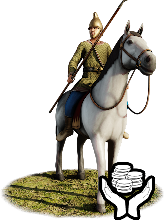
Mercenary. Hired from a regional pool, not recruited from a building.
Class: light · Category: cavalry · Men per unit: 30
Description
Cappadocia, the land of beautiful horses! Although some of these horsemen had the means to acquire a helmet, most wear little to no armour. Still, very few can match the quality of their horses, and even fewer can beat their fancy Phrygian caps, decorated tunics, and sharp lances. These cavalrymen wear trousers in the Galatian style, so contrary to the Greeks, no child will be scared after looking up. Agile and swift, these horsemen are some of the best units in the region, capable of holding their own for a while. Still, due to their lighter equipment, they are best used for scouting, pursuing routing enemies, and countering enemy skirmishers or light cavalry on the flanks of an army. They are too fragile to charge dense lines of infantry and will not survive long if left without support from heavier units.
Historical background
A rolling plateau cut by mountains, nearly isolated by winter snows, Cappadocia in the east contains bare central highlands, in the west a nearly treeless landscape, and in the north mountainous tracts marked by fertile valleys, especially on the lower Halys river. In the south greater economic value is found on the plains around Tyana and Cybistra, in the well-watered Melitene plateau, and in the region of Cataonia. In the center stands Mount Argaeus and at its well-timbered side lies the royal capital, Mazaca.
Agriculture, livestock, and mining make Cappadocia wealthy (Strabo, 11.525, 12.535). The realm provides wheat (e.g., Athenaeus, 3.112c, 113a-b) and Melitene fruits (Strabo, 12.535). Cattle (along the Halys; at Mazaca; Strabo, 12.539), sheep, and wild asses (Strabo, 12.540, 546) all created revenue. Mining garners red ochre, translucent marble, silver and stone (these two from the land around Mazaca; Strabo, 12.540), salt, and iron (Pliny, Natural History 34.14.41). Horses provide both tribute and defence (Strabo, 11.525). To secure a frequent supply of horses for the Persian army, Cappadocia and Armenia were obliged to pay an annual tribute in horses to the Persian king, further attesting the good quality of the Cappadocian horses (Koolen, Of Horses and Men (2012), p. 27).
Cappadocian Cavalry were numerous, as apparently Ariarathes I commanded 15,000 mounted soldiers in 322 BC (Diod. XVIII, 16, 2). On several third century coins of the Cappadocian rulers Ariaramnes and Ariarathes III (dated variously between 280 and 220 BC), we find a rider with a lance, Pilos like helmet, cloak, scale armour cuirasses, trousers and long sleeves and metal headgear for the horses appears on the reverse (e.g., Simonetta 6; SNG von Aulock 6357; HGC 7, 795 or Simonetta 2a; HGC 7). This reflects the importance given to the cavalry, which acted as the shield and spear of Cappadocia.
At the Battle of Gaugamela (331 BC), Cappadocian cavalry, together with the Armenians, led the attack and successfully overwhelmed Alexander's Asian and Greek mercenary cavalry but were ultimately halted by the Thessalian cavalry, demonstrating their good capabilities against similar light horse units (Arr. Anab. 3.7-16).
After the death of Alexander the Great, Eumenes of Cardia, one of the Diadochi of Alexander, was appointed satrap of Cappadocia, where he set up Greek settlements and distributed cities to his associates. In the following decades, the Seleucid Basileos founded many Greek settlements in the interior of Asia Minor, and this region would become popular for the recruitment of soldiers. Unlike other regions of Asia Minor where Greeks would settle in cities, most of the Greek settlements in Cappadocia and other interior Anatolian regions were villages. The Hellenistic kings would establish new Greek settlements in Cappadocia and other surrounding regions in order to secure their hold on this volatile region; under their rule Greek settlements would increase in the Anatolian interior (Cohen, The Hellenistic Settlements in Europe, the Islands, and Asia Minor (1995), pp. 43-44). As stated by Cohen: "( ...) In short, the available evidence makes clear that the Seleucids were very active founding settlements in the interior of Asia Minor. It says nothing about a similar Antigonid effort. There were, of course, other means available to control the area. According to Plutarch ( ...), when Eumenes was appointed satrap over Cappadocia he distributed cities to his friends, left behind judges (dikastai) and administrators (dioiketai), and appointed garrison commanders". Later on, he was able to raise 6,300 cavalrymen from the region through gifts and promises of exemption from taxes (Plut. Eumenes 4, 3-4).
Cappadocian history is recalled foremost in the context of sometimes stormy relations with larger and more powerful western powers (a rare notice depicting the Ariarathids as king-makers is found in Diodorus, 31.22 with 31.19a). With the fall of Persia, Cappadocia sought close ties with the Seleucids, who were themselves anxious that the routes to the east should be in friendly hands. Ariarathes III, the first of his family to style himself king on coins, married Stratonice, daughter of Antiochus II (Diodorus, 31.19.6). Their son, Ariarathes IV, married Antiochis, daughter of Antiochus III, and fought on Antiochus’s side against Pergamene Eumenes II and his Roman allies (Diodorus, 31.19.7; Livy, 37.40). Then, with Antioch eclipsed and Pergamum powerful, Ariarathes’ daughter was married to Eumenes II, whose new father-in-law helped fight enemy Pontus (182-79 B.C.; Polybius, 23.9, 24.1, 14-15, 25.2, 27.7). The half-Seleucid Ariarathes V then ascended, and Demetrius I sought to reassert familial influence, first through proposed marriage, then through support for a pretender (Orophernes). When Roman diplomacy proved ineffective, Cappadocian and Attalid forces returned the crown to Ariarathes (156 B.C.); Ariarathes died decades later while battling a pretender to the Pergamene throne (Polybius, 31-32, 33.6).
During the period of the Roman exploitation of western Anatolia, Iranian Pontus was revitalised; thus, the reigns of Ariarathes VI-VIII were marked by Pontic attempts to exert its influence over Cappadocia at the expense of Bithynia and Rome both by marriage (Laodice, daughter of Mithridates V, to Ariarathes VI: Appian, Mithridatic Wars 10; Justin, 38.1) and by murder (of Ariarathes VI in 116 B.C.; of Ariarathes VII in 101 B.C.). Mithridates VI eventually installed his own son, Ariarathes, as king.
Well-documented wars of Pontic and Roman generals and internal distrust marked the reigns of Ariobarzanes and his heirs, thought by many to hold the kingdom wrongfully (cf. Plutarch, Sulla 5.3, and Lucullus 14.6). Ariobarzanes I’s support for Rome first won him frequent expulsions, then new forts and land (Tomisa, Sophene, and part of southeast Lycaonia: Strabo, 12.535). Fatigued, he abdicated (Appian, Mithridatic Wars 105). Ariobarzanes II had married Athenais, daughter of Mithridates VI, a step that failed to prevent the dissension and exile which led to his death (Cicero, De provinciis consularibus 4, and Epistula ad familiares 15.2, 4). The disaffection of nobles and the wars among Roman generals tainted Ariobarzanes III’s reign; unable to collect revenues and deeply in debt (Cicero, Epistula ad Atticum 6.1, and ad familiares 15.1), Ariobarzanes was killed by his populace (Appian, Civil War 4.63). His younger brother Ariarathes IX then ruled, fitfully (Diodorus 49.32).
The last king, Archelaus, was at first a local noble, who had his palace at Cadena and his treasury at Nora (Strabo, 12.537). His reign (36 B.C.-A.D. 17), which overlapped that of Augustus, brought stability. An emperor’s favour and marriage to the Pontic widow Pythodoris (Diodorus, 57.17; Suetonius, Tiberius 8; Diodorus, 54.9; Strabo, 12.540, 555-56) gave Archelaus a realm equal in size to Datames’ satrapy. Augustus held the king as a man whose political wisdom was to be sought (cf. Josephus, Jewish Antiquities 16.357-60, and Jewish War 1.538). With stability came economic growth; Archelaus developed Elaioussa (Strabo, 12.537, 14.671; Josephus, Jewish Antiquities 16.131), wrote on horses, mining, and agriculture (Pliny, Natural History 1.8, 18.30.73, 36.45.1); to Comana he was savior and founder (OGIS, no. 358). Tiberius summoned him to Rome, where, unconvicted for suspected trouble, he died of old age (Diodorus, 57.17; Suetonius, Tiberius 37; Tacitus, Annals 2.42; Philostratus, Vita Apollonii 1.12). Cappadocia then became part of the princeps’ house, part of Rome.
Stats
| Rank in roster | ||
|---|---|---|
| Men per unit | 30 | █········· 8% |
| Attack | 8 | █········· 9% |
| Charge bonus | 25 | ████████·· 82% |
| Defence | 18 | ██········ 16% |
| · armour | 2 | █········· 13% |
| · defence skill | 16 | ███······· 28% |
| · shield | 0 | █········· 0% |
| Morale | 10 | ███······· 29% |
| Discipline | Impetuous (may charge without orders) | |
| Training | Highly trained | |
| Recruitment cost | 2,406 dn | ███████··· 65% |
| Upkeep per turn | 646 dn | █████····· 52% |
| Turns to recruit | 2 |
Weapons
| Primary | Secondary | Primary | Secondary | Primary | Secondary | Primary | Secondary | ||||
|---|---|---|---|---|---|---|---|---|---|---|---|
| Attack | 8 | 8 | Charge bonus | 25 | 20 | Type | melee · blade | melee · blade | Damage | piercing | piercing |
Defence
| Primary | Secondary | Primary | Secondary | Primary | Secondary | Primary | Secondary | ||||
|---|---|---|---|---|---|---|---|---|---|---|---|
| Total | 18 | — | Armour | 2 | — | Defence skill | 16 | — | Shield | 0 | — |
Condition and terrain
| Hit points | 1 | Mount | light horse | Ground: scrub / sand / forest / snow | -1 / 0 / -6 / 0 | Charge distance | 40 |
| Formations | Square |
Technical stats
| Time between blows (primary / secondary) | 2.5 s / 2.5 s | Extra fatigue in hot climates | 0 | Spacing between men: close / loose | 2 × 4.8 m / 3 × 7.2 m | Default ranks | 5 |
In battle: Very good stamina
Where to hire it
No mercenary pool on the campaign map offers this unit, so it cannot be hired.