
Mercenary Cilician Pirates
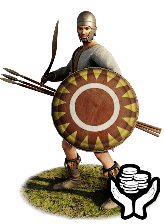

Mercenary. Hired from a regional pool, not recruited from a building.
Class: light · Category: infantry · Men per unit: 40
Description
A pirate is lightly armed, to be able to swiftly board ships and disembark to raid vulnerable coastlines. The equipment of these pirates does not differ much from that of Cilician Spearmen. A typical pirate would wear a woollen tunic, a round shield of raw oxhide, and a Phrygian cap. That is comfortable gear to cruise around the Mediterranean. Some pirates wear captured Attic helmets for battle. In close combat, they wield fearsome machaira swords, but most often they just skirmish with javelins.
Historical background
Despite extensive literature on (Cilician) piracy, we have limited material evidence of their existence (Hoff and Townsend (eds.), Rough Cilicia. New Historical and Archaeological Approaches [2013]). The pirates of Cilicia themselves did not leave behind written sources, nor are there concrete archaeological remains of pirate ships. Excavations in Cilicia have uncovered imported Italian amphoras, likely exchanged for slaves at the pirate haven of Delos. At Korakesion, in southwest Cilicia, there is indeed evidence of defensive architecture. Historians, thus, largely rely on pottery and written Roman texts for much of their analysis. These texts are source material produced by the victims and eventually, the subduers of piracy (De Souza, Piracy in the Graeco - Roman World (2012), pp. 3-9).
The term ‘pirates’ comes from the Greek πειρατής (peirates), meaning robbers or brigands, from which later the Latin "pirata" was derived. This Greek word came, in written form, into use in the early third century and was a synonym for the older word leistes (plunderers), in use since Homeric times (Ibid., p.3). It has to be noted that piracy and banditry were more closely linked in both language and perception than they are understood today.
Plutarch (Plut. Pomp. XXIV, 1), Polybius (XXI.12) and Appian (Syr. XXIX) all write that the Cilician pirates were already well-established before their heyday of the 1st century BC. Already during the Roman-Seleucid War, Cilician pirates were hired by Antiochos III to restrict the Roman movements around Greece and Asia. After the battle of Magnesia (190/189 BC), the Roman fleet dispersed the pirates. It is likely that after that point, Cilicians were less often hired as mercenaries for the wars between the main Hellenistic dynasties, and piracy really became a tempting undertaking. The Romans certainly helped the pirates by ordering the Seleucids to only maintain a fleet of 10 decked ships as stipulated in the treaty of Treaty of Apamea in 188 BC (see: Livy XXXVIII, 40). Furthermore, in the 3rd and early 2nd century BC, Rhodos had been the supreme maritime authority in the eastern Mediterranean. But after the Third Macedonian War (171-168 BC), Delos, under Roman guidance, became a free port, also frequented by Cilician pirates, and took away much of the Rhodian trade (Fraser, Rhodian Sea Power, 229–167 B.C. [1972]). This resulted in a weaker Aegean navy able to combat piracy. All these wars created a power vacuum for non-state groups (Ormerod, Piracy in the Ancient World (1924), p. 199, 203).
Possessing almost no navy to speak of, while only one main road went through the province, control over Cilicia became a problem for the Seleucids. This allowed it to become a hotbed for usurpers, who used piracy to raise funds during the latter part of the second century BC (Ibidem. pp. 204-205). By 102 BC, Rome exerted some influence over Cilicia, as the power of the Seleucids had declined further, and sent a praetor there to combat piracy (Marek, In the Land of a Thousand Gods (2016) p. 259). While the Seleucids still had de jure control over Cilicia east of the Calycadnus river, it is not surprising that the Roman senate provided jurisdiction for a military campaign against pirates in this area. Local warlord-pirates controlled the region, certainly in western Cilicia.
That first Roman campaign led by Marcus Antonius the Orator did not result in a long-term suppression of piracy. The Romans, after all, profited from piracy by trading goods for enslaved victims of piracy (Strabo, XIV,5,2). Landowning Roman aristocrats had a good reason to keep some piracy going. Appian (App. Mith. 92) explicitly states that, during the First Mithridatic War, the Pontic king sent the pirates out to sea around 88 BC. He describes their professionalisation:
“In the beginning they prowled around with a few small boats worrying the inhabitants like robbers. As the war lengthened, they became more numerous and navigated larger ships. Relishing their large gains, they did not desist when Mithridates was defeated, made peace, and retired. Having lost both livelihood and country by reason of the war and fallen into extreme destitution, they harvested the sea instead of the land […]”.
Plutarch (Plut. Pomp. XXIV, 1) also states that Mithridates explicitly strengthened the pirates:
“The power of the pirates had its seat in Cilicia at first, and at the outset it was venturesome and elusive; but it took on confidence and boldness during the Mithridatic war, because it lent itself to the king's service.”
This means that the Cilicians again acted more like mercenaries. Beel (Campaigning against Pirate Mercenaries. A very Roman Strategy (2019), p. 106) argues that this was not strange, as Hellenistic kings had often hired Cilicians. Sometimes to fight on land, but in this instance, to swell the ranks of their navy, a navy that managed to halt Roman forces from crossing to Anatolia on several occasions. But eventually, the Romans overcame the Pontic navy at the Battle of Tenedos in 86 BC.
These preliminary campaigns did not have that much impact, and the Romans returned 9 years later to really try to control the southern coast of Asia Minor. First Lucius Licinius Murena, and then the pro-consul of Cilicia, Publius Servilius Vatia Isauricus, campaigned against the pirates. Publius first won some costly naval victories, despite having heavier ships. Subsequently, he moved against the Cilician’s coastal fortresses between 77 and 76 BC, bringing about the demise of the pirate-king Zeniketes. The Romans captured and looted Olympos and Phaselis in Lycia and Korykos in western Cilicia, illustrating the wide geographical spread of pirate bases. The success was, however, not decisive, as they diverted their attention to other places in Asia Minor, such as Isauria and the start of the Third Mithridatic War (74–63 BC). Florus (I, XLI, 6) explicitly underlines their ‘savage nature’:
“But the pirates, though overcome by so many disasters, would not on that account confine themselves to the land, but, like certain animals whose nature fits them equally well for living in the sea and on the earth, as soon as ever the enemy had gone away, impatient of remaining ashore they launched forth again upon their natural element, the sea, and, extending their operations over a far wider area than before, were eager to create a panic on the coasts of Sicily and our own Campania by a sudden attack”.
Julius Caesar, who had just assisted Isauricus as a tribunus militum, was captured by the pirates in 75 BC as he was travelling to Rhodos, illustrating the ineffective end of the campaign. As the story goes (Suet., The life of Julius Caesar, 4) the future tyrant arranged his own ransom but eventually returned to crucify these pirates.
The piracy problem again flourished during the Third Mithridatic War as they once more started to assist Mithidrates. The Romans reacted by giving praetor Marcus Antonius, the father of the more famous bearer of that name, the task of eradicating piracy in the Mediterranean. A Pontic general even made his way to Cilicia and the Isauri in 73 BC (Appian, Mith, 75). In 72 BC, the pirates defeated Antonius off Crete (Holland, Rubicon (2003), p. 175) and later captured his daughter in Misenum and ransomed her (Tansey, "Antonia and the Pirates". The Classical Quarterly 60-2 (2010), pp. 656-658). It seems that these Cilicians were also land-based forces, and ended up in Asia Minor to defend the Pontic Heartlands. The Romans under Lucullus put 8,000 Cilicians to the sword when they captured the northern port city of Sinope in 70 BC (Luc.XXIII.3). Being based in this seaport seems to imply that they would have also been employed to project strength in the Black Sea.
In 69 BC, the Cilician pirates, who, among others, were also active from different bases in remote areas of the Mediterranean, burned Delos (Ormerod (1924), p. 232). This illustrates the total breakdown in relations between them and the Romans. Even the fleet of Publius Clodius Pulcher was defeated off the coast of Cilicia (Tatum, The Patrician Tribune: Publius Clodius Pulcher (1999), pp. 49-52). By now, the Romans called all pirates Cilicians, even if they came from Libya or Crete, and a bunch of them attacked Rome's port city of Ostia a year later. With rising food prices, many (noble) Romans captured, and their own port in flames, Pompeius Magnus saw his chance for glory. The Lex Gabinia, proposed by one of his patronised tribunes, gave him the power and finances to raise an army three times the size of what the decentralised pirates could field. Appian (Mith., 94) estimates the strength as 120,000 footmen and 4,000 horsemen, as well as 270 ships, including large hemiolii. The plan was to hit the pirate bases in the west all at once. The story goes that it is, hence, no surprise that the Romans steamrolled the pirates.
Appian (Mith., 95) describes the Roman strategy as follows. They divided the Mediterranean into 13 seas and coastlines and ousted the pirates from their bases. As they fled to another area, they were intercepted by the praetor guarding that particular area. This prevented a wild goose chase. Apparently he was able to rout the pirates back to Cilicia (and Crete) in less than 3 months:
“He astonished all by the rapidity of his movement, the magnitude of his preparations, and his formidable reputation, so that the pirates, who had expected to attack him first, or at least to show that the task he had undertaken against them was no easy one, became straightway alarmed, abandoned their assaults upon the towns they were besieging, and fled to their accustomed citadels and inlets. Thus the sea was cleared by Pompey forthwith and without a fight, and the pirates were everywhere subdued by the praetors at their several stations.”
Appian (Mith., 96) states that when Pompey arrived, the Cilician pirates surrendered without a fight, as they were terrified of him (and his large army). Plutarch (Life of Pompey, 26-28) describes a more difficult fight. The pirates had to be rooted out of the Tyrrhenian and Libyan Seas by force. But he spared most pirates. This resulted in a mass surrender to Pompey personally: “All these he spared, and it was chiefly by their aid that he tracked down, seized, and punished those who were still lurking in concealment because conscious of unpardonable crimes.” A classic example of divide and conquer. After this initial stage, he went to Cilicia, where “[…] the most numerous and powerful had bestowed their families and treasures and useless folk in forts and strong citadels near the Taurus mountains, while they themselves manned their ships and awaited Pompey's attack near the promontory of Korakesion in Cilicia; here they were defeated in a battle and then besieged.” The war ended with, besides other ships, 90 large ships with brazen beaks and 20,000 pirates being captured. These were resettled more to the east in Soli (renamed Pompeiopolis), Mallos, Adana, and Epiphanea, in the more urbanised areas of Cilicia, and Dyme in Achaia. The Romans portrayed this urbanising and agricultural effort as a civilising measure that legitimised their empire building (Avidov, ‘‘Were the Cilicians a Nation of Pirates?’’, Mediterranean Historical Review 12-1 (1997), pp. 5-55). Strabo (XIV.3.2) also contradicts the ‘decent’ Lycians with the ‘shameful’ Cilicians and Pamphylians.
The Romans indeed established colonies in the more fertile, inland eastern side of Cilicia. Roman sources try to underline their civilisation effort by giving them land to farm. But why would Pompeius spare them? Maybe they paid him off with part of their captured wealth, and Pompeius could move on with his army to fight even more lucrative campaigns. With his gigantic resources and propagated victory, he replaced Lucullus as commander in the last phase of the Mithridatic War, which was happening nearby. This resulted in Roman dominance over Asia Minor and Armenia. Pompeius also widened his supporter base in that part of the empire with some crafty men (Tröster, “Roman Hegemony and Non-State Violence: A Fresh Look at Pompey’s Campaign against the Pirates”, Greece & Rome 56-1 (2009), p. 28). Especially if some settlers became Roman citizens down the line.
It is also likely that (Cilician) pirates were not totally crushed, and some remained active long enough to contributed to Sextus Pompeius’ holdout in Sicily during the later Roman civil wars – him being the son of the famous general (Lenchuk, ‘‘On the social base of Sextus Pompey's Sicilian state’’, Genesis 11 (2024), pp. 46-55). Perhaps, these are the same pirates Cicero references during the civil war in 44 BC. He says that, unsurprisingly, the resettled pirates in Dyme again turned to piracy during the turmoil (Cicero Att. XVI.1). There were also instances of renewed piracy off Cilicia and Syria. Cilician pirates probably ended up fighting against Julius Caesar at Alexandria (Ormerod (1924), p. 249).
It is a possibility, therefore, that the ‘brilliant’ victory of Pompeius "Magnus" was overstated. In 71 BC, Pompey also took a lot of credit for ending the Third Servile War, despite Crassus and his legions doing the bulk of the fighting. Pompey killed off only some stragglers and announced to Rome that he had crushed the slave uprising. Perhaps we are deceived by his lightning-quick campaign against the (Cilician) pirates in only 5 months. There were many other Romans that contributed to the victory over the pirates, as Metellus certainly did with his conquest of Crete. A conquest Pompey tried to stall to deny Metellus a triumph, illustrating that, while Rome was very powerful, it was politically fragmentated. Plutarch (Pomp. 29) states that Pompey assisted the pirates of Crete with diplomacy and advice while they were besieged by Metellus.
Herodotos (VII, 91) states on Cilician marines during the Persian invasion of Greece during the fifth century BC: "They also wore on their heads their native helmets, carried round shields of raw oxhide, and were clad in woolen tunics; each had two javelins and a sword very close in style to the knives of Egypt". As this is the only clear description we have for their outfit, RIS opted for this traditional gear. Knives of Egypt refers to the curved Machaira. In the base game of Rome Total War, the Cilician Pirates skirmish by throwing harpoons. This is, sadly enough, not a historical fact. So in our mod, these men skirmish with just spears. As we do not have records of them fighting in pitched land battles, they are just a well-armed skirmisher unit, albeit one with a cool story!
Stats
| Rank in roster | ||
|---|---|---|
| Men per unit | 40 | ███······· 30% |
| Attack | 11 | ███······· 34% |
| Charge bonus | 9 | ███······· 33% |
| Defence | 23 | ███······· 25% |
| · armour | 2 | █········· 13% |
| · defence skill | 18 | ████······ 37% |
| · shield | 3 | ████······ 37% |
| Morale | 11 | ████······ 39% |
| Discipline | Impetuous (may charge without orders) | |
| Training | Trained | |
| Recruitment cost | 2,384 dn | ██████···· 64% |
| Upkeep per turn | 582 dn | ████······ 36% |
| Turns to recruit | 2 |
Weapons
| Primary | Secondary | Primary | Secondary | Primary | Secondary | Primary | Secondary | ||||
|---|---|---|---|---|---|---|---|---|---|---|---|
| Attack | 11 | 10 | Charge bonus | 9 | 11 | Type | thrown · blade | melee · blade | Damage | piercing | slashing |
| Projectile | javelin | — | Range | 60 | — | Ammunition | 5 | — | Properties | Thrown | — |
Defence
| Primary | Secondary | Primary | Secondary | Primary | Secondary | Primary | Secondary | ||||
|---|---|---|---|---|---|---|---|---|---|---|---|
| Total | 23 | — | Armour | 2 | — | Defence skill | 18 | — | Shield | 3 | — |
Condition and terrain
| Hit points | 1 | Ground: scrub / sand / forest / snow | 0 / 0 / 0 / 0 | Charge distance | 30 | Formations | Square |
Technical stats
| Time between blows (primary / secondary) | 2.5 s / 2.5 s | Extra fatigue in hot climates | 0 | Collision mass per man (1.0 is normal) | 0.84 | Spacing between men: close / loose | 1.1 × 1.3 m / 2.2 × 2.6 m |
| Default ranks | 5 |
In battle: Can sap · Very good stamina
Where to hire it
No mercenary pool on the campaign map offers this unit, so it cannot be hired.