
Mercenary Gortynian Hippeis (Late)
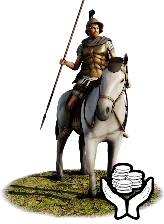
Mercenary. Hired from a regional pool, not recruited from a building.
Class: heavy · Category: cavalry · Men per unit: 30
Description
"There is a single plane tree at the site of a spring at Gortyn in the island of Crete, which is celebrated in records written both in Greek and Latin as never shedding its leaves; and a (...) story about it has come down from early times, to the effect that underneath it Zeus lay with Europa (...)" – Pliny the Elder (Natural History, 12.37.4)
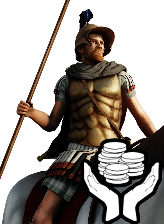
These horsemen are the nobles of Gortyn, the largest city of Crete. Unlike other Greek cavalry, the Cretans once fought with the Aspis shield, and now that other Hellenes have adopted this practice, they themselves have abandoned it. Instead, they are now equipped like the xystophoroi of Alexander the Great. Their long lance is perfectly suited for a deadly charge on the battlefield, and metal cuirasses with pteryges have been added to their equipment to protect them in melee. Additionally, their legs are now shielded by bronze greaves and their heads by Boiotian or Konos helmets. The plumes or crests on their helmets, the finely made metal muscles of their cuirasses, and their expensive cloaks mark their status as Gortyn’s leading citizens. Should they be forced into a melee in narrow spaces, they can draw their xiphos swords from their sheaths and hack the enemy into pieces.
Historical background
In the early 2nd century BC, Gortyn had good reasons to introduce new cavalry units. Its conflict with Knossos had apparently not ended with the termination of the so-called Cretan War (205-200 BC) (Cf. Chaniotis, Cretan Koinon (2015), p. 381). Gortyn was eager to find a solution, however, and it received help from its ally Magnesia on the Maiandros. The envoys of the Ionian polis came to Gortyn, probably in the second half of the 190s BC, because they wanted to make a deal. About four decades earlier Miletos, trying to oust Priene from the lower valley of the Maiandros, had hired thousands of Cretan mercenaries and subsequently settled them in the newly conquered land (Chaniotis, Age of Conquest (2018), p. 309). During the Cretan War, fighting broke out between Miletos and Magnesia, and the Magnesians prevailed in taking the land Miletos had settled with the Cretans for themselves (cf. Syll. 3.588 and I.Milet. 3.148 for the Milesian-Magnesian War). These Cretans had no interest in serving Magnesia and soon began to create problems for the Magnesian governor of the valley. The Magnesian government therefore appointed ambassadors who were to ask the Cretan cities to take back their (former) citizens. After much haggling, the Magnesians agreed to broker a peace deal between Knossos and Gortyn while Gortyn would take back all of the former mercenaries who still held Gortynian citizenship (IC_4.176). The Knossians initially welcomed this initiative, offered Magnesia the same terms (IC_1.8.9), and even brought a present to Gortyn: Roman legionaries they had captured on a campaign in the Peloponnese in support of their ally Nabis of Sparta (cf. Liv. 37.60.5, Armstrong, Cretan Women (2006), p. 306). Despite an amicitia with Rome, the Gortynians happily accepted to use the Romans as slaves (cf. Klär, Kreta im Spannungsfeld der hellenistischen Monarchien (upcoming)). And yet, when Knossos received an offer from the Seleucid king Antiochos III, the peace negotiations seemingly broke down. Knossos threw in its lot with the Seleucids, while Gortyn sided with the Achaians (Chaniotis (2015), p. 381). As is well known, Antiochos III was eventually defeated at Magnesia (on the Sipylos, not on the Maiandros), however, and by 188 BC, Knossos gave in and agreed to join Gortyn’s Cretan Koinon (Klär, Kreta). At this time, a famous guest came to Gortyn: Hannibal. Having commanded a fleet for Antiochos, he now sought refuge on Crete and hid some of his treasures there (Nep. Hannibal 9). Why he chose the only Rome-friendly city on the island remains a mystery, but he soon left for Bithynia via Armenia and does not seem to have ever returned.
Later that year, the Roman praetor Quintus Fabius Laebo sailed to Crete to free the enslaved Romans and Italics. Upon arrival, he threatened to make war on the Gortyno-Knossian coalition (Liv. 37.60.3). The Cretans boldly dismissed the Roman request; only Gortyn freed some of the captives and handed them over to their amici. The Cretan Koinon had little interest in listening to the Romans as it was already busy with another war, this time against Kydonia and its allies, which may have included Lato, Olous and Polyrrhenia (Klär, Kreta). The Kydonians conquered Phalasarna in western Crete, but seem to have suffered a crushing defeat against the Gortynians in the East, for they had to hand over hostages (Polyb. 15.15.3). The Gortynian victory gave Knossos the creeps and they secretly opened talks with Kydonia and offered to abandon the coalition. At least, this is the most likely solution, for Polybios reports that Kydas, the son of Antalkas, as the newly elected leader of Gortyn in 185/184 BC, captured Lykastion from the Knossians and gave it to Rhaukos and then conquered Diationion and donated it to its old enemy Lyttos, now a member of the Koinon (Polyb. 15.15.1). In 184 BC, a Roman commission led by Appius Claudius arrived on the island, presumably upon Knossos' or Kydonia's request. To appease everyone, they ruled to restore the status quo ante bellum: Kydonia had to give back Phalasarna in return for the hostages, Rhaukos and Lyttos handed over Lykastion respectively Diationion to the Knossians, and the Knossians rejoined the Cretan Koinon (Polyb. 15.15.3-6). In the next year, 183 BC, the league signed a treaty with Pergamon in which it promised to supply the Attalids with mercenary cavalry (Syll. 627 = IC 4.179). The cities that signed it were: Gortyn, Knossos, Lyttos, Phaistos, Rhaukos, Hierapytna (near Itanos), Eleutherna, Aptera (near Kydonia), Polyrrhenia, Sybrita, Lappa, Axos, Pransos, Allaria, Arkades, Keraia, Praisos, Lato, Biannos, Malla, Eronos, Chersonesos (the port city of Lyttos), Apollonia, Elyros, Hyrtakina, Eltynia, Anopolis, Araden, Istron, and Tarrha. Kydonia is not listed, but seems to have lost most of its allies, while Phalasarna, which was embroiled in a civil war, Ptolemaic Itanos, and Rhodian Olous are also missing (Chaniotis (2015), p. 381).
Peace only reigned for 14 years: in 170 BC, Kydonia attacked its own ally Apollonia on the southwestern coast of the island, much to the anger of Knossos and Gortyn. When the Kydoniats achieved a quick victory and annexed Apollonia, Knossos and Gortyn declared war on Kydonia and invaded the territory of Apollonia. In the ensuing battle, the coalition prevailed, and the Kydoniats conceded defeat. Our beloved Knossians and Gortynains disagreed on what to do with Apollonia, however, and immediately went to war with each other over the area in question. From 169-168 BC, the bloody conflict cost many lives, until Gortyn achieved a decisive victory (Chaniotis, Das antike Kreta (2004), pp. 82-83). King Ptolemy VI Philometor personally intervened in the congress and brought about a lasting ceasefire (IC IV 181). Both poleis rejoined the Cretan League, and to suppress any lingering hatred, they decided to attack Rhaukos, Gortyn’s ally from the war of 185/184 BC. Rhaukos stood no chance against its neighbours, and after it had been roundly defeated, Knossos and Gortyn built a new border exactly through the centre of the city! This was an idea to prevent further conflict and may have been suggested by the Ptolemaic pharaoh (cf. Chaniotis (2004), pp. 82-83). With peace once again restored, Pyroos, presumably one of the Gortynian commanders, now went to serve in the Ptolemaic army. He would come back to his mother city with a contingent of Egyptian soldiers a few years later, when Gortyn was attacked. Whether by Knossos or someone else we do not know, but once again Ptolemy VI helped to end the hostilities (Bagnall, The administration of the Ptolemaic possessions (1976), p. 118).
During the wars of the 2nd century BC, Gortynian horsemen mainly fought as xystophoroi. A stela from the shrine of Glaukos and Kounabi in Eltyna (between Knossos and Gortyn) – probably erected in the 2nd century BC – depicts a xystophoros with a crested Boiotian helmet, metal cuirass, xiphos, and chlamys. The elite warriors of Knossian (and Gortynian) society had thus adopted the armament of Macedonian cavalry, arguably because of Philip V’s impressive and quick victories on the island during the Lyttian War (221-215 BC). We have added some Konos helmets for variety, and bronze greaves, but otherwise closely stuck to the image of the stele. Such horsemen will have been very efficient on the plains such as the Messara around Gortyn, where battles against attacking Knossians or the younger citizens in the civil war will have taken place. On such a mountainous island, they needed to be combined with missile troops or infantry at all times, but there is no doubt that cavalry existed and was an important element of any major Cretan army.
Stats
| Rank in roster | ||
|---|---|---|
| Men per unit | 30 | █········· 8% |
| Attack | 13 | ██████···· 57% |
| Charge bonus | 35 | ██████████ 96% |
| Defence | 32 | █████····· 49% |
| · armour | 13 | ████████·· 75% |
| · defence skill | 19 | ████······ 44% |
| · shield | 0 | █········· 0% |
| Morale | 13 | ███████··· 70% |
| Discipline | Normal | |
| Training | Highly trained | |
| Recruitment cost | 3,990 dn | █████████· 92% |
| Upkeep per turn | 1,071 dn | █████████· 92% |
| Turns to recruit | 4 |
Weapons
| Primary | Secondary | Primary | Secondary | Primary | Secondary | Primary | Secondary | ||||
|---|---|---|---|---|---|---|---|---|---|---|---|
| Attack | 13 | 12 | Charge bonus | 35 | 29 | Type | melee · blade | melee · blade | Damage | piercing | slashing |
Defence
| Primary | Secondary | Primary | Secondary | Primary | Secondary | Primary | Secondary | ||||
|---|---|---|---|---|---|---|---|---|---|---|---|
| Total | 32 | — | Armour | 13 | — | Defence skill | 19 | — | Shield | 0 | — |
Condition and terrain
| Hit points | 1 | Mount | light horse | Ground: scrub / sand / forest / snow | -3 / -1 / -8 / -1 | Charge distance | 40 |
| Formations | Square · Wedge |
Technical stats
| Time between blows (primary / secondary) | 2.5 s / 2.5 s | Extra fatigue in hot climates | 4 | Spacing between men: close / loose | 2 × 4.8 m / 3 × 7.2 m | Default ranks | 5 |
In battle: Very good stamina
Where to hire it
No mercenary pool on the campaign map offers this unit, so it cannot be hired.