
Mercenary Liburnian Pirates
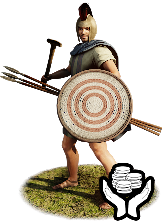

Mercenary. Hired from a regional pool, not recruited from a building.
Class: light · Category: infantry · Men per unit: 40
Description
“From time immemorial Illyrians had attacked and robbed ships sailing from Italy” – Polybius (2.8, 1)
Liburnian Pirates are famous for their raiding, often striking rapidly from their Liburni boats. These warriors are armed with a menagerie of weapons such as clubs, axes, and javelins, while staying fairly nimble, wearing only Illyrian helmets, light woollen chitons, and round wicker shields as protection. This allows to respond flexibly to threats during one of their violent incursions, but also enables them to retreat swiftly if confronted by too strong a threat, or even to swim if battling at sea.
Historical background
The Liburnians were a distinct group in Illyria, whose society, culture, and piracy were often subject to comment by their Greek and Roman neighbours, but whose ethnic make-up is hard to define (Tonc, To be or...NOT to be Liburnian (2022), p. 127). Pseudo-Skylax (21.1/2) states that Liburnian territory included many cities and “great” islands, but spends more time lingering over their society. He describes it as an alien or at least very un-Roman one “ruled by women; and the women are (wives) of free men, but mingle with their own slaves and with the men of the nearby lands”. Dzino has interpreted Marcus Terrentius Varro’s work ‘On Agriculture’ (Var. RR 2.10.9) to be about the Liburnians, too. Varro, who may have lived with the Liburnians in the first century BC, paints a picture of a fairly liberal society in which women engage in sex before marriage and work, even directly after childbirth, in herding and household tasks (Dzino, “Liburni Gens Asiatica” (2017), pp. 68-69). In Liburnian society children were reared together until they were 5 years old, then at the age of 8 these children were allotted to the men they most physically resembled. This continued for some time under the Romans too as there are epitaphs showing matrilineal names and kin groups (Wilkes, The Illyrians (1996), p. 187). The Liburnians’ matrilineal society certainly invoked the imagination of Roman writers. Solinius (Polyhistor 2.51) implied their society to be an unusual one even for barbarians as they “are an Asiatic people”. Servil on Vergil, claimed that they must have been descended from Amazons – a statement serving the dual purpose of highlighting that the Liburnians have a female-led society according to textual tradition and also that they are an ‘other’ and Asiatic society (Dzino (2017), p. 70).
The Liburnians were known to the Greeks since at least the 8th century BC, and while they may have initially just been pirates to Romans, they had a reputation for hospitality to travellers to the Greeks. The Liburnians combined seafaring and pastoralism, an interesting dichotomy. For example, their flocks of sheep were notable for their fertility, but also produced course wool that could not make soft garments (Wilkes (1996), p. 186). The Liburnians’ nautical influence was significant, with Liburnian and other Illyrian piracy causing many problems for their neighbours and often inciting a violent response. These raids and their aftermath feature in many primary sources, including Livy (10.2.4-7) on the expedition of the Spartan leader Kleonumos in 302 BC, Polybius (2.4-5, 2.8) on the causes of the First Illyrian War, and Cassio Dio (12.4.9) and Appian (Ill. 8.23) on Histrian-Illyrian piracy leading to the Second Illyrian War. Piracy was also mentioned by Appian (App. Ill. 16.47) in the context of Octavian’s operations in the eastern Adriatic and its hinterland, where in 35 BC Liburnian piracy in the 1st century led to the confiscation of their ships by Octavian (Borsic, Liburnians and Illyrian Lembs (2021), p. 22).
The constant raiding and exposure to Liburnian naval technology led to the Roman adoption of the Liburnian boat, which is attested by Appian and Vegetius (App. Ill 3.7; B Civ 2.39; Veg. Mil 4.33), who ascribe the origins of the ship to the Liburnians (Dzino and Borsic, Transfer of Technology in the Late Republican Adriatic (2020), p. 184). The Roman adoption of the liburni was often combined with the hiring, usage, or even seizure of Liburnian ships, a habit which proved very effective against Carthage and other rivals to Rome. Liburnian naval power was formidable and had to be curtailed on several occasions during Roman expeditions in 129 BC and 25 BC. Even so, their potential as a naval threat remained high, with the Liburnians even possibly assisting in and contributing to defeating Cleopatra’s navy northwest of Greece at Actium in 21 BC (Wilkes (1996), p. 187).
The Liburnians had a warlike reputation, as their history of fighting and piracy can attest. In order to survive and thrive, they often had to raid others. Material evidence indictes that there was an absence of centralised political institutions and that elites would use warfare to prove their statues and, of course, accumulate wealth (Borsic (2021), p. 18). The Liburnian lack of centralisation meant that Illyrians and Liburnians could often be found in the employ of Greek and Roman armies. During the Roman Civil War both Caesar and Pompey made use of Liburnian mercenaries (Dzino, Illyricum in Roman Politics (2010), p. 91). The archaeological evidence for Liburnian Pirates in RIS is quite varied, with Illyrian helmets of the IIIA-1 type having been found at sea at a depth of 15-16 m near Cape Jablanac on the island of Cres. Although the reason for these helms being underwater is unknown, perhaps due to ritual, warfare, or something else, what is known is that the Illyrian helm was in use from roughly 550-400 BC and was a status symbol in the Illyrian peninsula (Borsic (2021), p. 22). The round convex shield can be found on a silver bronze pendant from the 6th century BC Liburnian necropolis of Nin and it seems round shields continued to be used despite Celtic and Hellenic influences (Borsic (2021), p. 16).
Stats
| Rank in roster | ||
|---|---|---|
| Men per unit | 40 | ███······· 30% |
| Attack | 11 | ███······· 34% |
| Charge bonus | 12 | ████······ 42% |
| Defence | 34 | ██████···· 55% |
| · armour | 3 | ██········ 21% |
| · defence skill | 29 | █████████· 91% |
| · shield | 2 | ███······· 25% |
| Morale | 11 | ████······ 39% |
| Discipline | Normal | |
| Training | Untrained | |
| Recruitment cost | 2,522 dn | ███████··· 71% |
| Upkeep per turn | 615 dn | █████····· 46% |
| Turns to recruit | 2 |
Weapons
| Primary | Secondary | Primary | Secondary | Primary | Secondary | Primary | Secondary | ||||
|---|---|---|---|---|---|---|---|---|---|---|---|
| Attack | 11 | 10 | Charge bonus | 12 | 16 | Type | thrown · blade | melee · blade | Damage | piercing | blunt |
| Projectile | javelin | — | Range | 60 | — | Ammunition | 5 | — | Properties | Thrown | — |
Defence
| Primary | Secondary | Primary | Secondary | Primary | Secondary | Primary | Secondary | ||||
|---|---|---|---|---|---|---|---|---|---|---|---|
| Total | 34 | — | Armour | 3 | — | Defence skill | 29 | — | Shield | 2 | — |
Condition and terrain
| Hit points | 1 | Ground: scrub / sand / forest / snow | 0 / 0 / 0 / 0 | Charge distance | 30 | Formations | Square |
Technical stats
| Time between blows (primary / secondary) | 2.5 s / 2.5 s | Extra fatigue in hot climates | 0 | Collision mass per man (1.0 is normal) | 0.83 | Spacing between men: close / loose | 1 × 1.2 m / 2 × 2.4 m |
| Default ranks | 5 |
In battle: Can hide in long grass · Can sap · Very good stamina
Where to hire it
No mercenary pool on the campaign map offers this unit, so it cannot be hired.