
Mercenary Mariandynian Javelinmen
Mercenary. Hired from a regional pool, not recruited from a building.
Class: missile · Category: infantry · Men per unit: 40
Description
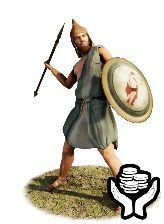
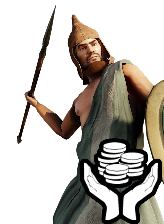
These light javelinmen hail from the Mariandynians, a small ethnos that dwells in the hilly area between the Sangarios and Billaios rivers in northwestern Paphlagonia. Despite their proximity to the coast, the Mariandynians are now mostly a farming people, and they have long since lost their freedom to the ambitious and aggressive Greeks of Herakleia Pontike. Most Mariandynians thus only ever go to war in Herakleiote armies, or are forced to serve as rowers in the Herakleiote navy. Their thirst for freedom has never vanished, however, and many of them are thus keen to be recruited into the armies of Herakleia’s enemies. While brave and athletic, the Mariandynians are now only given javelins and small, round Pelte shields. They wear typically Greek chitones or exomides and Phrygian caps. In melee, the Mariandynians use their javelins as spears, and will fight with them underhand.
Historical background
The Mariandynians were a very ancient people, who had settled the fertile landscape between the Sangarios and Hypios rivers in the West, and the lower Billaios in the East, in a time long before historical records (Steph. Byz. s.v. Μαριανδυνία). Their hero and founder was Mariandynos, probably a son of Phrixos (Schol. Apoll. Rhod. Arg.2.723 & 780). Initially, their territory hugged the so-called Mariandynian Gulf at the southern coast of the Black Sea (Plin. nat. hist. 6.1). On his travels with the Argonauts, Herakles assisted the Maryandynoi against the Bebrykes (Apollod. Bibl. 2.5.9), but their heavy losses led to the invention of the threnos or threnody, a specific type of wailing which was sung at public burials (Aisch. Pers. 937). Yet, the conquest of the Bebrykes helped the Mariandynians to carve out a flourishing kingdom (Theopompos apud Strab. 12.3.4C542). Herakles would return to Mariandynia to enter the underworld here (Apoll. Rhod. 2. 351-353) and to bring back Kerberos the hellhound (Mela 1.103).
According to Strabo, the Mariandynians were Thracians (Strab. 12.3.4C542, 7.3.2C295), while Herodotus (Hdt. 3.90.2) distinguished them from the Thracians of Asia Minor (i.e. the Bithynians). Elsewhere, Strabo confidently defines them as Paphlagonians (Strab. 8.3.17C345). According to Herodotus, they were also armed like the Paphlagonians in the Achaemenid army (Hdt. 7.72.1), while the equipment of the Bithynians is quite different (Hdt. 7.75.2), which makes it more likely that they were Paphlagonians rather than Thracians. Whatever their ethnic origin, the fate of the Mariandynians changed in 560 BC, when settlers from Megara with a group of Tanagrans (in Boiotia; Strabo [12.3.4C542] also mentions Milesians) arrived on their shores to found a port settlement which they aptly named Herakleia after their hero (Paus. 5.26.7). The city would become known as the Pontic Herakleia, Herakleia he Pontike, because it lay on the southern coast of the Pontos Euxeinos, the Black Sea. Pompeius Trogus, a Gallo-Roman author from the early imperial period, writes:
‘‘For when the Boiotians (the Tanagrans) were suffering from a pestilence, the oracle at Delphi had told them, that 'they must plant a colony in the country of Pontos, dedicated to Herakles. But as [...] the matter was neglected, the Phokians made war upon them; and after suffering from unsuccessful struggles with that people, they had recourse to the oracle a second time. The answer which they received was, that 'what was a remedy for the pestilence would also be a remedy for the war'. Raising therefore a body of colonists, and sailing to Pontos, they built the city Herakleia; and as they had been led to that settlement by the guidance of fate, they soon acquired great power.’’ (Trog. = Iust. 16.3)
As in many founding stories, the oracle of Delphi played a starring role, but Trogus is not wrong about the exceptional history of Herakleia. The city soon rose to become the most important town in the region and its leading men saw the Mariandynians as a hindrance. At the time, there was a bigger fish, however: Kroisos or Croesus, the mighty king of Lydia, was expanding the northern borders of his kingdom and the rulers of Mariandynia accepted his overlordship (Hdt. 1.28.1). Herakleia was restricted to a narrow coastal strip until Kroisos, too, found an even greater enemy: Kyros or Cyrus the Great, the founder of the Achaemenid Empire. In 541 BC, Sardis, the capital of Lydia, was besieged and captured by the Persians and Kroisos lost his realm (Hdt. 1.84, Xen. Cyr. 7.2). Suddenly, the peoples of northwestern Anatolia were released from their obligations to the Lydian monarchy. The Bebrykes apparently conspired with the Paphlagonians, possibly the kingdom of the Pylaimenids (who are a faction in RIS), and rebelled against Mariandynian rule. Hard pressed by the two enemies, they turned to Herakleia for help. The Mariandynian king offered his Dorian neighbours more coastal territory in return for military help (Hind, Megarian Colonization (1998), p. 135). The Greek hoplites prevailed, and they were now confident that they were militarily superior to their three neighbours. When Persian troops arrived soon after and forced the northerners to acknowledge the authority of the Great King, Paphlagonia and Mariandynia were merged into the third, Cappadocian satrapy (Hdt. 3.90.2), while Herakleia Pontike retained its autonomy as a Persian ally (Iust. 16.3).
In 480 BC, a Mariandynian contingent, which was commanded by prince Gobryas and queen Artystone, took part in the doomed expedition to Greece (Hdt. 7.72.2). Their dedication to the fight gained them credit with the Persians, but the Herakleiots, too, impressed their Achaemenid overlords after these had been defeated in Greece:
“When the Athenians were at the height of power [...] after the overthrow of the Persians, (they) imposed a tax on Greece and Asia for the support of a fleet, and when all were promptly contributing to the maintenance of their safety, the Herakleiots alone, from friendship for the kings of Persia, refused to pay. Lamachos was accordingly despatched by the Athenians with an army to exact from them what was withheld; but leaving his ships on the coast, and going to ravage the lands of the Herakleiots, he lost his fleet, with the greater part of his army, by shipwreck, in a tempest that came on suddenly. As he was not able, therefore, to return by sea, from having lost his ships, and did not dare, with so small a body of men, to return by land through so many warlike nations, the Herakleiots, thinking this a more honourable opportunity for kindness than for revenge, sent the invaders away with a supply of provisions and troops to protect them; deeming the devastation of their lands no loss, if they could but make those their friends who had formerly been their enemies.” (Trog. = Iust. 16.3)
This event earned Herakleia even more prestige in the Greek world and their harbour was now growing in importance. Meanwhile, the struggle between the Paphlagonians and Bebrykes on the one side and the Mariandynians on the other side was not over. The Mariandnyians may also have suffered relatively high losses in the Greek campaign. In any case, they were hard pressed and again asked the Herakleiots for help. It is not completely clear what happened next, as we only have the condensing perspective of the polymath Poseidonios of Apameia from the early 1st century BC. He claims the Mariandynians were ‘weak in intellect’ and therefore ‘put themselves in subjection to the Herakleiots, promising to serve them continually so long as the Herakleiots provided for their needs, though they stipulated in addition that there should be no selling of any of them beyond the Herakleiote territory, but that they should stay right in their own territory’ (Poseid., Hist. 11 = Athen. 6.263d). The process was probably gradual, with the Herakleios initially seizing the fertile Lykos valley and then gaining more and more control over the Mariandynian king or the individual chieftains, who probably lacked soldiers, income, or population rather than intellect (cf. Hind (1998), pp. 135-136). The 2nd century AD travel writer Pausanias represents the process as much more violent, with the Herakleiots ‘overruning’ Mariandynia (Paus. 5.26.7). In any case, the Mariandynians became Helots, not actual slaves, as is clear from Poseidonios’ description. For Plato, the subjection of the Mariandynians was less controversial than that of Sparta’s Helots (Plato Nom. 6.776d), perhaps, because they were no Hellenes. They also served in the Herakleiote navy as rowers and in the army as javelinmen (Hind (1998), p. 136).
After the annexion of Mariandynia, Herakleia Pontike became a major player in the Pontic area. Under powerful and merciless tyrants, they became more and more independent from the Persians and preserved their autonomy in the age of Alexander. When Dionysios of Herakleia died in 305 BC, shortly after taking on the title of King, his empire stretched from the Rhebas river in the West to Kytoros in Paphlagonia in the East, while the old Milesian colonies Sesamos, Kromna, Tion, and Kytoros had become Perioikoi towns and the new metropolis Amastris was named after the wife and successor of Dionysios (Burstein, Outpost of Hellenism (1974) pp. 72-74 and 79; cf. Memn. 4.6 for the royal title). Even though Herakleia would lose parts of its eastern territory in the beginning of the 3rd century BC, it remained a regional power and there was thus no chance for the Mariandynians to break out of their servitude. They kept serving Herakleia, and we have armed them in the way Herodotus (7.72.1) described them: ‘The Paphlagonians in the army had woven helmets on their heads, and small shields and short spears, and also javelins and daggers; they wore their native shoes that reach midway to the knee. The Ligyes and [...] Mariandyni [...] were equipped like the Paphlagonians’. The woven helmets are much like Phrygian caps, while we have given the Mariandynians Greek style clothes, since the soldiers would be partly equipped by the Herakleiots. Even though their status was one of Helots, they still played an important role in the small Herakleiote Empire and can serve a player in RIS well enough.
Stats
| Rank in roster | ||
|---|---|---|
| Men per unit | 40 | ███······· 30% |
| Attack | 10 | ██········ 19% |
| Charge bonus | 1 | █········· 4% |
| Defence | 17 | █········· 12% |
| · armour | 1 | █········· 0% |
| · defence skill | 14 | ██········ 17% |
| · shield | 2 | ███······· 25% |
| Morale | 4 | █········· 0% |
| Discipline | Low | |
| Training | Untrained | |
| Recruitment cost | 1,224 dn | █········· 8% |
| Upkeep per turn | 299 dn | █········· 9% |
| Turns to recruit | 2 |
Weapons
| Primary | Secondary | Primary | Secondary | Primary | Secondary | Primary | Secondary | ||||
|---|---|---|---|---|---|---|---|---|---|---|---|
| Attack | 10 | 3 | Charge bonus | 1 | 1 | Type | thrown · archery | melee · blade | Damage | piercing | piercing |
| Projectile | javelin | — | Range | 60 | — | Ammunition | 7 | — | Properties | Thrown | — |
Defence
| Primary | Secondary | Primary | Secondary | Primary | Secondary | Primary | Secondary | ||||
|---|---|---|---|---|---|---|---|---|---|---|---|
| Total | 17 | — | Armour | 1 | — | Defence skill | 14 | — | Shield | 2 | — |
Condition and terrain
| Hit points | 1 | Modifier against mounts | horse +3 · chariot +3 · camel +3 | Ground: scrub / sand / forest / snow | 8 / 0 / 6 / 0 | Charge distance | 30 |
| Formations | Square |
Technical stats
| Time between blows (primary / secondary) | 2.5 s / 2.5 s | Extra fatigue in hot climates | 0 | Collision mass per man (1.0 is normal) | 0.85 | Spacing between men: close / loose | 1.1 × 2.6 m / 1.98 × 4.68 m |
| Default ranks | 5 |
In battle: Very good stamina
Where to hire it
No mercenary pool on the campaign map offers this unit, so it cannot be hired.