
Mercenary Northern Illyrian Spearmen
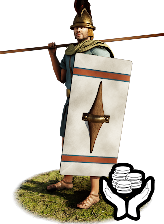

Mercenary. Hired from a regional pool, not recruited from a building.
Class: spearmen · Category: infantry · Men per unit: 40
Description
The simple but varied equipment of the Northern Illyrian Spearmen is highly suitable for their role as agile but sturdy spearmen. They fight with long Sibyna spears, and have been equipped with Smarjeta, Negau and Giubiasco helmet types, as well as a mix of round and thureos shields. They lack body armour. Polybius ( XI, 11, 4) still distinguished these spearmen from the Thorakitai, which means that these men had a lighter combat role and equipment than some of their peers. Nonetheless, they are fearsome and manoeuvrable warriors, who will form a dependable backbone for any army.
Historical background
Those we and many ancient Greek authors refer to as the Illyrian "people" were not a monolith, nor were they one, uniform "pseudo-ethnic identity" (Dzino, The Celts In Illyricum (2008), p. 50). The Romans, too, seemed quite happy to hand wave any complexities in culture, ethnicity or state by assigning the geographic term ‘Illyricum’ to deal with the entire territory between Cisalpine Gaul and Macedonia (Dzino, Deconstructing ‘Illyrians’ (2008), p. 47). However, the people of Illyria were surprisingly varied in language, custom and culture – both materially and behaviourally, with recent archaeological discoveries shedding light on many different tribes.
Illyria had many connected and differing cultural, social and ethnic groups. In RIS, they are primarily separated into two main groups, the Northern and Southern Illyrians. In the case of the Northern Illyrians, there are some reasons for this distinction. This region was initially primarily influenced by Northern Italy (Wilkes, The Illyrians (1996), p. 40). Northern Illyria was rumoured to have been influenced initially by horse and cart-riding "Thraco-Cimmerians" but this idea is seemingly false according to more recent academic findings of Italic cultural influence in Croatia, Slovakia, Western Bosnia and Slovenia’s lower Carniola area. (Wilkes (1996), p. 41). The Northern Illyrians are characterised by their slower adoption and integration of Greek influences and material goods in contrast to many of the Southern Illyrian groups such as the Dardanians. The Liburnian League and later the Histrian Kingdom on the Adriatic coast were slower to absorb this Greek influence, but in the end it was gradually transmitted to the Cisalpine and Transalpine Iapodes and finally to the Delmatae in the Illyrian hinterland (Dzino, Deconstructing ‘Illyrians’, p. 49).
Northern Illyrian Spearmen have a strong, 2-2.5 metre spear named a Sibyna, which was stated by Festus (p. 336m) to be the main weapon of the Illyrians, and in addition they also carry a small curved knife as a sidearm. Their helmets come from a variety of sources of varying ‘modernity’. Some of their helmets, for example, are of a somewhat dated Smarjeta or Negau/Negova type, which were common in classical Etruria in the 5th century BC but saw continued usage in Northern Illyria. Some newer types of helmets include the Vače type Negau helmets from the 4th century BC, the Idrija Negau variant from the 4th to the 1st century BC (Karl et. al., Die Negauer Helme aus Ženjak (2019), pp. 322-323), along with Giubiasco type helmets from roughly the same time period (Guštin, Zu den alpinen negauer Helmen (2019), p. 383). Northern Illyrian Spearmen used a few different types of shields of varying origin and design. Some have Hellenic-inspired or possibly manufactured thureos shields, which have been depicted on situlas (a type of urn/vessel), as well as on a Iapodian burial-chest from Ribic, Bosnia (Wilkes (1996), p. 199). The majority of other shields are smaller round shields, as depicted on belt plates from Prozor (Kukoč, Grčki simboli u ilirskom svijetu (1998), pp. 8-10). Otherwise, their clothing is fairly simple. These men wear no body armour, only chitons.
Stats
| Rank in roster | ||
|---|---|---|
| Men per unit | 40 | ███······· 30% |
| Attack | 10 | ██········ 19% |
| Charge bonus | 12 | ████······ 42% |
| Defence | 38 | ███████··· 68% |
| · armour | 2 | █········· 13% |
| · defence skill | 32 | ██████████ 97% |
| · shield | 4 | █████····· 48% |
| Morale | 11 | ████······ 39% |
| Discipline | Normal | |
| Training | Untrained | |
| Recruitment cost | 2,457 dn | ███████··· 68% |
| Upkeep per turn | 600 dn | ████······ 41% |
| Turns to recruit | 2 |
Weapons
| Primary | Secondary | Primary | Secondary | Primary | Secondary | Primary | Secondary | ||||
|---|---|---|---|---|---|---|---|---|---|---|---|
| Attack | 10 | — | Charge bonus | 12 | — | Type | melee · blade | — | Damage | piercing | — |
| Properties | Light spear (braced against cavalry charges from the front) · +8 attack against cavalry | — |
Defence
| Primary | Secondary | Primary | Secondary | Primary | Secondary | Primary | Secondary | ||||
|---|---|---|---|---|---|---|---|---|---|---|---|
| Total | 38 | — | Armour | 2 | — | Defence skill | 32 | — | Shield | 4 | — |
Condition and terrain
| Hit points | 1 | Ground: scrub / sand / forest / snow | -1 / 0 / -2 / 0 | Charge distance | 30 | Formations | Square |
Technical stats
| Time between blows (primary / secondary) | 2.5 s / — | Extra fatigue in hot climates | 0 | Collision mass per man (1.0 is normal) | 0.9 | Spacing between men: close / loose | 1 × 1.2 m / 2 × 2.4 m |
| Default ranks | 5 |
In battle: Can hide in long grass · Can sap · Very good stamina
Where to hire it
No mercenary pool on the campaign map offers this unit, so it cannot be hired.