
Mercenary Paphlagonian Light Infantry
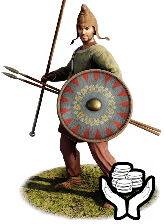
Mercenary. Hired from a regional pool, not recruited from a building.
Class: missile · Category: infantry · Men per unit: 40
Description
Fast, numerous, and lightly armoured, these spearmen cannot hold the line against heavy units, but they will do wonders when chasing and attacking lighter units. They wear woven helmets and Phrygian caps on their heads, wielding javelins and a short spear for close combat. Their small shields, beautifully decorated with local motives, as well as their excellent morale, will help these men to stand their ground for a bit longer. As Herodotus relates: "The Paphlagonians in the army had woven helmets on their heads, and small shields and short spears, and also javelins and daggers; they wore their native shoes that reach midway to the knee." (Hdt. VII, 72).
Historical background
Paphlagonia, a rugged mountainous country situated between Bithynia and Pontus, is home to hardy hillmen capable of ambushing your armies as you move. Over its history, Paphlagonia came under the control of various empires, including Lydia, Persia, and eventually that of Alexander the Great in 333 BC. After Alexander's death, the region enjoyed a measure of independence before being gradually absorbed by the expanding Pontic kingdom in the 3rd and 2nd centuries BC. Following the defeat of Mithradates VI by Pompey in 65 BC, parts of Paphlagonia were incorporated into the Roman provinces of Bithynia and Galatia.
The Paphlagonians were noted for their military prowess, particularly as light infantry. While specific historical records about the Paphlagonians are scarce, they seem to have been a menace in the region, making their appearance throughout the histories. The Paphlagonians were one of the most ancient nations of Anatolia and were already listed among the allies of the Trojans in the Trojan War (ca. 1200 BC or 1250 BC), in which their king Pylaimenes and his son Harpalion perished (Iliad, ii. 851–857). In Xenophon's Hellenika (4.1.13), King Otys of Paphlagonia supports Agesilaos with a thousand horsemen and two thousand peltasts. Xenophon also speaks of them as being governed by a prince of their own, without any reference to the neighbouring satraps, a freedom perhaps due to the nature of their country, characterised by lofty mountain ranges and strenuous passes.
According to Greek legends, Phineas was the son of Agenor, king of Tyre. He and his four brothers, Cadmus, Cilix, Phoenix, and Thasus departed their Phoenician home in search of their sister, Europa, who had been abducted by Zeus. Phineas gave up his search in eastern Thrace, where he settled on the western shores of the Black Sea and ruled a city state of his own. Phineas became the father to Bithynus, Mariandynus, Paphlagonus, and Thynus (Bithynus and Thynus are adopted from one Odrysus, the eponymous namesake of the later Thracian kingdom). The four each found kingdoms along the shores of the Black Sea; Bithynia, Mariandynia, Paphlagonia, and Thynia.
As outlined by Manolis Manoledakis, the Paphlagonians remained politically semi-autonomous well into the Hellenistic period, often negotiating their freedom between the Seleucids, Pontic rulers, and invading Galatians by offering military support and regional knowledge (Manoledakis, Politics and Diplomacy in Paphlagonia [2017]). While their leaders occasionally posed as kings or dynasts, most Paphlagonian communities retained a fiercely independent and martial identity. Indeed, the events during the lifetime of the empire suggest that the Paphlagonians were not especially controlled by anyone other than themselves. Occasionally local leaders would be able to form a unified tribal kingdom, but rarely one that endured. The invasion and conquest of Anatolia by Alexander the Great gave the natives the chance of governing themselves, as Alexander was content to accept nominal submission from them without tribute being exacted. As was true for most peoples in this part of the world, the Paphlagonians’ destiny eventually intertwingled with that of Rome, and they are mentioned by Festus, who wrote a compendium of Roman history in around 370 AD, during the reign of the Emperor Valens. Festus (Brev. 11) writes that the “King Pylaemenes, a friend of the Roman people, controlled Paphlagonia. Having often been driven thence from his kingdom, he was restored by us and, with his death, the legal status of a province was imposed on Paphlagonia”. The Paphlagonians were thus assimilated by Rome, becoming part of its growing empire.
Stats
| Rank in roster | ||
|---|---|---|
| Men per unit | 40 | ███······· 30% |
| Attack | 13 | ██████···· 57% |
| Charge bonus | 3 | ██········ 16% |
| Defence | 24 | ███······· 26% |
| · armour | 2 | █········· 13% |
| · defence skill | 20 | █████····· 48% |
| · shield | 2 | ███······· 25% |
| Morale | 8 | ██········ 19% |
| Discipline | Impetuous (may charge without orders) | |
| Training | Trained | |
| Recruitment cost | 1,790 dn | ████······ 36% |
| Upkeep per turn | 437 dn | ██········ 16% |
| Turns to recruit | 2 |
Weapons
| Primary | Secondary | Primary | Secondary | Primary | Secondary | Primary | Secondary | ||||
|---|---|---|---|---|---|---|---|---|---|---|---|
| Attack | 13 | 4 | Charge bonus | 3 | 3 | Type | thrown · archery | melee · blade | Damage | piercing | piercing |
| Projectile | javelin | — | Range | 60 | — | Ammunition | 7 | — | Properties | Thrown | — |
Defence
| Primary | Secondary | Primary | Secondary | Primary | Secondary | Primary | Secondary | ||||
|---|---|---|---|---|---|---|---|---|---|---|---|
| Total | 24 | — | Armour | 2 | — | Defence skill | 20 | — | Shield | 2 | — |
Condition and terrain
| Hit points | 1 | Modifier against mounts | horse +3 · chariot +3 · camel +3 | Ground: scrub / sand / forest / snow | 8 / 0 / 6 / 0 | Charge distance | 30 |
| Formations | Square |
Technical stats
| Time between blows (primary / secondary) | 2.5 s / 2.5 s | Extra fatigue in hot climates | 0 | Collision mass per man (1.0 is normal) | 0.84 | Spacing between men: close / loose | 1.1 × 2.6 m / 1.98 × 4.68 m |
| Default ranks | 5 |
In battle: Very good stamina
Where to hire it
No mercenary pool on the campaign map offers this unit, so it cannot be hired.