
Mercenary Thracian Peltasts (Reform)

Mercenary. Hired from a regional pool, not recruited from a building.
Class: missile · Category: infantry · Men per unit: 40
Description
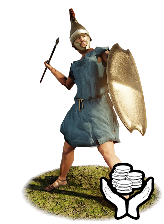
Mercenary Thracian Peltasts are lightly armed soldiers that historically made up the majority of Thracian armies. They are excellent for missions that require quick movement and action, like scouting, skirmishing, ambushing, or protecting camps, strongpoints, and marching columns. While this made them a valuable and significant parts of Classical armies, their fighting style became a common elements among the Greeks after the Peloponnesian War. What still made the Thracians stand out was their fierceness in combat, ascribed to them by later authors, even though they themselves had undergone some changes since their depictions as wild barbarians on Archaic and Classical Attic pottery. By the Hellenistic period, their iconic look of colourful cloaks, pointy felt hats and highly decorated crescent shields had changed significantly. Their life under the hegemony of the Macedonians of Philip II (382-336 BC), Alexander III (356-323 BC), and Lysimachos (360-281 BC) as well as their continued service in the armies of the successors led to a Hellenization of their armament and clothing. The colourful cloaks, mantles, and tunics were replaced by monocolour chitons and exomides in red and blue tones, sometimes decorated with two vertical stripes on the side (Webber, The Thracians (2001), p. 19). As new helmet styles developed, the Thracians adopted for themselves newer Attic-style helmets and Phrygian helmets reminiscent of their native hats, and some even put on Kausia hats, a type of headwear mainly associated with the Macedonians (Dintsis, Hellenistische Helme (1986), p. 183ff; see p. 192 for the Kazanlak tomb in Thrace). Instead of the crescent pelte, the Thracians are now protected by oval shields of leather (thureos), sometimes perhaps with a thin sheet of bronze facing, some of them with small notches on top and bottom. As they keep their primary role as skirmishers and scouts, however, they largely retain their original weaponry. This consists of javelins (akontia) with throwing thongs, and a short sword (machaira) or knife for close combat (Stoyanov: Warfare, in: A Companion to Ancient Thrace (2015), p. 426). In order to move quickly on the battlefield, they wear no heavy armour or additional protective equipment.
Historical background
The Thracians were perceived as wild and ferocious, and repeatedly referred to as warlike peoples (Thuc. II.98.3; Liv. XXXIX.1). They even figured among those described as the most warlike in Europa, along with the Illyrians and Paionians (Arr. Anab. II.7.1). Constant intertribal fighting led to a specialisation in mobile warfare, with a bigger focus on both cavalry and javelin-armed infantry – the peltasts – named after the light shield (pelte) that protected them. This specialisation made them quite appealing to the poleis of southern Greece, whose forces were mainly made up of heavily equipped infantry (hoplites), few non-professional skirmishers (psiloi), and a handful of aristocratic cavalry, if any at all. During the Peloponnesian War, Athens recruited Thracian peltasts on several occasions (Thuk. II.29.5; IV.129.2. VII.27.1), and later the Spartans followed their example (Thuk. V.6.4; Xen. Hell. III.2.2; Xen. Anab. I.2.9). They were the main element of the Thracian infantry, which generally lacked heavier troops (Xen. Anab. VII.3.36, 37, 40; VII.4.22; Diod. Sic. XVIII.14.2).
After the conquest of Thrace by Philip II of Macedon, Thracians, Paionians, and Agrianes were employed as cavalry and javelinmen by Alexander the Great for his campaign into Persia. As the meaning of the word “peltast” slowly shifted towards being used for assault infantry instead of shielded skirmishers (Iphikratean peltast reform towards peltasts with longer spears: Diod. Sic. XV.44.3; Ascl. 1.2), Thracians stopped to be called “peltasts” and were instead generally described as “akontistai” (javelinmen: Arr. Anab. I.28.4) or just “Thracians” (Plut. Aem. XVIII.2; Pol. V.7.11). Griffith even asserts that Thracians disappeared as mercenaries in the late Classical period due to being replaced in their combat role by Greek peltasts (counter: Best, Thracian Peltasts (1968), pp. 110-119). However, they also experienced a “renaissance” during the Hellenistic period, where they were used by the Macedonians, Ptolemies, Seleucids, and Attalids (Griffith, The Mercenaries of the Hellenistic World (1935), p. 253). They were still used in the same roles as in Classical times, as scouts (Dio Cass. XXXVI.9.3), foragers (Plut. Aem. XVIII.2), to clear roads (Arr. Anab. I.14.3), as flank or rearguards (Pol. V.7.11), and – most importantly – skirmishers (Arr. Anab. I.28.4; Liv. XXXII.25).
Mercenary Thracian service is especially well attested in the Ptolemaic Kingdom. Evidence for their settlement is quite prominent in Egypt and confirmed through historiographical sources and papyrus remains (Griffith (1935), p. 114; 243). The ethnic composition of Thracian chiliarchies and hipparchies are questionable, though, as one case is known where a soldier known as “the Thracian” was actually Pergamene (Griffith (1935), pp. 250-251), whereas examples for purely ethnically Thracian units that were institutionalised exist as well (Johstono, The Army of Ptolemaic Egypt 323-204 BC (2020), p. 151). For the battle of Raphia (218 BC), the Ptolemies fielded 6,000 Gauls and Thracians: 2,000 newly recruited mercenaries, and 4,000 coming from settled populations, commanded by Dionysos the Thracian (katoikoi: Pol. V.65.10; Griffith (1935), p. 118f). Paul Johstono, who analysed the Ptolemaic military (army and garrisons) through papyri, inscriptions, and historiographical sources, asserts that Thracians made up 15% of the overall “Ptolemaic military personnel” (Johstono (2020), p. 93).
Thracian peltasts were also found in other Hellenistic armies. At Raphia, 2,000 Thracians served in the Seleucid army (Pol. V.79.6), and later a total of 3,000 Thracians marched in the Daphne parade (Pol. XXX.25.3). The Macedonians also still made extensive use of Thracians. Philip V (238-179 BC) used them as flank guards in Aitolia (Pol. V.7.9) and against the Romans at Kynoskephalai (197 BC; Pol. XXVIII.37.9). Philip allotted land to Thracians in Macedonia, replacing potentially dangerous Macedonian families, which provided him with a readily available force of loyal warriors that he could levy in times of war (Griffith (1935), pp. 74-78; Liv. XLII.51; XLIV.44; Pol. XXIII.10.3).
The Thracian warriors of the Hellenistic period were equipped to the standards of contemporary Greek and Macedonian military. On the wall paintings of the 3rd century BC Kazanlak tomb (Meyboom, The Tomb of Kazanlak reconsidered (2010)), the warriors wear Greek-style chitons and exomides in red and blue tones without the typical Classical Thracian patterns. On the 4th century BC Alexandrovo tomb, some Thracians additionally have vertical stripes of white or red on their chitons. The Phrygian-style bronze helmets became quite common among infantry and cavalry, as well as Attic-style helmets. One of the warriors on the Kazanlak tomb also wears a Kausia, a hat associated with Macedonians that could also serve as a “helmet” (Dintsis (1986), p. 184). Besides the typical Thracian machaira swords and javelins, the Hellenistic Thracian peltasts were equipped with unique oval shields, also depicted on the Kazanlak tomb. They may have been made of wood, wicker, or leather, and have been covered with hide or a bronze sheet. One oval shield with bronze cover, measuring 90x65 cm, was found in Dolan Koznitsa, Kyuszendil district (Stoyanov, Warfare (2015), pp. 429-430). These shields may have been influenced by the Celts that migrated towards Thrace in the early 3rd century BC, and offered a much better cover than the old Classical peltai.
Stats
| Rank in roster | ||
|---|---|---|
| Men per unit | 40 | ███······· 30% |
| Attack | 13 | ██████···· 57% |
| Charge bonus | 4 | ██········ 21% |
| Defence | 19 | ██········ 17% |
| · armour | 2 | █········· 13% |
| · defence skill | 14 | ██········ 17% |
| · shield | 3 | ████······ 37% |
| Morale | 8 | ██········ 19% |
| Discipline | Normal | |
| Training | Untrained | |
| Recruitment cost | 1,790 dn | ████······ 36% |
| Upkeep per turn | 437 dn | ██········ 16% |
| Turns to recruit | 3 |
Weapons
| Primary | Secondary | Primary | Secondary | Primary | Secondary | Primary | Secondary | ||||
|---|---|---|---|---|---|---|---|---|---|---|---|
| Attack | 13 | 8 | Charge bonus | 4 | 6 | Type | thrown · archery | melee · blade | Damage | piercing | slashing |
| Projectile | javelin | — | Range | 60 | — | Ammunition | 7 | — | Properties | Thrown | — |
Defence
| Primary | Secondary | Primary | Secondary | Primary | Secondary | Primary | Secondary | ||||
|---|---|---|---|---|---|---|---|---|---|---|---|
| Total | 19 | — | Armour | 2 | — | Defence skill | 14 | — | Shield | 3 | — |
Condition and terrain
| Hit points | 1 | Ground: scrub / sand / forest / snow | 8 / 0 / 8 / 0 | Charge distance | 30 | Formations | Square |
Technical stats
| Time between blows (primary / secondary) | 2.5 s / 2.5 s | Extra fatigue in hot climates | 0 | Collision mass per man (1.0 is normal) | 0.88 | Spacing between men: close / loose | 1.2 × 2.8 m / 2.16 × 5.04 m |
| Default ranks | 5 |
In battle: Can hide in long grass · Very good stamina
Where to hire it
No mercenary pool on the campaign map offers this unit, so it cannot be hired.