
The Great Pyramid and Sphinx of Giza
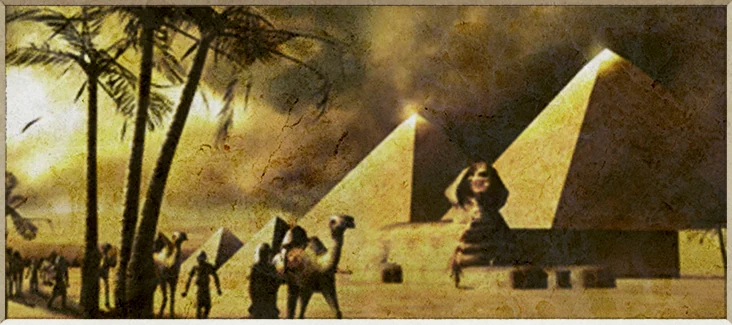
Effect: The Great Pyramid increases the loyalty of Egyptians to the owning faction, regardless of culture.
Where: Memphis, in Lower Aigyptos, held at the campaign start by Ptolemaic Kingdom.
The Great Pyramid at Giza is a marvel: a mountain built to mark the grave of a great monarch. It is truly ancient, built around 2560 BC by the order of Pharaoh Khufu of the Fourth Dynasty. It is built to a very precise alignment to the four points of the compass and the difference in the length of the four faces is less than one part in a thousand! Even the slope of each of the faces is an amazingly precise 51 degrees and 51 minutes. Yet, for all this it is the sheer size of the Pyramid which is mindboggling, and for all of its long history the Great Pyramid and its magnificent companions have awed the imaginations and souls of men who have stood in their shadows.
Colossus of Rhodes
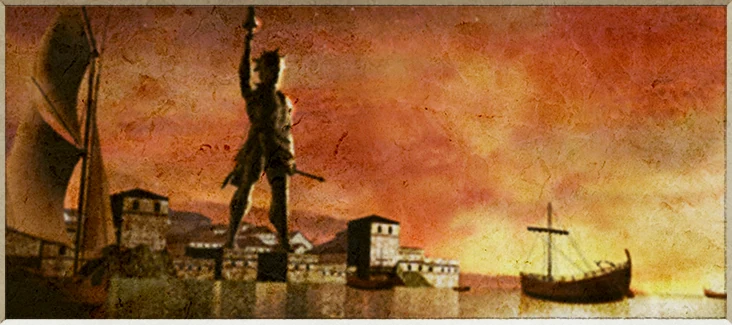
Effect: The Colossus increases naval trade by 40%.
Where: Rhodes, in Rhodos, held at the campaign start by Rhodes.
The Colossus is a giant statue of the Sun God, Helios, standing at the entrance to Mandraki harbour at Rhodes. The people of Rhodes managed to pay for this enormous statue by selling equipment abandoned during an unsuccessful Macedonian siege of their city. Standing more than 30m high, it was created by the sculptor Chares of Lindos and took 12 years to finish, work ending in 282 BC. Historically, in 226 BC an earthquake brought the statue crashing down, but the shattered pieces remained objects of wonder to visitors. After the statue collapsed Pliny wrote that "...few people can make their arms meet around the thumb." This was an immense statue by anyone's standards! No attempts were ever made to rebuild the Colossus because an oracle forbade the work.
Mausoleum at Halicarnassus
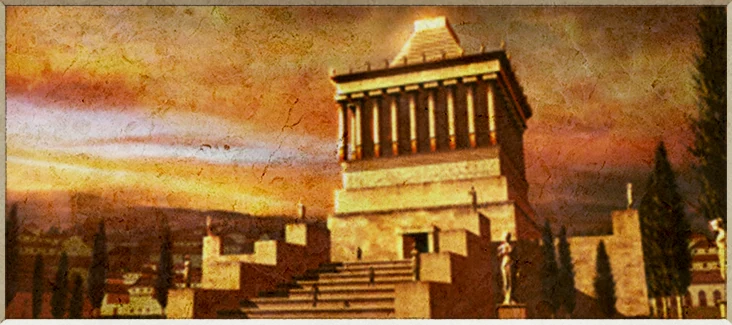
Effect: The Mausoleum reduces building construction times by 20%. This has no effect on buildings that take less than 5 turns to complete.
Where: Halikarnassos, in Karia, held at the campaign start by Ptolemaic Kingdom.
The Tomb of Mausolos is at Halicarnassus and is one of the most beautiful buildings in the world. Mausolos, a Satrap, was the local governor of Caria in Asia Minor, then a part of the Persian Empire and so far from the centre of power that he was, to all intents and purposes, an autonomous king. His legacy - this superb tomb - was the idea of his wife and sister, Artemisia, and although it was probably started during his lifetime it was only finished three years after his death and a year after Artemisia was also dead. The building itself is simple and elegant, but it is the superb carvings and statues that make it so beautiful that travellers come just to gaze upon it. Bryaxis, Leochares, Scopas, and Timotheus, four hugely talented sculptors worked on creating the dozens of statues that adorn the building, each being in charge of the works on one side. The Mausoleum, while beautiful in itself, is also noteworthy because it is not dedicated to the gods of Ancient Greece.
Pharos at Alexandria
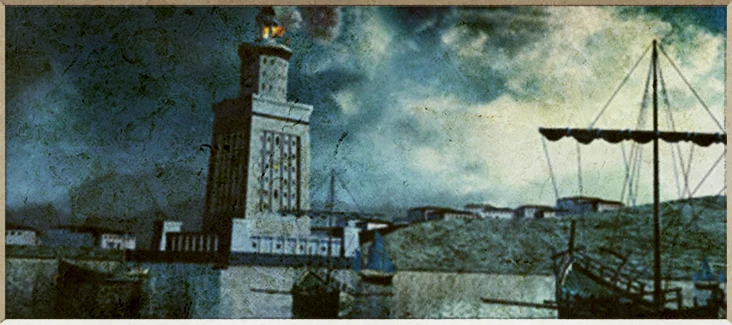
Effect: The Pharos halves the chance of nearby ships at sea sinking and increases naval movement allowances.
Where: Alexandria, in Marmarike, held at the campaign start by Ptolemaic Kingdom.
After Alexander's death his empire disintegrated as his generals fought each other. In Egypt Ptolemy Soter made himself Pharaoh and, in around 290 BC started construction of a lighthouse on an island off the coast at Alexandria - this coastline had long been regarded as dangerous for shipping. The scholars of the Great Library were involved in its design and the construction, which was completed in the reign of Ptolemy Philadelphus. At night, a beacon was kept burning, while during the day a mirror system reflected sunlight to catch the attention of sailors. The Lighthouse was more than 117m in height (roughly a 40-storey building) and was topped with a statue of Poseidon, the God of the sea. It was relatively intact until earthquakes in 1303 AD and 1323 AD.
Temple of Artemis at Ephesus
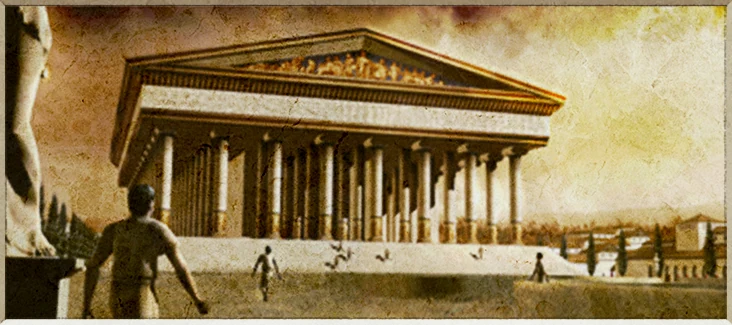
Effect: The Temple reduces the cost of new religious buildings by 30% in all settlements.
Where: Ephesos, in Ionia, held at the campaign start by Seleucid Empire.
Artemis, the goddess of fertility, hunting and nature is honoured at a magnificent and beautiful temple at Ephesus, a building filled with precious treasures and artworks. The temple is old, and work there had been sponsored by King Croesus of Lydia (a ruler of enormous, even proverbial wealth) but in its current form is the result of a terrible arson attack by a man - or, more accurately, ignorant thug - named Herostratus who wanted his name to be remembered for all time. The temple was destroyed in 356 BC on the very night Alexander the Great was born, and Plutarch claimed that the goddess was too busy watching over Alexander to look after her temple! The temple was eventually restored in 323 BC after Alexander's death with works by the sculptors Pheidias, Polycleitus, Kresilas and Phradmon, and continued to attract thousands of visitors and pilgrims from across the world.
Statue of Zeus at Olympia
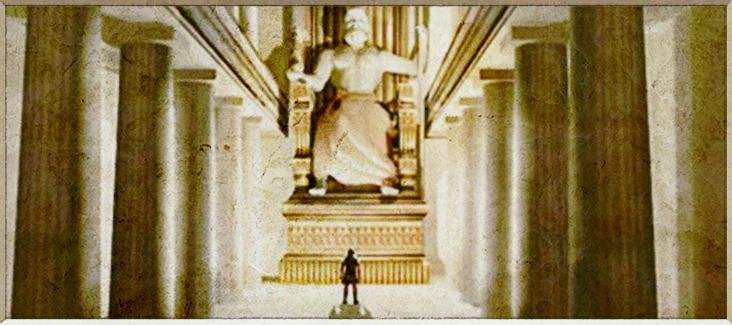
Effect: The Statue of Zeus gives a +4 bonus to population loyalty in all settlements.
Where: Aigion, in Achaia, held at the campaign start by Achaean League.
The Great Temple at Olympia houses a magnificent gold and ivory statue of Zeus, the father of the Gods - possibly the greatest statue ever made in the Greek world. The Temple itself was built by Libon in 450 BC and, although impressive in itself, was not felt to be sufficiently great for such an important site. The Athenian sculptor Pheidas was given the sacred task of constructing a truly majestic statue of Zeus. His skills were such that he created a seated Zeus that looked as if he would knock down the Temple if he ever stood up! The effect of this 13m tall figure was awe-inspiring, exactly as intended.
Hanging Gardens of Babylon
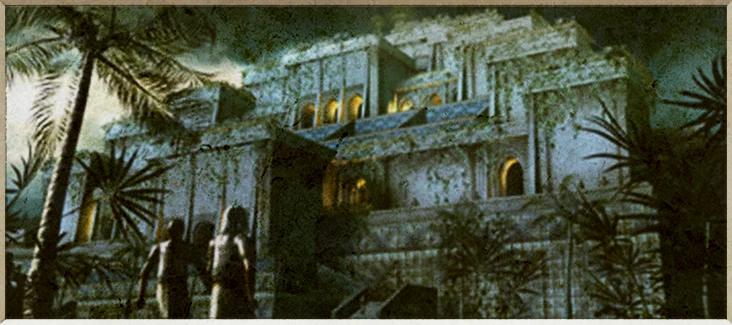
Effect: The Hanging Gardens give a 20% bonus to farming income in all settlements.
Where: Babylon, in Babylonia, held at the campaign start by Seleucid Empire.
The Gardens were attributed by the Greeks to Nebuchadnezzar II (604 BC - 562 BC), who was said to have created them to please his wife or concubine from Medea, who had a "passion for mountain surroundings". Whatever the truth of the matter, when Alexander's soldiers returned from Mesopotamia, they told tales of the wonderful ancient land and its gardens that they had seen. The cunning irrigation systems and many terraces of plants and trees, all in the middle of a desert landscape, were seen as a wonderful luxury and a work of genius. Babylonian records, oddly, do not have any references to the Hanging Gardens...