
Mercenary Dalmatian Footmen
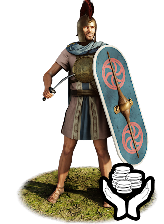

Mercenary. Hired from a regional pool, not recruited from a building.
Class: light · Category: infantry · Men per unit: 40
Description
Dalmatian Footmen form the mass of most Delmatae armies, being a flexible infantry unit that combines Illyrian tactics with some innovative equipment adapted from the Scordisci Celts. They fight in close Illyrian style and harass their enemies with deadly javelins, close in with a fearsome charge to use their Sibyna spears and Pecine knives, and are able to hold the line should the need call for it using their strong thureos shields. The Delmatae have constantly fought to expand their realm, so many Footmen have looted enough to be able to afford helmets of Shmarjet or Illyrian make, and even occasionally wear a bronze pectoral chestplate. The Delmatae were a fierce, pugnacious people, as testified by their warriors being immortalised in a Roman triumphal carving!
Historical background
When describing the Delmatae, Strabo (VII.5.5) showed off some of their ‘alien’ customs. They had a ‘peculiar custom of making a redistribution of their land every seven years’, and perhaps even stranger to him, they did not use coined money, ‘as compared with others in that part of the world’. This last claim is probably unsurprising to most modern readers, as a non-monetary economy was typical of many barbarian peoples (Sasel Kos, Peoples on the Northern fringes of the Greek World (2011), p. 623). The Delmatae proved curious even among other Illyrian peoples such as the Illyrian kingdoms of Ballaeus, Genthius, and the Daorsi (a tribe who were notable for minting money), because the Delmatae had an markedly alternative habit of taking tribute in grain and livestock from their subdued neighbours (Strab. VII.5.5). The Delmatae proved fairly successful conquerors by the mid-2nd to the 1st century BC, with Polybius describing their territory as being carved from several other powers including the Issaian settlements of Tragurium and Epetium, and reaching up to the coastal town of Salona (Polyb. XXXII.9). Strabo (VII.5.5) further elaborated on later Dalmatian territorial gains, saying that they held ‘some fifty important settlements, some of which were veritable towns, such as Salona, Promona, Ninia, as well as new and old Sinotium’. It is likely that the Delmatae managed to subdue various indigenous peoples, such as the Bulini, Nesti, Hilei, and Tariotes, who ranged across the pass of Klis into the Manian Bay (Sasel Kos (2011), p. 627). Salona itself later became an important colony of the Romans, eventually developing into the capital of the province of Dalmatia.
The Romans documented that the Liburnians and other coastal tribes were more developed and cultured after the Roman ways than their Delmatae neighbours, although they all became more Romanised over time (Sasel Kos, Appian and Illyricum (2005), p. 244). However, that is not to say the Delmatae had no developments of their own, as they were quite renowned hillfort builders. For example, a fortress on a hill named Lib was found to be an acropolis for a much larger settlement that lay further down its hill. This proto-urbanised site had key defensive points secured by a multitude of smaller defensive mounds, which had additional use as burial mounds (Wilkes, The Illyrians (1996), p. 192).
The Delmatae were a significant power in their region, so much so that the Roman conquerors of Illyria under Vespasian named their province ‘Dalmatia’ after them (Sasel Kos (2005), p. 242). This Roman habit had some precedence even from before their conquest, for example in correspondence between eminent Romans such as Cicero and Vatinius, who discussed hoping to find a lost slave in the lands of the ‘Vardaei’ (Ardiaei) rather than in Dalmatia, where recovery would be much more problematic. This letter also explains that the Delmatae had expanded significantly from twenty towns to a total of sixty towns in Vatinius’ time (Sasel Kos (2005), pp. 291-2). This not only shows that this geographical area was associated with the Dalmatians, but also gives some hint of the more intransigent or antagonistic nature that they held towards the Romans at the time, as well as the threat they posed.
The Dalmatian Footmen in RIS represent the rank and file tribal warriors of a culture that combined Illyrian methods of warfare with Celtic technology. Historical findings support this cultural amalgamation, with records of Dalmatian names having both Celtic and Illyrian origin, indicating influences from the Liburni, “Real Illyrians”, as well as the Pannonians. Other Dalmatian names are found in common with southern Illyrian groups, too, although their origin appears to be Northern not Southern Illyria. John Wilkes affirms that Delmatae nomenclature is more varied than Southern Illyrian groups, often having both a personal name, and a family name with a patronym at the end, such as Plator Carvius Batonis (filius) or Aplis Lunnicus Triti (filius). Furthermore, a local variation of this convention appears to have the family name included in the patronymic formula, Platino Platoris Tizi filia, 'Platino, daughter of Plator Tizus' (Wilkes (1996), pp. 75-6).
The hybridised culture of the Delmatae is exemplified by their weapons being fairly similar to those of other Illyrians, their footmen using Pecine knives, javelins, and spears, while the influence of their Scordisci allies and Celtic La Tene culture is shown by their adoption of the thureos shield as well as some Celtic style helmets. Celtic influence would have been integrated into Dalmatian warfare and material culture for some time by our mod’s start date, as they had been allies of the Scordisci by at least 156 BC, and likely been in touch with Celtic culture for some time before (Lazic, The Celts and the Scordisci within the Territory of Serbia (2017), p. 75). The final evidence for their equipment is shown by the Roman triumphal stone carving of Delmatae from the 80s BC. The stone carving took measure of what the Romans defeated, displaying a Dalmatian in a linothorax with round metal breastplate wielding a thureos. Furthermore, even as early as the 3rd or 2nd century BC, a stela from Borcani shows a round, pectoral armour piece as part of the Dalmatian panoply (Pijerov, Oprema Deltaskog Ratnika (2018)). The Dalmatian Footmen were too poor to have afforded nor imported a linothorax, but nevertheless could afford the more locally produced forms of body protection, such as the Borcani pectoral armour.
Stats
| Rank in roster | ||
|---|---|---|
| Men per unit | 40 | ███······· 30% |
| Attack | 16 | ████████·· 80% |
| Charge bonus | 16 | ███████··· 69% |
| Defence | 36 | ██████···· 61% |
| · armour | 4 | ███······· 33% |
| · defence skill | 27 | █████████· 85% |
| · shield | 5 | ██████···· 57% |
| Morale | 12 | ██████···· 57% |
| Discipline | Normal | |
| Training | Untrained | |
| Upkeep per turn | 672 dn | ██████···· 60% |
Weapons
| Primary | Secondary | Primary | Secondary | Primary | Secondary | Primary | Secondary | ||||
|---|---|---|---|---|---|---|---|---|---|---|---|
| Attack | 16 | 9 | Charge bonus | 16 | 18 | Type | thrown · blade | melee · blade | Damage | piercing | slashing |
| Projectile | javelin | — | Range | 50 | — | Ammunition | 2 | — | Properties | Used just before charging into combat | Armour-piercing (counts only half the target's armour) |
Defence
| Primary | Secondary | Primary | Secondary | Primary | Secondary | Primary | Secondary | ||||
|---|---|---|---|---|---|---|---|---|---|---|---|
| Total | 36 | — | Armour | 4 | — | Defence skill | 27 | — | Shield | 5 | — |
Condition and terrain
| Hit points | 1 | Ground: scrub / sand / forest / snow | 0 / -1 / 0 / -1 | Charge distance | 30 | Formations | Square |
Technical stats
| Time between blows (primary / secondary) | 2.5 s / 2.5 s | Extra fatigue in hot climates | 0 | Collision mass per man (1.0 is normal) | 0.98 | Spacing between men: close / loose | 1 × 1.2 m / 2 × 2.4 m |
| Default ranks | 5 |
In battle: Can hide in long grass · Can sap · Very good stamina
Where to hire it
Mercenaries are hired from a regional pool, not recruited from a building. This unit is offered by 1 pool covering 2 regions, at 4,574 dn to hire and 2 experience.
Mercenary pool: Dalmatia
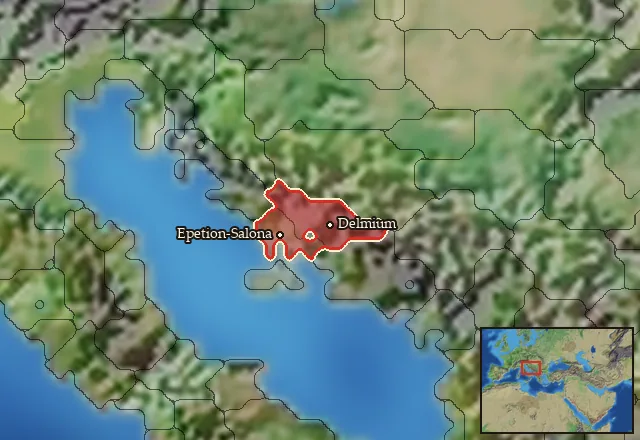
At least one of those pools sells to any faction that has an army in range, with no faction restriction.