
Mercenary Gortynian Thureophoroi
Mercenary. Hired from a regional pool, not recruited from a building.
Class: spearmen · Category: infantry · Men per unit: 40
Description
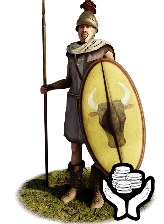
The proliferation of thureophoroi in Hellenistic militaries reached even the island of Crete. Here, they were utilised in much the same fashion as they were used by the warring polities of the mainland, with some regional variations. The Gortynian Thureophoros traded in his javelins for a short sword (xiphos), while his shield (thureos) was slightly curved compared to those of his foreign contemporaries. More typical were their clothing and protective equipment. The Gortynian Thureophoroi wore a mix of helmet styles, tunics, linothorakes with pteryges, as well as, occasionally, bronze greaves.
While one might see the Gortynian Thureophoroi as hamstringed due to their lack of javelins, the true value of this unit lies in their mobility as a spear-armed unit. They are best-utilised as a mobile reserve, or deployed on the flanks, where they will acquit themselves well in close-quarter combat and flanking manoeuvres.
Historical background
‘‘Gortyna was one of the trio of great Kretan towns, and is called by Homer ‘the well-walled’.” – (Merriam, Law Code of the Kretan Gortyna (1885), p. 325)
Also known as Gortyn or Gortys, the city was supposedly home to the tree under which Zeus and Europa spent their first night together. This is not the only time that Gortyn is linked with Greek mythology, as it also makes an appearance in Homer’s Odyssey, as well as in the Iliad. It is said that the Cretans of Knossos and Gortyn were led by “the famous spearman Idomeneus” (Hom., Illiad 2.646). Gortyna had already been settled during the Minoan period, where it was subject to the rule of the city-state Phaistos (Bennet, Knossos in Context (1990), p. 200).
It was sometime in the 3rd or 2nd century BC that Gortyn would subjugate Phaistos during its period of expansion, which saw Gortyna attempting to partition Crete between itself and Knossos with the Lyttian war of 220-216 BC. This caused internal strife in Gortyn, however, which saw the young men of Gortyna oppose the war against Lyttos (Polyb. 4.53). It is hypothesised that the dominant position of Gortyna and Knossos may, without external interference, have continued to result “in the eventual division of the island into larger territories [… ] under a number of “super-states,” such as […] Gortyna” (Bennet, Knossos in Context (1990), pp. 201-203). Though Polybius (4.53) attests that Gortyna along with Knossos “had a short time previously reduced the whole island under their control”, the long-term partitioning of Crete between “super-states” did not occur, and Crete was ultimately conquered in the 1st century BC, where Gortyna was established as the capital of the Roman province of Crete.
Thureophoroi were widely available as mercenaries throughout the Hellenic world, and were typically deployed along the flanks of the heavily armoured hoplite phalanx (Ma, Fighting poleis of the Hellenistic World (2009), p. 357). The thureophoroi fulfilled their role as a mobile reserve, capable of reinforcing faltering troops or being committed to the defence of an army’s flanks (Taylor, Celtic Military Equipment in the Ancient Mediterranean (2024), p. 591). In RIS, the Gortynian Thureophoroi are distinguished from their counterparts by their equipment. Their oval shields are slightly curved, and they lack the javelins that other thureophoroi units possess. This distinction is based on a Gortynian stele from the Heraklion Archaeological Museum, which is dated to the late 3rd or early 2nd century BC, which presents a thureophoros with a xiphos (short sword) and spear, with a bent thureos (shield) and without any javelins. They are armoured in a similar fashion, however, bearing plumed Konos helmets, as well as Thracian, Chalcidian, and Askalon helmets. This compliments their mix of Greek tunics and linothoraxes with pteryges and occasional bronze greaves.
Stats
| Rank in roster | ||
|---|---|---|
| Men per unit | 40 | ███······· 30% |
| Attack | 13 | ██████···· 57% |
| Charge bonus | 10 | ████······ 35% |
| Defence | 41 | ████████·· 76% |
| · armour | 6 | ████······ 38% |
| · defence skill | 30 | █████████· 93% |
| · shield | 5 | ██████···· 57% |
| Morale | 12 | ██████···· 57% |
| Discipline | Normal | |
| Training | Highly trained | |
| Upkeep per turn | 678 dn | ██████···· 62% |
Weapons
| Primary | Secondary | Primary | Secondary | Primary | Secondary | Primary | Secondary | ||||
|---|---|---|---|---|---|---|---|---|---|---|---|
| Attack | 13 | — | Charge bonus | 10 | — | Type | melee · blade | — | Damage | piercing | — |
| Properties | Light spear (braced against cavalry charges from the front) · +8 attack against cavalry | — |
Defence
| Primary | Secondary | Primary | Secondary | Primary | Secondary | Primary | Secondary | ||||
|---|---|---|---|---|---|---|---|---|---|---|---|
| Total | 41 | — | Armour | 6 | — | Defence skill | 30 | — | Shield | 5 | — |
Condition and terrain
| Hit points | 1 | Ground: scrub / sand / forest / snow | -1 / -1 / -4 / -1 | Charge distance | 30 | Formations | Square |
Technical stats
| Time between blows (primary / secondary) | 2.5 s / — | Extra fatigue in hot climates | 0 | Collision mass per man (1.0 is normal) | 1.03 | Spacing between men: close / loose | 1 × 1.2 m / 2 × 2.4 m |
| Default ranks | 5 |
In battle: Can sap · Very good stamina
Where to hire it
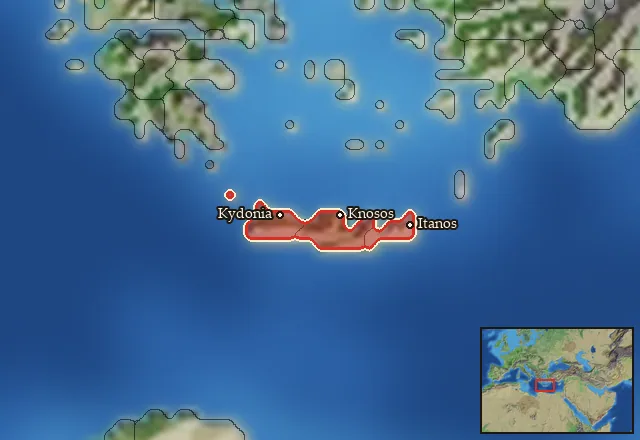
Mercenaries are hired from a regional pool, not recruited from a building. This unit is offered by 1 pool covering 3 regions, at 4,138 dn to hire and 0 experience.
Mercenary pool: Crete
At least one of those pools sells to any faction that has an army in range, with no faction restriction.
The 3 regions where this unit appears in a mercenary pool
Itania · Kydoniatis · Minoa