
Mercenary Ionian Epibatai
Mercenary. Hired from a regional pool, not recruited from a building.
Class: missile · Category: infantry · Men per unit: 40
Description
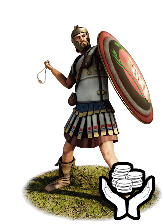
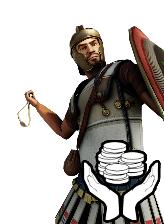
Ionian Epibatai are the marines of Ionian cities and islands such as Miletos and Chios. Their mastery of the art of the sling can be devastating to their opponents. When in close combat, these Epibatai switch to common swords. For protection, they trust on their large wooden aspides shields covered with bronze. They wear bronze helmets that cover a large part of the head. Some of the men wear Attic helmets, with or without a crest. This weaponry makes them durable, both as skirmishers and as supporting infantry. Epibatai should open the battle by hurling objects at opposing skirmishers and archers. Due to their large shields, they can run inside the range of unarmoured enemy archers and take them out in a prolonged skirmish. Hailing from a wealthy region, the Ionian Epibatai can afford linothorax armour. While it is dangerous to wear armour at sea, on land it can save the life of many a skirmisher!
Historical background
Ionia, the central part of the western coast of Anatolia, was settled by Ionian Greeks during the 11th century BC, after the Ionians themselves had been pushed out of the northern Peloponnesos by the Achaians (Hdt. 1.145). After this so-called Bronze Age collapse, the area slowly recovered. Bounded by their mythical ancestor Ion, they formed a league (koinón Iōnōn) in the middle of the 7th century BC compromising Miletos, Myous, Priene, Ephesos, Kolophon, Lebedos, Teos, Klazomenai, Phocaia, Chios, Erythrai and Samos. Herodotus (Ibid.) judges that twelve Ionian groups had left the Peloponnesos and that each settled its own city or land. This league ended the ‘barbarian’ Carian state and divided its lands. The Ionian League was later unsuccessfully used to counterbalance the threat of Persia and other larger powers. As a common mythical background was important to the peaceful coexistence of the cities, religious festivals provided some common ground. Around 289 BC, Smyrna, a city of the Aeolic tribes but under the influence of Kolophon, was admitted to the league (Kholod, On the Ionian League in the Fourth Century BC, Studia Antiqua et Archaeologica 26-2 (2020), p. 206). The League evolved into a cultural and religious council and feast. Politically, the Ionians remained divided between independent cities and the Seleucid and Ptolemaic Kingdoms. Perhaps, you should unite the Ionians under one banner. In that case these Epibatai will come in handy!
In the Aegean of the 3rd century BC, fleets were vital to support armies, defend trade routes, and to raid enemy lands. The Ionians were capable seamen, hailing from a trading hub of goods (and ideas). Fleets tried to outmanoeuvre and ram the opposing ships while pelting the enemy with stones, arrows, and spears, but if that did not work the Epibatai (“Those who board” / “Marines”) had to conduct boarding actions. These boarding actions were conducted with swords (Herzogenrat-Amelung, Naval Hoplites: Social Status and Combat Reality of Classical Greek "epibatai" (2017), p. 46). We know that the inhabitants of Chios assigned 40 wealthy citizens as Epibatai to each of their ships during the Ionian Revolt (499-493 BC) (Hdt. 6.15.2) and the Athenians only put ten Epibatai on their triremes during the Peloponnesian War (431-402 BC) (Herzogenrat-Amelung (2017), pp. 47-48). So it depended on the wind, type of ship, and the tactic employed to determine how many Epibatai would embark. Ten Epibatai per ship was probably the norm (Herzogenrat-Amelung (2017), p. 49), but perhaps the Ionians preferred more. If the fight was in a harbour, a narrow space, or a landing action, more Epibatai would be embarked. Thucydides quotes the Athenian commander Nikias making such a consideration: “A number of archers and darters will go on board, and a multitude that we should not have employed in an action in the open sea, where our science would be crippled by the weight of the vessels; but in the present land-fight that we are forced to make from shipboard all this will be useful.” (Thuc. 7.62.2). The Epibatai were free men that commanded and controlled the sailors on the loud and unruly sea (Thuc. 2.84 & Herzogenrat-Amelung (2017), p. 53).
Klazomenai, Miletos, and probably other Ionian cities still operated fleets and the necessary Epibatai in the 1st century BC. Asklepiades of Klazomenai and Meniskos of Miletos are attested in 78 BC by the Roman senate to have served as captains in the fleet of Sulla. Therefore, they received the title "friends of the Roman people" (Coskun, Amici Populi Romani (2021), p. 162).
The Ionian Epibatai wear armour on land. Probably not at sea, as a linothorax a would be their undoing if they would fall overboard (Ioannidou, Hellenic Marine Forces in Late Bronze Age Greece (2018), p. 10; Herzogenrat-Amelung (2017), p. 47). The armour would start to suck in water and become increasingly heavy. Being a wealthy region, it is likely linothorax armour was available to the Ionians to a degree Epibatai would wear it. In addition they wear bronze Attic helmets (see coinage BMC 48, Phocaea, Ionia, Electrum Hekte) and large Aspis shields. The Attic helmet, known for its lightweight design, stood out among Greek helmets for offering full facial visibility (Obert, A Brief History of Greek Helmets, AncientPlanet Online Journal Vol. 2 (2012), p. 50). It features a short neck guard, allowing for greater comfort and leaving ample room around the ears. The hinged cheek guards were unique, as they could be adjusted or even removed entirely. This innovative design balanced protection with increased visibility, making it a practical choice for Epibatai on both land and sea. The Aspis shields were held by an armband (porpax) right before the left elbow, while the hand gripped a leather handle (antilabe). This enabled the Epibatai to support the weight (on average weighting 6.2 kg or 13.7 pounds) on both the elbow and the wrist. This mechanism also made it possible to use shield and sling at the same time. The shield was not very thick, reducing its effectiveness against arrows and javelins (Fink, The Battle of Marathon in Scholarship (2014), pp. 31-34). Therefore, some skirmishers would prefer a smaller shield. Epibatai, however, were expected to fight in melee as light infantry, and preferred the Aspis. The Ionians still produced coins under Augustus with a Greek warrior wielding an aspis shield (RPC 2495).
Greek slingers used a long sling, and in war the ammunition was ideally lead shot, weighing around 0.7-1.05 ounces (20-30 grammes) but occasionally up to 1.9 ounces (55 grammes). Sling-missiles would usually be carried in the fold of the cloak, behind the shield or in special pouches. Bullets were often inscribed with the name of the commander (Echols, ‘The Ancient Slinger’, pp. 227-228). Such leaden bullets were shaped like an almond, tapering to a dull point at the end, which gave the bullet a whirling motion that increased its penetrating power. This lead shot easily outranged the stone shot of the Persian slingers and sometimes even the range of their archers (Xen. Anab. 3.4.18). As melee weapons, the Ionians used straight iron swords, despite evidence that the curved machaira became more popular during this period. These swords are also attested on the Pergamon reliefs (Everson, Warfare in Ancient Greece (2004), p. 119).
Stats
| Rank in roster | ||
|---|---|---|
| Men per unit | 40 | ███······· 30% |
| Attack | 7 | █········· 6% |
| Charge bonus | 10 | ████······ 35% |
| Defence | 36 | ██████···· 61% |
| · armour | 10 | █████····· 54% |
| · defence skill | 21 | █████····· 54% |
| · shield | 5 | ██████···· 57% |
| Morale | 11 | ████······ 39% |
| Discipline | Normal | |
| Training | Trained | |
| Upkeep per turn | 732 dn | ███████··· 70% |
Weapons
Its secondary attack is the stronger one: 10 against 7.
| Primary | Secondary | Primary | Secondary | Primary | Secondary | Primary | Secondary | ||||
|---|---|---|---|---|---|---|---|---|---|---|---|
| Attack | 7 | 10 | Charge bonus | 10 | 12 | Type | missile · archery | melee · blade | Damage | blunt | piercing |
| Projectile | stone | — | Range | 150 | — | Ammunition | 27 | — |
Defence
| Primary | Secondary | Primary | Secondary | Primary | Secondary | Primary | Secondary | ||||
|---|---|---|---|---|---|---|---|---|---|---|---|
| Total | 36 | — | Armour | 10 | — | Defence skill | 21 | — | Shield | 5 | — |
Condition and terrain
| Hit points | 1 | Ground: scrub / sand / forest / snow | 0 / -1 / 0 / -1 | Charge distance | 30 | Formations | Square |
Technical stats
| Time between blows (primary / secondary) | 2.5 s / 2.5 s | Extra fatigue in hot climates | 1 | Collision mass per man (1.0 is normal) | 1.11 | Spacing between men: close / loose | 1.2 × 1.4 m / 2.4 × 2.8 m |
| Default ranks | 5 |
In battle: Can sap · Very good stamina
Where to hire it
Mercenaries are hired from a regional pool, not recruited from a building. This unit is offered by 3 pools covering 9 regions, at 3,483 dn to hire and 2 experience.
Mercenary pools: Aegean Islands · Euboia · Ionia
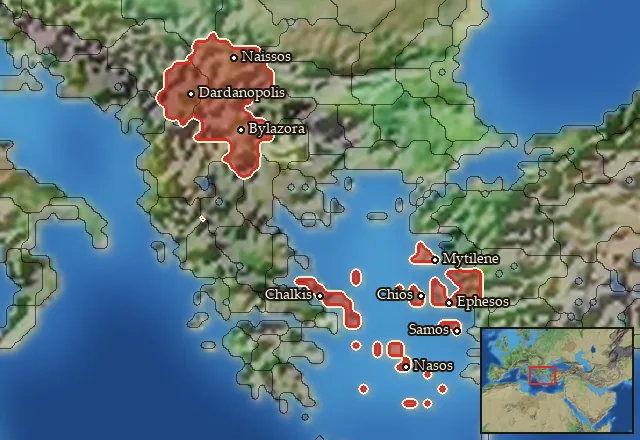
At least one of those pools sells to any faction that has an army in range, with no faction restriction.