
Mercenary Paphlagonian Javelinmen
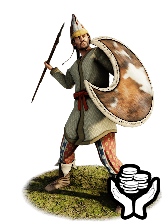

Mercenary. Hired from a regional pool, not recruited from a building.
Class: missile · Category: infantry · Men per unit: 40
Description
"We fought the Persians, we fought the Macedonians, and we have bled all who dared cross our lands in arms. We shall continue to do so for as long as we value our freedom!"
Light-footed, capable of hurling javelins with great accuracy, and to strike with sharp spears once in close range, these highland Paphlagonian Javelinmen are exceptionally dangerous when faced in the rugged, mountainous terrain of their homeland. In terms of equipment, they forego heavy armour in favour of mobility, carrying only a small shield for basic protection. They are dressed in short sleeve tunics, a pair of their native shoes that reach midway to the knee, topped off with woven helmets or Phrygian caps on their heads.
Historical background
The Kingdom of Paphlagonia was situated along the Euxine (Black Sea) coast between Bithynia and Pontos, and often found its autonomy endangered due to the ambitions of its neighbours. This vulnerability prompted an alliance between Mithridates of Pontos and Nicomedes of Bithynia, who invaded Paphlagonia and divided its territory between them. Alarmed by this aggressive expansionism, the Roman Republic declared Paphlagonia a free state. They forced Mithridates and Nicomedes to release their hold on the territory, thus planting the seed for the subsequent Mithridatic Wars. Capitalising on Rome’s being distracted during the civil wars in Italy, Mithridates swept through Asia Minor and reclaimed his former regional dominance. He deployed puppet leaders, such as Socrates Chrestos (sometimes referred to as Pylaimenes) to govern the territory on Pontos’ behalf. Mithridates maintained his grip on Paphlagonia until the conclusion of the First Mithridatic War, at which point he was compelled to relinquish his dominion over the region. (Klinkott, ‘Mithridates VI and the Formation of an Empire’, in: Droß-Krüpe et al. (eds.), Societies at War (2020), pp. 421-456). However, following the decisive victories of the Roman general Pompey the Great, Mithridates was defeated and driven into exile. Pompey subsequently integrated coastal Paphlagonia into the new Roman province of Bithynia and Pontus.
The Paphlagonians were well-known for having retained their independence for a surprisingly long time, while being surrounded by more powerful kingdoms, as well as for their military contributions to neighbouring powers, particularly as light infantry. While specific historical records about the Paphlagonians are scarce, they nevertheless constituted some of the most fearsome warriors in the region and appear throughout the histories. The Paphlagonians were already known to the Greeks in the Archaic period, listed among the allies of the Trojans in the Iliad, where their king Pylaimenes and his son Harpalion perished (Hom. Il., ii. 851–857). Later, King Otys of Paphlagonia supports Agesilaos with a thousand horsemen and two thousand peltasts. Xenophon also speaks of them as being governed by a prince of their own, without any reference to the neighbouring satraps, a freedom perhaps thanks to the nature of their country, with its lofty mountain ranges and difficult passes (Xen. Hell. 4.1.13).
Accordingly, these javelinmen are recruited from the free peasantry and fierce mountain clans, communities long accustomed to border raids and tribal warfare. While their equipment is basic, their skill with the javelin should not be underestimated. As the historian John Ma notes in his analysis of the Çan Sarcophagus (2008), the Paphlagonians were defined first and foremost as light, small-shielded skirmishers, a tradition that influenced both their infantry and (later) their cavalry.
Stats
| Rank in roster | ||
|---|---|---|
| Men per unit | 40 | ███······· 30% |
| Attack | 10 | ██········ 19% |
| Charge bonus | 1 | █········· 4% |
| Defence | 17 | █········· 13% |
| · armour | 2 | █········· 13% |
| · defence skill | 13 | █········· 13% |
| · shield | 2 | ███······· 25% |
| Morale | 4 | █········· 0% |
| Discipline | Low | |
| Training | Untrained | |
| Upkeep per turn | 300 dn | █········· 9% |
Weapons
| Primary | Secondary | Primary | Secondary | Primary | Secondary | Primary | Secondary | ||||
|---|---|---|---|---|---|---|---|---|---|---|---|
| Attack | 10 | 4 | Charge bonus | 1 | 1 | Type | thrown · archery | melee · blade | Damage | piercing | piercing |
| Projectile | javelin | — | Range | 60 | — | Ammunition | 7 | — | Properties | Thrown | — |
Defence
| Primary | Secondary | Primary | Secondary | Primary | Secondary | Primary | Secondary | ||||
|---|---|---|---|---|---|---|---|---|---|---|---|
| Total | 17 | — | Armour | 2 | — | Defence skill | 13 | — | Shield | 2 | — |
Condition and terrain
| Hit points | 1 | Modifier against mounts | horse +1 · chariot +1 · camel +1 | Ground: scrub / sand / forest / snow | 8 / 0 / 8 / 0 | Charge distance | 30 |
| Formations | Square |
Technical stats
| Time between blows (primary / secondary) | 2.5 s / 2.5 s | Extra fatigue in hot climates | 0 | Collision mass per man (1.0 is normal) | 0.84 | Spacing between men: close / loose | 1.1 × 2.6 m / 1.98 × 4.68 m |
| Default ranks | 5 |
In battle: Very good stamina
Where to hire it
Mercenaries are hired from a regional pool, not recruited from a building. This unit is offered by 2 pools covering 4 regions, at 3,239 dn to hire and 0 experience.
Mercenary pools: Paphlagonia Interior · Paphlagonia Main
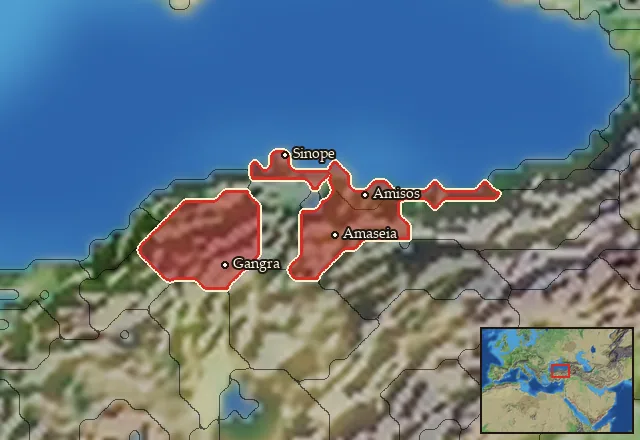
At least one of those pools sells to any faction that has an army in range, with no faction restriction.
The 4 regions where this unit appears in a mercenary pool
Paphlagonia · Pontos · Saramene · Sinopeia