
Argive Epilektoi
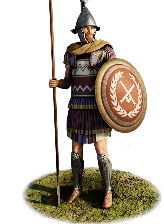
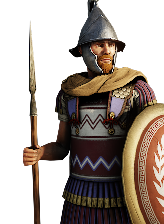
Class: spearmen · Category: infantry · Men per unit: 40
Reforms: Unlocked by The Decree of Aratos
Description
The best men of Argos now serve the Achaian League in their traditional equipment. Traditionally armed with heavy body armour, these Hoplites have been selected from the strongest younger and the most experienced older men of Argos. The Wolf’s head so prominent on their shields alludes to the myth of Danaos, the progenitor of the Danaans. When he came to Argos, the Argives were reluctant to choose him as their king, but when they saw a lonely wolf killing the leader of a herd of bulls, they understood the allegory and chose to submit themselves to Danaos. The age of kings and tyrants alike has now gone and these men will serve the Achaian League well.
Historical background
Argos is one of the oldest continuously settled cities in Europe. From its position on the Eastern Peloponnese, sitting just above the end of the Argolic Gulf, it controls the fertile Argive plain and the mountainous Akte to the East, which ends at Hermione. From the earliest times onwards, it was one of the largest cities of Greece, as the role of Diomedes of Argos and his contingent in the Trojan War demonstrates (for this, see TW: Troy ;)). Its famous rivalry with Sparta went back to Archaic times, when the Hoplite Phalanx may have originated in Argos. In the 6th century, the conflict between the two Poleis concentrated on the landscape known as Thyrea which lay south of Argos. After a lengthy war, they agreed to decide the outcome of the fighting by what Herodotus called the "Battle of the 300 Champions". Only three Argives and one Lakedaimonian survived the slaughter, but since the Argives left the battlefield to their injured enemy they had thought dead, Sparta could still claim victory (Hdt. I, 82).
At any rate, the Lakedaimonians seem to have gained the upper hand by the end of the century and Argos did not take part in the war against the Persians because they would not fight together with their arch-rivals. In the Peloponnesian and Corinthian Wars, Argos repeatedly took the side of Sparta's enemies and for a short time annexed Corinth in 392 BC. Yet, the rise of Thebes and Macedon in the 4th century BC condemned Argos to the status of a mere regional power in the eastern Peloponnese. The great line of kings, which traced itself back to the times of Perseus, ended in 460 BC, and Argos was ruled by a democratic government for almost two centuries. After it found itself on the losing side during the Lamian War of 323/322 BC, the city came under increasing Macedonian influence. By the early 3rd century BC, tyrants who supported the Antigonid case controlled the Polis and its territory (Liv. XXXIV, 26). In 270 BC, at the start of the RIS campaign, it was ruled by one Aristippos. His rival Aristeas had tried to oust him by calling Pyrrhos to intervene in 272 BC, but after Aristippos survived the attack, his tyranny was safe (Plut. Pyrrhos 30,2). At an unknown point, his son Aristomachos followed him on the throne. He is known as an ally of Athens: together, they fought against the Antigonid usurper Alexander of Corinth (IG II² 774). In 240 BC, however, Aratos of Sikyon (271-213 BC), leader of the Achaian League, tried to remove Aristomachos and to incorporate Argos into the confederation. Even though he failed, the tyrant was murdered by his slaves soon thereafter (Plut. Aratos 25, 4).
Next in line was his son Aristippos II, the grandson of the older Aristippos. Again, our sources, the Achaian historian Polybios and all later writers for whom Polybios was the main source, depict him as a violent, bloodthirsty despot, but this image is at least tendentious. Aratos of Sikyon continued to attack Argos and eventually had Aristippos killed in an ambush near Kleonai in 234 BC (Plut. Aratos 27-29). His daughter Apis would later marry Nabis (ca. 230-192 BC), the tyrant of Sparta (IG IV² 621), while his brother, Aristomachos II, managed to secure Argos for himself. When Demetrios II Aitolikos (born 275 BC, reigned from 239 BC), Antigonid king of Macedon, passed away in 229 BC, Aratos offered Aristomachos 50 talents to retire. The tyrant realised that the Achaian League had become the foremost power on the Peloponnese and that it may have become difficult to hold on to his throne, so he agreed on the condition to be made Strategos of the confederation – to which the Achaians agreed (Plut. Aratos 35; Polyb. II,44,6; Paus. II,8,6). Yet, when Kleomenes III of Sparta (254-219 BC) began his war against the league in the following year, Aristomachos was quickly replaced. Disappointed by his new allies, he betrayed Argos to the Spartans (Plut. Aratos 35; Kleomenes 4; Polyb. II,60,6). Finally, in 224 BC, the Argives had become fed up with Lakedaimon and rejoined the Achaian League – in the course of these events Aristomachos, the last tyrant of Argos, drowned in the sea.
Little is known about the army of Argos in this period, but in 217 BC the decree of Aratos for the Achaian army mentions that five hundred picked foot soldiers and fifty horsemen (Epilektoi) should be kept under arms at all times (Polyb. V, 91, 6). We can only speculate about their equipment, but since there seem to have been no great military reforms in the 3rd century BC, they were most likely Hoplites. In 418 BC, Argos had established a corps of 1,000 Hoplite Epilektoi (Spence, Dictionary of Ancient Greek Warfare 2002, p. 63). This unit probably survived in reduced form and it is logical that Argos should provide a sizeable elite contingent to the Achaian confederation, just like Megalopolis, the other large member city at the time, did (Kralli, Hellenistic Peloponnese 2017, p. 277).
Stats
| Rank in roster | ||
|---|---|---|
| Men per unit | 40 | ███······· 30% |
| Attack | 11 | ███······· 34% |
| Charge bonus | 17 | ███████··· 71% |
| Defence | 51 | ██████████ 95% |
| · armour | 12 | ███████··· 69% |
| · defence skill | 32 | ██████████ 97% |
| · shield | 7 | █████████· 91% |
| Morale | 12 | ██████···· 57% |
| Discipline | Normal | |
| Training | Highly trained | |
| Recruitment cost | 2,149 dn | ██████···· 56% |
| Upkeep per turn | 787 dn | ████████·· 76% |
| Turns to recruit | 4 |
Weapons
| Primary | Secondary | Primary | Secondary | Primary | Secondary | Primary | Secondary | ||||
|---|---|---|---|---|---|---|---|---|---|---|---|
| Attack | 11 | — | Charge bonus | 17 | — | Type | melee · blade | — | Damage | piercing | — |
| Properties | Light spear (braced against cavalry charges from the front) · +8 attack against cavalry | — |
Defence
| Primary | Secondary | Primary | Secondary | Primary | Secondary | Primary | Secondary | ||||
|---|---|---|---|---|---|---|---|---|---|---|---|
| Total | 51 | — | Armour | 12 | — | Defence skill | 32 | — | Shield | 7 | — |
Condition and terrain
| Hit points | 1 | Ground: scrub / sand / forest / snow | -1 / -1 / -4 / -1 | Charge distance | 30 | Formations | Square |
Technical stats
| Time between blows (primary / secondary) | 2.5 s / — | Extra fatigue in hot climates | 3 | Collision mass per man (1.0 is normal) | 1.29 | Spacing between men: close / loose | 1 × 1.05 m / 2 × 2.4 m |
| Default ranks | 5 |
In battle: Can sap · Very good stamina
Who can recruit it
A core roster unit for one faction, which can raise it anywhere it holds the right building:
A further 1 faction can raise it in the provinces below.
Exactly what a settlement must have, route by route (4)
| Building | Also requires | Building | Also requires | Building | Also requires | Building | Also requires |
|---|---|---|---|---|---|---|---|
| Direct Rule | Tier 3 Military Industrial Complex · Tier 2 Colony | Direct Rule | Tier 3 Military Industrial Complex · The Decree of Aratos · Argive area of recruitment · Tier 2 Colony | Homeland | Tier 2 Military Industrial Complex | Homeland | Tier 2 Military Industrial Complex · The Decree of Aratos · Argive area of recruitment |
Areas of recruitment
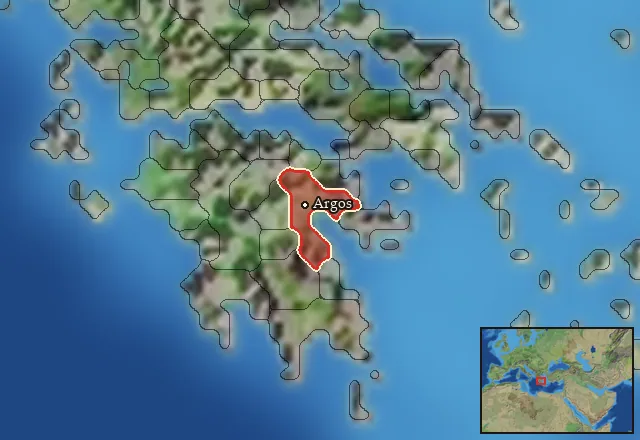
| Zone | Provinces | ||||||
|---|---|---|---|---|---|---|---|
| Argive | 1 |