
Description
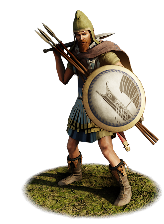
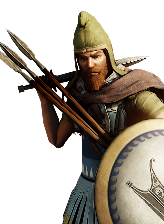
The Bithynian Promachoi are elite light infantry that outclasses normal peltasts. Crucial to the Bithynian style of warfare, they are efficient skirmishers and can pack a punch in melee, the unit being composed of particularly brave men. Their main weapon is the javelin, which they can throw with much precision from well over 50m afar. Should the enemy fire back, they can block missiles with their small, round pelte shields, or rely on their linen linothorakes. Some promachoi also wear Chalcidian bronze helmets, while Phrygian felt caps are enough for others. Light, short sleeved tunics and solid military boots allow them to run quickly across the battlefield. They carry xiphos type swords for melee. Therefore, the promachoi are an excellent peltast unit that can break up enemy formations as well as defend itself in close combat.
Historical background
‘‘One may come and pour tears on the tombs of cowards who have died an inglorious death through illness. But earth has received me, who fought near the flow of the Phrygian river for my fatherland and for my parents, as a man who died while fighting with others before the line, having first slain many enemies. For this, may someone praise the Bithynian Menas, the son of Bioeris, who exchanged light life with bravery.”
– Grave Stone of Menas, early 2nd century BC (Istanbul Archaeological Museum Inv. 1176, l. 1–8)
The stela of the Bithynian Menas is a fascinating artifact for many reasons. His tomb inscription portrays him as a brave warrior, which is not unusual, but he emphasises that he fought “before the line” (repeated in l. 14: μετὰ προμάχοισι δαμέντα). This makes him a so-called promachos, “the one who fights before the line”. The term is already attested in the Iliad, where many battles are decided by such promachoi: thus, Hektor fights as a promachos against nine Greek promachoi and kills them all in the 11th book (Il. 11.299-309), the promachos Aeneas secures the retreat of his men before the attacks of the promachoi Menelaos and Antilochos, the son of Nestor, in the fifth book (Il. 5.517-572), and the promachos Odysseus slays seven Lycian promachoi at once soon after (Il. 5.676-680). In Hellenistic Bithynia, these Homeric motifs were well-known and Menas - or those who erected the grave stele - was keen to allude to such heroism in his epitaph. Anyone who has played Total War: Troy will easily be able to imagine how the protagonists of the epic cycle fought in front of their lines and struck down countless enemies or duelled other famous individuals to decide a battle before the rest of the army had to be involved (for the function of the promachia, see: Latacz, Kampfparänese in der Ilias (1977)). But did that really still happen in the Hellenistic period? In an age when the tightly organised Macedonian phalanx ruled the battlefields of the Eastern Mediterranean and western Asia? When single warriors would have been easily hunted down by heavy cavalry or lethal archers such as the famed Cretan mercenaries?
In Greece, this seems unlikely indeed, but while the Hellenistic Bithynians were well-read, they were still Thracians. And like other Thracians, many Bithynians fought as peltasts (cf. Post, Ruben, The Bithynian Army in the Hellenistic Period (2022), p. 10). If the promachos of the Heroic age survived in one troop type at all, then it was as the peltast: expert skirmishers who could outrun other foot soldiers, pepper them from afar with javelins and - in difference to archers, slingers, or lighter javelinmen - survive in melee for a while if they had to. These and other reasons made the Canadian historian Ruben Post suggest that Menas does not just call himself promachos: he WAS a promachos (Post (2022), p. 10). In fact, such a blend between Thracian and Greek traditions would fit Bithynia in this period very well. While old customs survived, Greek poleis were created in Bithynia, the Greek language spread throughout the realm, and both Hellenic culture as well as Hellenistic kingship became widely accepted (Michels, Kulturtransfer und Monarchischer Philhellenismus (2008)). Peltasts still played a crucial role in the Bithynian army, and such promachoi would be the most courageous of the peltasts. Their bold behaviour would motivate others to follow their example, and such fighters would be extremely valuable in staving off attacks from more powerful enemies such as the Seleucids. In fact, Menas says that he fought together with other promachoi and successfully beat back an attack by (light?) cavalry - perhaps on rugged terrain (Ortimni, Epitafi per Menas di Bitinia caduto in battaglia (2024), p. 120).
In the rest of the Menas epitaph, the deceased claims that he killed a Thracian and a Mysian in battle, who may have fought for the Seleucids, but more likely for the Attalids - after the end of Seleucid rule in western Asia Minor in 189 BC (Bar-Kochva, Menas' Stele and Curupedion (1974), p. 22). Bar-Kochva is cautiously followed in this line of reasoning by Pietro Ortimni, who dates Menas' fight and death to the Bithyno-Pergamene War of 156-154 BC (Ortimni (2024), p. 102; though he also entertains the possibility that the Battle of Kouroupedion in 281 BC is meant: id., p. 103). Gabelko suggested the Bithynian invasion of the Attalid Kingdom in 208 BC (Gabelko, История Вифинского царства [tr. History of the Bithynian Kingdom] (2005), pp. 160-161), but almost nothing is known of this conflict or any actual clashes of the armies that may have occurred in it, so we may follow the communis opinio that Menas fell in the 150s BC. That our Bithynian hero states he bested a Thracian and a Mysian warrior before being cut down himself is ironic on two levels: first, the Swiss archaeologist Erich Kistler has rightly observed that the accompanying image on the grave stela does not depict a slain Mysian or Thracian, but a Galatian (Kistler, Keltenbilder (2009), p. 54)! Kistler rightly argues that Galatian raids and attacks in western and central Anatolia had left such a deep impression that all of its inhabitants came to regard them as the archetypical enemies - even the Bithynians, who - and this is the second level - had invited the Celts to cross over to Asia in the first place (Memn. 11.2)!
Having decided that Menas was a Bithynian promachos who lived in the early to mid-2nd century BC, it remains to see how such promachoi could have been armed. The connection with the peltasts is obvious, so we assumed that they would have worn javelins, and gone into battle without being hindered by the heaviest armour. Since they are clearly an elite - Menas is very proud of his deeds - they have received some helmets and linothorax armour, however. Their armour is finely decorated to display the self-image of the soldiers as “the bravest of the brave”. Further evidence for their equipment comes from other stelae that also attest the existence of such promachoi. The floor stele of Mokazis from Tarsos in Bithynia (now Adliye Köy) shows a peltast-like warrior with a straight sword, probably a xiphos (Rumscheid/Held, Erinnerungen an Mokazis (1994)). Meanwhile, the tomb stele of Diliporis features his son Numisios, whose appearance matches our promachoi in RIS almost perfectly. Clothed in tunic, linothorax, and high boots, his head is protected by a Chalcidian helmet while he carries two javelins and a rimless, round pelte shield. Finally, a short sword is hanging from his left hip (Cremer, Hellenistisch-römische Grabstelen 2. Bithynien (1991), p. 17, no. NS 1 fig. 4.). Therefore, Menas was by far not the only promachos in the Bithynian army, and the common inclusion of such warriors on Bithynian grave stelae of the 3rd to the 1st century BC proves that they were highly regarded. That a centaur appears on their shields, as on the coins of several Bithynian kings, such as Prusias II (r. 182-149 BC; silver coins like SNG Copenhagen 641 or SNG von Aulock 256), completes the literally epic look of these Bithynian Promachoi.
Stats
| Rank in roster | ||
|---|---|---|
| Men per unit | 40 | ███······· 30% |
| Attack | 14 | ███████··· 65% |
| Charge bonus | 8 | ███······· 31% |
| Defence | 29 | ████······ 40% |
| · armour | 9 | █████····· 50% |
| · defence skill | 18 | ████······ 38% |
| · shield | 2 | ███······· 25% |
| Morale | 10 | ███······· 29% |
| Discipline | Normal | |
| Training | Untrained | |
| Recruitment cost | 1,497 dn | ██········ 17% |
| Upkeep per turn | 548 dn | ███······· 28% |
| Turns to recruit | 4 |
Weapons
| Primary | Secondary | Primary | Secondary | Primary | Secondary | Primary | Secondary | ||||
|---|---|---|---|---|---|---|---|---|---|---|---|
| Attack | 14 | 11 | Charge bonus | 8 | 10 | Type | thrown · archery | melee · blade | Damage | piercing | piercing |
| Projectile | javelin | — | Range | 60 | — | Ammunition | 7 | — | Properties | Thrown | — |
Defence
| Primary | Secondary | Primary | Secondary | Primary | Secondary | Primary | Secondary | ||||
|---|---|---|---|---|---|---|---|---|---|---|---|
| Total | 29 | — | Armour | 9 | — | Defence skill | 18 | — | Shield | 2 | — |
Condition and terrain
| Hit points | 1 | Ground: scrub / sand / forest / snow | 8 / -1 / 8 / -1 | Charge distance | 30 | Formations | Square |
Technical stats
| Time between blows (primary / secondary) | 2.5 s / 2.5 s | Extra fatigue in hot climates | 1 | Collision mass per man (1.0 is normal) | 1 | Spacing between men: close / loose | 1 × 2.4 m / 1.8 × 4.32 m |
| Default ranks | 5 |
In battle: Can sap · Very good stamina
Who can recruit it
A core roster unit for one faction, which can raise it anywhere it holds the right building:
Exactly what a settlement must have, route by route (2)
| Building | Also requires | Building | Also requires | ||||
|---|---|---|---|---|---|---|---|
| Direct Rule | Tier 3 Military Industrial Complex · Tier 2 Colony | Homeland | Tier 2 Military Industrial Complex |