
Bithynian Rhomphaiophoroi
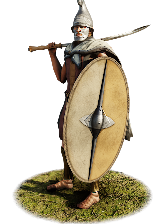
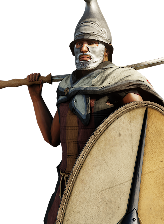
Class: light · Category: infantry · Men per unit: 40
Description
These Bithynian warriors are armed with the long and sharp rhomphaia, an iron weapon originating from the Rhodopes of European Thrace. The rhomphaia is best suited for deadly charges against their enemies, their resolve being broken with frightening war cries after their formations have been disrupted using precursor javelins. The Rhomphaiophoroi [i.e. “rhomphaia-bearers”] are relatively well protected, wearing iron Phrygian helmets, thureos shields, heavy boots, and long cloaks, common for warriors from Thrace.
Historical background
In a past already distant to our Hellenistic authors, the land that was to them known as Bithynia was coveted by many migrating tribes. When and how these arrived is impossible to say, but the ancient authors assert that the Phrygians at some point settled the land. Several tribes moved in after them, like the Bebrikians, then the Mysians, and lastly and most recently the Thracians originating in the Strymonian valley, north-east of Macedon (Strab. 7.3.2; 12.3.3; Hdt. 7.75). By the time of our earliest surviving author, Herodotos, in the last third of the 5th century BC, those Thracians had already established themselves in that location, assimilating the Mysians, and calling themselves Bithynians. According to Herodotos, their warriors dressed in fox-hats, tunics, loose mantles, and boots made of deerskin (Hdt. 7.75). They were closely connected to other Strymonian tribes, like the Maidoi – in fact the “Maidobithynoi” (Strab. 7.3.2) could still be found close to the Bithynians in Asia Minor – though they retained closest in contact to the Thynoi directly across the Bosporus (Strab. 12.3.3). This Thracian connection was very obvious to ancient authors. Our late 5th to early 4th century BC author Xenophon, who had led the Kyraian army – i.e. the mercenary army of the Persian pretender Kyros (423 – 401 BC) of the 10,000 mercenaries through both Bithynia and Thynia, still consistently called them former “Thracians” in his narrative (Xen. Anab. 6.3). His description of the Thynoi still matches the description given by Herodotos (Xen. Anab. 7.4.4). Though they would always remain being associated with their Thracian origin, in the Hellenistic Period, the Bithynian king Zipoites (ca. 326 BC – 278 BC) and his successors established a kingdom on par with other Hellenistic powers, thus creating a “Bithynian” identity that went beyond being just another “Thracian tribe”. It is thus hard to say how long the connections between the Asian and European Thracians were upheld beyond the Classical period. Most significantly, Bithynians were more heavily involved in local Asian and Pontic affairs rather than in European politics, dealing with the Byzantines, Chalkedonians, Herakleiotes, Seleucids, and later the Galatians.
It could have been the latter who introduced the rhomphaia, a long iron weapon very familiar to the Rhodopian Thracians, into Bithynian lands. Almost all findings of the rhomphaia, a weapon developed in the late 4th century BC and in use until the 1st century BC (and perhaps even later), were found in the Rhodope area. These are often accompanied by items of the La Tène horizon, probably adopted as fashion trends by the Thracians as the invading Galatians of the early 3rd century BC marched through Thrace. Graves from the Rhodopes like at modern Pletena (rhomphaia, greaves, Phrygian helmets, 6 bronze torques – Archibald, The Odrysian Kingdom of Thrace (1998), p. 254) or at Assenovgrad (rhomphaia, greaves, bearded Phrygian helmet, torque – Archibald (1998), p. 254) show the development of the Hellenistic Thracian panoply attested by Cornelius Nepos during the Third Macedonian War (171-168 BC, Plut. Aem. 18.5). He describes them with rhomphaias, white thureos shields, greaves, and black tunics, the latter probably thanks to their mercenary service in the Macedonian army. The Galatians in Europe had established a kingdom in Thrace at Tylis, from where they drew tribute from the Greek cities until they were destroyed by Thracians (Pol. 4.46.3). Galatians continued being called into Asia as mercenaries (Pol. 5.111), especially by Pergamon, the Bithynians, and the Seleucids. These Galato–Thracian mixed troops could have brought the rhomphaia with them, if it had not already travelled there through inter-Thracian contacts between Bithynians and Strymonian Thracians, who lived at the western end of the Rhodopes. The lack of weapon finds in Bithynian lands, besides depictions on grave steles, make it difficult to get any confirmation on military influences on the Bithynians, though the rhomphaia would have been a great addition to their newly Hellenised military.
Stats
| Rank in roster | ||
|---|---|---|
| Men per unit | 40 | ███······· 30% |
| Attack | 15 | ███████··· 72% |
| Charge bonus | 11 | ████······ 38% |
| Defence | 26 | ███······· 32% |
| · armour | 4 | ███······· 33% |
| · defence skill | 17 | ████······ 35% |
| · shield | 5 | ██████···· 57% |
| Morale | 11 | ████······ 39% |
| Discipline | Normal | |
| Training | Untrained | |
| Recruitment cost | 1,666 dn | ███······· 29% |
| Upkeep per turn | 610 dn | █████····· 45% |
| Turns to recruit | 3 |
Weapons
| Primary | Secondary | Primary | Secondary | Primary | Secondary | Primary | Secondary | ||||
|---|---|---|---|---|---|---|---|---|---|---|---|
| Attack | 15 | 11 | Charge bonus | 11 | 23 | Type | thrown · blade | melee · blade | Damage | piercing | slashing |
| Projectile | javelin | — | Range | 50 | — | Ammunition | 2 | — | Properties | Used just before charging into combat | Armour-piercing (counts only half the target's armour) |
Defence
| Primary | Secondary | Primary | Secondary | Primary | Secondary | Primary | Secondary | ||||
|---|---|---|---|---|---|---|---|---|---|---|---|
| Total | 26 | — | Armour | 4 | — | Defence skill | 17 | — | Shield | 5 | — |
Condition and terrain
| Hit points | 1 | Ground: scrub / sand / forest / snow | 0 / -1 / 0 / -1 | Charge distance | 30 | Formations | Square |
Technical stats
| Time between blows (primary / secondary) | 2.5 s / 2.5 s | Extra fatigue in hot climates | 0 | Collision mass per man (1.0 is normal) | 0.98 | Spacing between men: close / loose | 1 × 1.2 m / 2 × 2.4 m |
| Default ranks | 5 |
In battle: Can sap · Very good stamina
Who can recruit it
A core roster unit for one faction, which can raise it anywhere it holds the right building:
Exactly what a settlement must have, route by route (3)
| Building | Also requires | Building | Also requires | Building | Also requires | ||
|---|---|---|---|---|---|---|---|
| Indirect Rule | Tier 2 Military Industrial Complex · Tier 1 Colony | Direct Rule | Tier 2 Military Industrial Complex · Tier 1 Colony | Homeland | Tier 2 Military Industrial Complex |