
Bithynian Royal Peltasts
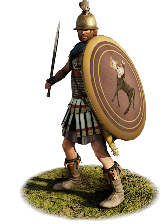
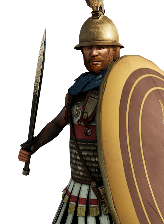
Class: heavy · Category: infantry · Men per unit: 40
Reforms: Unlocked by Bithynian Reforms I
Description
These peltasts are the elite infantry of the Bithynian army. Armed with rimless, round aspis shields, xiphos swords, and javelins, they can overcome almost any enemy. Linothorakes or muscle cuirasses, high boots and plumed Bithynian helmets afford them extra protection against missile fire or otherwise lethal blows. Modelled after the royal peltasts of the Antigonids, who themselves follow the role model of the legendary Hypaspists, this regiment only admits the bravest and most disciplined young men. They will fight and die for their country, their king, and their honour.
Historical background
The development of an elite infantry regiment in the Bithynian army was probably a rather late development. With the kingdom only safely established in the early 3rd century BC and being home to a small population to begin with, a larger elite regiment would probably have been too costly under Nikomedes I (ca. 280-255 BC) or his son Ziaelas (254-228 BC). With their conquests and those of Prusias I and Prusias II (228-148 BC), however, Bithynia became a major player in Anatolia, and would have been able to afford a larger army. With only four kings ruling over a period of 132 years, the kingdom was also relatively stable, despite several bloody successions. Even though some coins of Nikomedes I (r. 279-255 BC) already show the goddess Bendis with a decorated Aspis, javelins, and a straight sword (Davis/Kraay, Hellenistic Kingdoms (1973), pl. 186; 187; 190), nothing indicates that any major units of the army were armed with this equipment. Our main evidence for elite infantry armed with swords dates to the second half of the 2nd century BC and the first half of the first century BC (see below), and it is thus possible that an actual regiment was only introduced in this period.
What could the historical context be in which such a unit was raised? After Nikomedes II had killed his father Prusias II in 148 BC, he spent some time securing his position. To improve his ‘international’ standing, he strengthened the close relations with Kos that had once been established by the first Nikomedes (Plin. nat. hist. 7.39, 36.20). This is apparent from the fact that the Koans set up a cult for Nikomedes, probably after the king had donated money or provided military support (Habicht, Neues zur hellenistischen Geschichte von Kos (2007), p. 150). Around this time, Nikomedes became known as Epiphanes, “the one (deity) who appears” (IG IV2 591). Taken together, we may assume that the new monarch helped repair and build temples both in Bithynia and on Kos, and supported the organisation of sacred festivals. It took another decade until we hear of Bithynians at arms again. When the usurper Aristonikos made war on Rome because he would not accept that the Attalids had bequeathed their kingdom to the senate, the Bithynian king sided with Rome. Not much is known about the actual contribution of Bithynian troops between 133 and 129 BC, but Nikomedes thought them considerable and expected to receive Greater Phrygia as a prize. When the area was given to Mithridates V of Pontos (r. ca. 150-120 BC), instead, he was bitterly disappointed, but he died soon after anyway (Iust. 37.1.2., 38.5.3, Schottky, s.v. Nikomedes II., in: DNP online).
Nikomedes was succeeded by his son, Nikomedes III (r. ca. 128/127-95/94 BC). He, too, made generous donations to communities within and outside the realm and became known as Euergetes ("the benefactor") (IG IV 558, 25; OGIS 345). After his father had acted friendly towards the Romans, Nikomedes III returned to previous Bithynian policy. He rejected a request to send troops to help Rome against the Cimbri and Teutones in 104 BC, because the publicani, the Roman tax collectors, had created much hatred in Asia Minor (Diod. 36.3.1-2). Nikomedes had actually gone even further when he invaded Paphlagonia in 107 BC in concert with Mithridates VI of Pontos. They divided the ancient kingdom around Gangra between themselves, and when the senate protested, Nikomedes merely made his son king of Paphlagonia in his stead, and gave him the regnal name Pylaimenes that had been borne by most native Paphlagonian kings (Iust. 37.4). A few years later, Mithridates had his brother-in-law Ariarathes VII of Cappadocia murdered because he coveted his kingdom. Nikomedes put a spoke in his wheel when he immediately mobilised the Bithynian army and occupied all of Cappadocia. He then married Laodike, the sister of Mithridates and widow of Ariarathes, but his triumph did not last. When Mithridates enacted a full-scale Pontic invasion, the Bithynians were defeated and had to retreat (Iust. 37.5).
In 94 BC, Nikomedes passed away and left the kingdom to his son Nikomedes IV, who called himself Philopator ("the one who loves his father"). Mithridates VI immediately ousted him from the throne by supporting his half-brother Sokrates Chrestos (Iust. 38.5.). Nikomedes IV fled to Rome, gathered support and returned in 92 BC, invading Pontos and being defeated, upon which he escaped again in 88 BC (Strab. 12.3.40C562, Memn. 22.6). In 84 BC, the victorious Sulla established him on the Bithynian throne once again (Plut. Sulla 22, 24) so that he could meet the young Caesar who came to Nikomedia in 80/79 BC (Suet. Caesar 2.29, Plut. Caesar 1, Cass. Dio 43.20.2-4). Nikomedes IV had wed Nysa, the daughter of the late Ariarathes VI of Cappadocia, but when he started disliking both her and the son she had borne him, he had her executed, annulled the fatherhood, and bequeathed his kingdom to Rome in his last will, which came into effect after his death in 74 BC (App. bell. civ. 1.111, Arr. Frg. 14). In a final act, the Bithynian army supported M. Aurelius Cotta when he besieged Herakleia Pontike in 72/71 BC (Memn. 34.1). After heavy losses, Cotta captured the proud city thanks to a traitor, but his sack of Herakleia would lead to his political downfall as the Herakleiotes later convinced the senate that Cotta was a monster (Memn. 39).
Looking at the late history of Bithynia, there only really seem to be two phases when the royal peltasts could have been raised: either by Nikomedes II before his war against Aristonikos, or by Nikomedes III before the invasions of Paphlagonia and Cappadocia. Since the Antigonids were obviously not around anymore at this point, it is perhaps likelier that they were already introduced by Prusias I or II and then enlarged by Nikomedes II or III. In any case, they must have played a central role in all of these Bithynian wars in the 2nd and 1st century BC. The royal peltasts in RIS are based on several reliefs from 2nd century BC Bithynia and their interpretation by Ruben Post (Bithynian Army (2022)). The main inspiration is the figure of Numisios on the grave stele of his father Diliporis, which Numisios probably erected to commemorate his family, which also encompassed his mother Dintise and his two sisters (Post (2022), p. 8). Numisios wears a linothorax with long pteryges, javelins or a spear, a plumed Bithynian helmet, and high boots that reach halfway up the knee. With some fantasy, a sword can also be made out; one definitely appears as the weapon of an armoured footman on the so-called Bithynian Black Sea Coast stele (also dated to the mid or late 2nd century BC: Post (2022), p. 8). A 1st century BC relief from Adapazari shows another Bithynian elite warrior with sword, probably a xiphos, and javelins (Post (2022), pp. 10-11). The most interesting detail of Numisios’ equipment is perhaps his shield: though it is round like an aspis, it lacks the rim. This is probably a local, Bithynian variant of the Greek shield, just like the unique Bithynian and Bithynian konos helmets found on the stelae. To add some variety, some of the soldiers in RIS received Thracophrygian or Sidon helmets - often crested.
In the Museum of Bursa, the stela NS features a similar round shield as that of Numisios with a spindle-shaped midrib protecting the lower figure, so our unit has both of these mixed. Stela NS 2 from the same museum shows one Bithynian with a muscle cuirass with echarpe and two long rows of pteryges ending in fringes as well as a neck protector attached to the top. Therefore, some of our peltasts wear a cuirass that resembles this, a mix halfway between muscle cuirass and linothorax. Finally, red and blue cloaks represent the elite status of these soldiers.
Stats
| Rank in roster | ||
|---|---|---|
| Men per unit | 40 | ███······· 30% |
| Attack | 17 | █████████· 87% |
| Charge bonus | 13 | █████····· 52% |
| Defence | 47 | █████████· 92% |
| · armour | 11 | ██████···· 64% |
| · defence skill | 29 | █████████· 91% |
| · shield | 7 | █████████· 91% |
| Morale | 14 | ████████·· 79% |
| Discipline | Normal | |
| Training | Highly trained | |
| Recruitment cost | 2,368 dn | ██████···· 64% |
| Upkeep per turn | 867 dn | ████████·· 83% |
| Turns to recruit | 4 |
Weapons
| Primary | Secondary | Primary | Secondary | Primary | Secondary | Primary | Secondary | ||||
|---|---|---|---|---|---|---|---|---|---|---|---|
| Attack | 17 | 12 | Charge bonus | 13 | 14 | Type | thrown · blade | melee · blade | Damage | piercing | piercing |
| Projectile | javelin | — | Range | 50 | — | Ammunition | 2 | — | Properties | Used just before charging into combat | — |
Defence
| Primary | Secondary | Primary | Secondary | Primary | Secondary | Primary | Secondary | ||||
|---|---|---|---|---|---|---|---|---|---|---|---|
| Total | 47 | — | Armour | 11 | — | Defence skill | 29 | — | Shield | 7 | — |
Condition and terrain
| Hit points | 1 | Ground: scrub / sand / forest / snow | 0 / -1 / 0 / -1 | Charge distance | 30 | Formations | Square |
Technical stats
| Time between blows (primary / secondary) | 2.5 s / 2.5 s | Extra fatigue in hot climates | 1 | Collision mass per man (1.0 is normal) | 1.23 | Spacing between men: close / loose | 1 × 1.2 m / 2 × 2.4 m |
| Default ranks | 5 |
In battle: Can sap · Very good stamina
Who can recruit it
A core roster unit for one faction, which can raise it anywhere it holds the right building:
Exactly what a settlement must have, route by route (2)
| Building | Also requires | Building | Also requires | ||||
|---|---|---|---|---|---|---|---|
| Direct Rule | Tier 3 Military Industrial Complex · Bithynian Reforms I · Tier 2 Colony | Homeland | Tier 2 Military Industrial Complex · Bithynian Reforms I |