
Bithynian Thureophoroi
Class: spearmen · Category: infantry · Men per unit: 40
Reforms: Unlocked by Bithynian Reforms I
Description
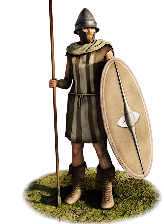
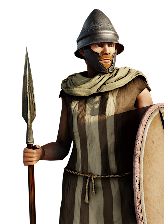
Thureophoroi are becoming an ubiquitous sight throughout the Hellenistic world, and Bithynia is no exception. Wars against the Seleucids and cooperation with the Galatians have taught them the advantages of using large, oval shields, and accordingly the Bithynian kings armed parts of their infantry with thureos, javelins, spears, as well as pilos and Sidon helmets. Wearing ankle-high boots and tunics in earthy colours with lighter coloured stripes, these men retain their Bithynian looks and identity, but combine it with effective new weaponry.
Historical background
“O Passing, can you say to me: Goodbye, may the earth lay lightly upon you.”
– Epitaph of a Bithynian mercenary in Egypt (Launey, Recherches (1949), p. 809).
When Nikomedes I of Bithynia and the Northern League transported a large army of Galatians with their wives and children across the Bosporos in 278/277 BC (Paus.10.23.14), the king also armed some of them who lacked weapons and armour with equipment from the royal armoury (Memn. 11.5). The exchange of arms and military ideas was probably mutual, however, for thureos shields soon appeared among Bithynian soldiers. The large shields afforded much protection against missile fire and spears in particular, and were a perfect fit for the predominantly light units of the Bithynian army. Nikomedes may have introduced Thureophoroi towards the end of his reign, after the end of the initial campaigns in which the Galatians moved south and eastwards, and the Bithynians had expanded their territory into Phrygia (Iust. 25.2). This success needed to be secured by an efficient army, and Thureophoroi were the military fashion of the day, something no monarch could do without.
Even though the Celts had brought the thureos (or thyreos) to Bithynia, Thureophoroi were soon found throughout the Greek world and wore Greek spears and javelins. The introduction of the new warriors can thus also be seen as part of Nikomedes’ programme of Hellenisation and modernisation: first of all, he founded a new capital opposite Astakos and named it after himself (Memn. 12.1). Situated at the end of the gulf of Astakos – which is now known as the Gulf of İzmit, the modern name for Nikomedia – it proved a more successful foundation than his father’s Zipoiton (Memn. 12.5, Strab. 12.4.2C563). While Zipoiton lay under Mount Lyparos, Nikomedia possessed a good harbour, which contributed to its survival and prosperity. Yet, its beginnings were equally ominous: after the foundation at some point between 265 and 260 BC, an earthquake struck and destroyed the new buildings (Liban. Or. 61.4). The confident king was not to be deterred by nature, however, and proceeded to simply set up his colony in Astakos itself (Paus. 5.12.7). The tale has to be taken with a pinch of salt, however, as it is very similar to stories about the foundation of the Seleucid Tetrapolis in northern Syria, and the Bithynians may have spread the myth of an earthquake so as to legitimate Nikomedia as a new Antioch (Ladynin, The Burial of Seleucus I Nicator (2019), p. 53). This would then fit the intended ‘Hellenisation’ even better, as it would have been an attempt to firmly establish Bithynia as part of the Greek world.
Furthermore, Nikomedes donated an ivory statue of himself to the sanctuary of Olympia (Paus. 5.12.7) and forged close relations with Kos, a well-known centre of culture and learning. While in Kos, he took a ferry to Knidos on the Carian mainland, where he saw the famous Knidian Aphrodite, a work of the Athenian sculptor Praxiteles and one of the most famous marble statues of the ancient world (Plin. nat. hist. 36.20; Roman copies survive in the collection Ludovisi and the Vatican Museums). Nikomedes was so amazed by the statue that he offered to pay all of Knidos’ debts – many of which they must have accumulated when buying the Aphrodite in the first place! But they were still in love with her, and flatly rejected the bid (Plin. nat. hist. 7.39).
Paris did see me naked,
Adonis, and Anchises,
except I knew all three of them.
Where did Praxiteles see me?
– (Anth. Graec. 16.168)
In this context, it may come as no surprise that Nikomedes’ soldiers, too, began to adopt the Greek language. As such, they were now very interesting and lucrative mercenaries for the Hellenistic kingdoms. In the 2nd century BC, a man from Bithynia called Dionysios fought and died in the service of the Ptolemaic kingdom. After his death, a painted stele was erected for him, which is now in the Alexandria Museum (inv. 20919). Dionysios is portrayed wearing a dark brown tunic with a vertical white stripe down the middle, ankle-high Thracian boots, a spear, a yellow-brown thureos, javelins, and a helmet (Post, Bithynian Army (2022), p. 15). Like other Thureophoroi and other Ptolemaic mercenaries, these Bithynians use Sidon and pilos helmets. Similarly armed men fought for the Antigonids, as is demonstrated by evidence from Demetrias, one of the military centres of the dynasty, where three Bithynians erected stelai for themselves (Post (2022), p. 15). Not just Thureophoroi, but even Bithynian Thureophoroi specifically, therefore became a common sight throughout the Hellenistic world.
Stats
| Rank in roster | ||
|---|---|---|
| Men per unit | 40 | ███······· 30% |
| Attack | 15 | ███████··· 72% |
| Charge bonus | 8 | ███······· 31% |
| Defence | 31 | █████····· 46% |
| · armour | 3 | ██········ 21% |
| · defence skill | 23 | ███████··· 65% |
| · shield | 5 | ██████···· 57% |
| Morale | 11 | ████······ 39% |
| Discipline | Normal | |
| Training | Untrained | |
| Recruitment cost | 1,628 dn | ███······· 26% |
| Upkeep per turn | 596 dn | ████······ 40% |
| Turns to recruit | 2 |
Weapons
| Primary | Secondary | Primary | Secondary | Primary | Secondary | Primary | Secondary | ||||
|---|---|---|---|---|---|---|---|---|---|---|---|
| Attack | 15 | 11 | Charge bonus | 8 | 11 | Type | thrown · blade | melee · blade | Damage | piercing | piercing |
| Projectile | javelin | — | Range | 50 | — | Ammunition | 2 | — | Properties | Used just before charging into combat | Light spear (braced against cavalry charges from the front) · +8 attack against cavalry |
Defence
| Primary | Secondary | Primary | Secondary | Primary | Secondary | Primary | Secondary | ||||
|---|---|---|---|---|---|---|---|---|---|---|---|
| Total | 31 | — | Armour | 3 | — | Defence skill | 23 | — | Shield | 5 | — |
Condition and terrain
| Hit points | 1 | Ground: scrub / sand / forest / snow | 0 / 0 / -1 / 0 | Charge distance | 30 | Formations | Square |
Technical stats
| Time between blows (primary / secondary) | 2.5 s / 2.5 s | Extra fatigue in hot climates | 0 | Collision mass per man (1.0 is normal) | 0.96 | Spacing between men: close / loose | 1 × 1.2 m / 2 × 2.4 m |
| Default ranks | 5 |
In battle: Can sap · Very good stamina
Who can recruit it
A core roster unit for one faction, which can raise it anywhere it holds the right building:
Exactly what a settlement must have, route by route (3)
| Building | Also requires | Building | Also requires | Building | Also requires | ||
|---|---|---|---|---|---|---|---|
| Indirect Rule | Garrison Building or Tier 1 Military Industrial Complex · Bithynian Reforms I · Tier 1 Colony | Direct Rule | Garrison Building or Tier 1 Military Industrial Complex · Bithynian Reforms I · Tier 1 Colony | Homeland | Garrison Building or Tier 1 Military Industrial Complex · Bithynian Reforms I |