
Bosporan Cataphracts
Class: heavy · Category: cavalry · Men per unit: 32
Reforms: Unlocked by Military Innovations from the Frontiers
Description
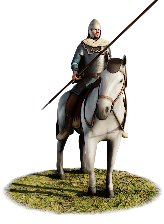
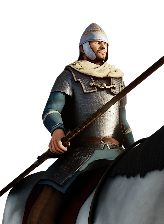
These horsemen are the heaviest unit of the royal Bosporan army and reflect centuries of Greek, Scythian, Sarmatian, and even Anatolian influences on their kingdom. The riders are clad in long-sleeved Scythian tunics with mail or scale on their arms, wear broad Scythian belts as well as chainmail, scale, or muscle cuirasses, and often chainmail or scale greaves on their legs. This impressive armour is completed by a variety of modern helmets: konos-Boiotian types represent a derivative of Hellenistic types, while the so-called Boiko Ponura is an imported Celtic design. Conical segmented helmets with cheek guards and stunning conical helmets made from a single piece of iron are exclusive to the area. These cataphracts are best used for charges with their two-handed, two-tipped kontos lances, which are long and stable and can pierce through bodies. The weight of the perfectly armoured rider and horse will allow them to smash even through lines of infantry. When in melee, these men use straight Sarmatian longswords with ring pommels.
Historical background
Though the Bosporan Kingdom lay on the edge of the Eurasian steppe, the development of cataphracts in its army was a relatively late phenomenon. Their emergence was traditionally seen as a sign of the ‘Sarmatisation’ of the originally Greek realm. Some Soviet archaeologists and later Russian and western researchers vigorously argued this case not only for the Bosporan Kingdom, but also for its neighbours Olbia and Chersonesos (cf. Mielczarek, Bosporan Army (1999), p. 73; Heinen, Antike am Rand der Steppe (2006), pp. 65-66). All three have occupied an important place in the national identities and self-perceptions of the Soviet Union, Russia, and Ukraine and, within this context, the gradual Sarmatisation was always seen as a decline compared to the glorious Greek origins of the medieval Rus and any modern states connected with it (Tsetskhladze, North Pontic Classical Archaeology: An Historical Essay [2021]). As a symbol for the Sarmatian way of life, the cataphracts became a metaphor for this ‘barbarising’ trend and occupied a crucial place in any discussion about the historical significance of the Bosporan Kingdom and its neighbours (Stahl, Kriegswesen und Kultur der eurasischen Steppennomaden der Eisenzeit (2023), pp. 79-80).
The idea of such a ‘Sarmatisation’ is primarily based on the appearance of typically Sarmatian names and weapons within the Greek poleis of the North Pontic region and their armies. As Gajkudevič already highlighted, the archaeological record from the beginning of the Bosporan Kingdom to its end in Late Antiquity consistently shows a blend of Greek and native material, however – be it Scythian, Sarmatian, Sindian, Maiotian, or Taurian (Gajkudevič, Bosporanisches Reich (1971), p. 492). Heinen adds that the distribution of Iranian names, which was traditionally interpreted as the adoption of a more Sarmatian nature, could also mean that the Greek poleis and the realm successfully integrated the newcomers. After all, these men all bear Hellenic offices and use Greek writing – albeit mistakes are common (Heinen (2006), pp. 65-66). The same would be true for the mostly Sarmatian soldiers of the Bosporan cataphracts, who appear in the Bosporan army from the 1st century BC (Mielczarek (1999), p. 73). Their creation perhaps fell into the period of Pontic occupation, when Mithridates the Great controlled the Kimmerian Bosporos (109-63 BC). After all, cataphracts also featured in his royal army (Ath. 5.214A = Poseidonios of Apameia, FGrHist 87 F 36 = F 253 Edelstein/Kidd = F 247 Theiler & Plut. Lucullus 37.3).
Cataphracts were heavy shock cavalry, armed with a long, two-handed, two-tipped kontos lance (Tac. Hist. 1.79). Should one end break off, the rider could simply turn the lance around and use the other end to pierce his opponents. For melee, Bosporan cataphracts used a long, Sarmatian cavalry sword (Tac. Hist. 1.79; Mielczarek (1999), p. 76). Thanks to its length of 110 cm, it allowed the cavalryman to easily reach his opponent from horseback (Mielczarek (1999), p. 90). This armament was less unique than the super heavy armour of the cataphract riders. The wall painting of a rich grave from Pantikapaion, dated to around 100 AD, shows such heavy horsemen in chainmail shirts which included the legs down to the boots, but not the arms, and high, iron helmets which resemble the simple pilos without cheek guards (Gajkudevič (1971), fig. 131). These cataphracts fight against light Scythian lancers, and a painting from the southern wall of Stasov’s catacomb in Pantikapaion (2nd century AD) depicts another cataphract battle against a horse archer – no doubt another foe from the steppes (Gajkudevič (1971), fig. 133). The Bosporan rider wears the same equipment as the first one, with an additional chlamys, while the niches of the wall depict cataphracts with classical Greek muscle cuirasses (Gajkudevič (1971), fig. 133). Other images illustrate that scale armour shirts were a third option for the Bosporan cataphracts, and they, too, reached all the way down to the knees (Mielczarek (1999), pl. XXIII, XXIV).
The Bosporan cataphracts charged their opponents in wedge formation (Mielczarek (1999), p. 88) and relied on the kinetic energy of the armoured rider and heavy, perhaps lightly armoured horse to smash through an enemy line – shields were not necessary and would in fact have prevented the soldiers from properly using their kontos (Mielczarek (1999), p. 96). Their panoply was completed by a huge variety of helmets. On two grave paintings from Pantikapaion (1st or 2nd century AD), conical segmented helmets with neck guards of leather plates, cheek guards, and (in one case) braids of mail armour appear (Mielczarek (1999), pls. XXI, XXIV). These might be Sarmatian framed helmets as known from Kurgan 40 between Kazanskaia and Tiflisskaia (Symonenko, Sarmatian Helmets (2015), fig. 13). The Stele of Rhodon, son of Helios, from the 1st half of the 1st century AD (erected in the vicinity of Pantikapaion), features an exceptional type which has some similarities to the framed helmets, but might be unique (Mielczarek (1999), p. 96; pl. XV).
During the Mithridatic Wars, new helmets found their way into the Bosporan Kingdom. Some were looted from the Romans and their allies, others brought into the area by Mithridates' Galatian allies and mercenaries (App. Mithr. 109, 111; Mielczarek (1999), p. 72). Chief among these were the Montefortino, an originally Celtic design utilised by the Roman legionaries, and the Boiko-Ponura, a Galatian type. As the former was an infantry helmet, the cataphracts would favour the Boiko-Ponura with its cheek guards and improved protection for the back of the head (Dedyulkin, The Boiko-Ponura Complex and the Problems of Genesis of Late La Tène Helmets. Комплекс из Бойко-Понуры и проблемы генезиса позднелатенских шлемов [2013]). At Orekhovka and Akhtanizovska around Lake Maiotis (Sea of Azov), Boioto-Konos helmets dating to the first half of the first century BC were found and represent rather classic Greek craftsmanship (Mielczarek (1999), p. 77). Finally, Tryphon, governor of Tanais in 163 AD, is later shown as a cataphract soldier with a helmet made from a single piece of metal (Mielczarek (1999), pl. XVIII), which fits to the pilos like types on Stasov’s catacomb. Tryphon, too, wears a chlamys and a broad belt.
While most of the horses on the illustrations have very little or no body armour, the cataphracts were still much heavier armed than most other horsemen. Developed under Sarmatian and Pontic influences, they seemingly became the core cavalry of the Bosporan army in the imperial period. Every RIS player will be familiar with cataphracts and their strengths and will surely appreciate their impact. There is little doubt that such excellent horsemen played their role in the long survival of the Bosporan Kingdom over the centuries.
Stats
| Rank in roster | ||
|---|---|---|
| Men per unit | 32 | ██········ 23% |
| Attack | 15 | ███████··· 72% |
| Charge bonus | 39 | ██████████ 99% |
| Defence | 35 | ██████···· 57% |
| · armour | 19 | ██████████ 99% |
| · defence skill | 16 | ███······· 28% |
| · shield | 0 | █········· 0% |
| Morale | 15 | █████████· 91% |
| Discipline | Normal | |
| Training | Highly trained | |
| Recruitment cost | 3,328 dn | █████████· 88% |
| Upkeep per turn | 1,273 dn | ██████████ 97% |
| Turns to recruit | 4 |
Weapons
| Primary | Secondary | Primary | Secondary | Primary | Secondary | Primary | Secondary | ||||
|---|---|---|---|---|---|---|---|---|---|---|---|
| Attack | 15 | 15 | Charge bonus | 39 | 30 | Type | melee · blade | melee · blade | Damage | piercing | slashing |
Defence
| Primary | Secondary | Primary | Secondary | Primary | Secondary | Primary | Secondary | ||||
|---|---|---|---|---|---|---|---|---|---|---|---|
| Total | 35 | — | Armour | 19 | — | Defence skill | 16 | — | Shield | 0 | — |
Condition and terrain
| Hit points | 1 | Mount | horse cataphract | Ground: scrub / sand / forest / snow | -7 / -1 / -8 / -1 | Charge distance | 40 |
| Formations | Square · Wedge |
Technical stats
| Time between blows (primary / secondary) | 2.5 s / 2.5 s | Extra fatigue in hot climates | 5 | Spacing between men: close / loose | 2 × 4.8 m / 3 × 7.2 m | Default ranks | 5 |
In battle: Good stamina · Powerful charge
Who can recruit it
A core roster unit for one faction, which can raise it anywhere it holds the right building:
Exactly what a settlement must have, route by route (2)
| Building | Also requires | Building | Also requires | ||||
|---|---|---|---|---|---|---|---|
| Direct Rule | Tier 3 Military Industrial Complex · Military Innovations from the Frontiers · Tier 2 Colony · Requires resource horses or horses supplied factionwide | Homeland | Tier 2 Military Industrial Complex · Military Innovations from the Frontiers |