
Bosporan Epilektoi Cavalry
Class: heavy · Category: cavalry · Men per unit: 6
Description
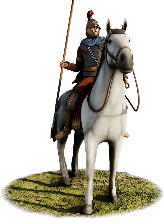
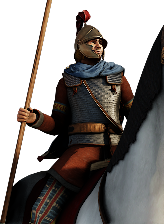
These horsemen are the elite riders of the royal Bosporan army. Though their realm was founded by Greek cities, it also encompassed strong local population elements, including Scythians, Taurians, Sindians and, from the 3rd century BC onwards, Sarmatians. They were joined by former mercenaries and their families from Thrace, Paphlagonia, and the Peloponnese, who settled in the lands around the Kimmerian Bosporos. The Bosporan cavalry recruits men from all of these groups, and thus their armament and tactics reflect multicultural influences. Most men prefer to wear long sleeved Scythian tunics, which are warmer than their Greek counterparts, trousers, and Scythian style belts. A mix of Greek linothorakes and expensive Scythian scale cuirasses are worn as body armour. Despite their using spears instead of lances, these men do not wear shields into battle, after the traditional Hellenic style. As secondary weapons, the Greek soldiers carry the curved one-edged machaira sword, while Scythians, Taurians, and Sindians fight with double-edged straight akinakes swords. Greek bronze greaves protect the legs of some of these horsemen, while their helmets are a mix of imported Attico-Thracian types from the Aegean, Scythian versions of the Hellenic konos and Chalcidian helmets, and locally produced pilos helmets which are, however, made of iron instead of bronze and feature added cheek guards. Some of the helmets are crested, to make them appear more impressive. Thus armed, the experienced warriors of the epilektoi (“chosen ones”) form an effective heavy cavalry division and serve as the bodyguard of Bosporan kings, princes, and magistrates.
Historical background
In the early 6th century BC, Ionian Greeks arrived on the northern shores of the Pontos Euxinos, the “friendly sea” (Black Sea), and founded a number of settlements dotted along the Kimmerian Bosporos, the modern Strait of Kerch. The most well-known and important of these were Pantikapaion, an apoikia (colony) of Miletos, and Phanagoreia, an apoikia of Teos (Strab. 7.4.4C309–310; Ps.-Scymn. 886–887). Pantikapaion would become the capital of the “European” part of the Bosporan realm, while Phanagoreia would serve as the centre of its “Asiatic” part (Vinogradov, Rhythms of Eurasia (2008), p. 16). That these Greek outposts on the borders of the steppes formed a sort of kingdom at all was most unusual. The reasons can probably be found in common trade interests, since the Bosporan territory was astonishingly fertile and produced a lot of grain, and the threat from neighbouring peoples, which in itself was a direct result of the exceptional wealth of the new Greek cities (Braund, Black Sea Grain for Athens? (2007); Petropoulos, Colonisation and Landscape Transformation (2021), pp. 282-294). Furthermore, Scythians often took slaves from rival peoples, and the Bosporan Greeks soon joined them in this lucrative business – an activity that would have escalated existing tensions even further (Polyb. 4.38.4).
Against this background, a territorial alliance led by the family of the Archaianaktids was formed in 480/479 BC (Diod. 12.31.1). This was not a kingdom – the new ‘rulers’ were only appointed as archontes in the leading poleis. We do not know any more details, aside from the fact that they hired Thracian mercenaries to help defend the area under their control (Mielczarek, Army of the Bosporan Kingdom (1999), p. 47). In 438/437 BC, a captain of said Thracians called Spartokos overthrew the Archaianaktids and made himself the new de facto ruler of the Bosporan Greek cities and their territories (Diod. 12.31.1). The dynasty of the Spartokids would remain in power until Mithridates the Great incorporated the Bosporans into his own realm in 110 BC, but it would take until the 3rd century BC until they finally took the title of king for their relations over both their Greek and non-Greek subjects (Saprykin, The Archaeanactids of Bosporus and urban development (2014), p. 297). A diversity of peoples lived in their kingdom. Among them were the families of the original Ionian settlers, later Greek newcomers including Dorian mercenaries (Mielczarek (1999), pp. 22-23), the descendants of the Thracian and Paphlagonian mercenaries of the Archaianaktids (KBN 180 = IOSPE II, 296), and, obviously, Scythians. In the 4th century BC, the Sindians who lived to the east of Phanagoreia were largely conquered and integrated into the kingdom (CIRB 1111, CIRB 6, CIRB 6a, CIRB 8), and from the 3rd century BC on, Sarmatians began migrating into the area (Podossinov, Geschichte des Bosporanisches Reiches (2002), p. 29).
Any cavalry force would have to be recruited from this blend of population groups. Even though conflicts existed, the heterogenous ethne within the Bosporan Kingdom developed a group identity over the centuries of coexistence which would eventually surpass their particular identities as Greeks, Scythians, or Thracians (Heinen, Antike am Rand der Steppe (2006), pp. 43-49). It is unclear how far this process had advanced by the beginning of RIS in 270 BC, and thus it was decided to have both clearly Scytho-Sarmatian, respectively Greek, and mixed units in the Bosporan roster. Though the native nomads were arguably more skilled and experienced at cavalry battles than the Greeks, strong Hellenic elements shaped the armament and tactics of Bosporan cavalry at least until the 1st century AD (Mielczarek (1999), pp. 80-89). Diodoros, probably following a contemporary source, says Satyros, the claimant to the Bosporan throne in 309 BC, rode into battle against his brother Eumelos at the River Thates surrounded by his epilektoi cavalry (Diod. 20.22.5). How would these men have been armed? As traditional Greek cavalry with probably only limited influence from Macedon, they are likely to have fought with spears and no shields (Willekes, Cavalry Battle in Greece and the Hellenistic East (2021), p. 95). Their secondary weapon was the Scythian akinakes, a straight, double-edged dagger or short sword (Mielczarek (1999), p. 57), or the curved Greek machaira, a weapon of similar size (Mielczarek (1999), pp. 46-47).
Without shields, these riders would have relied on their armour for protection. Linothorakes are the typical Greek cuirasses, while Scythian scale cuirasses testify to the impact of the cultural exchange in the Bosporan region. A scale cuirass is worn by the rider on the 4th century Solokha comb and a stunning copy of such armour has been found in kurgan 401 at Zhurovka in the Dnieper region east of Kyiv (Heinen (2006), p. 25; Cunliffe, The Scythians (2019), p. 248). Diverse types of helmets are known from the Bosporan realm and its neighbours and these epilektoi represent the whole range. Locally produced pilos helmets from Akhtanizovskaya (in the Sindike) and nearby Buerova Mogila dating to the late 2nd, or, more likely, early 1st century BC (Symonenko, Sarmatian helmets (2015), p. 283) appear, as do konos helmets found in Scythian Neapolis on Crimea (Symonenko (2015), fig. 9, no. 7). Attico-Thracian helmets imported from the Aegean are known from the vicinity of Pantikapaion as well as from Apostolidi in the area of the Siraces east of the Sindike (Symonenko (2015), p. 283). Finally, the stretch of Siracian territory northwest of the Caucasus has also produced several Chalcidian helmets (Symonenko (2015), pp. 283-284). Their legs were protected by classical Hellenic bronze greaves, which had been adopted in Scythia by the end of the fifth century BC (Mielczarek (1999), pp. 53-57; Polin/Daragan, The Construction and Functional Technology of Scythian Greaves [2023]). As clothes, Scythian belts, tunics with long sleeves, and trousers were preferred since they are better suited to the colder weather that dominates half of the year in the Eurasian steppe. Thus outfitted and armed, these epilektoi are an all-round cavalry unit that forms one of the backbones of the Bosporan army.
Stats
| Rank in roster | ||
|---|---|---|
| Men per unit | 6 | █········· 0% |
| Attack | 14 | ███████··· 65% |
| Charge bonus | 29 | █████████· 88% |
| Defence | 36 | ██████···· 61% |
| · armour | 15 | ████████·· 82% |
| · defence skill | 21 | █████····· 54% |
| · shield | 0 | █········· 0% |
| Morale | 16 | ██████████ 98% |
| Discipline | Normal | |
| Training | Highly trained | |
| Recruitment cost | 4,569 dn | █████████· 94% |
| Upkeep per turn | 66 dn | █········· 1% |
| Turns to recruit | 4 |
Weapons
| Primary | Secondary | Primary | Secondary | Primary | Secondary | Primary | Secondary | ||||
|---|---|---|---|---|---|---|---|---|---|---|---|
| Attack | 14 | 14 | Charge bonus | 29 | 28 | Type | melee · blade | melee · blade | Damage | piercing | slashing |
Defence
| Primary | Secondary | Primary | Secondary | Primary | Secondary | Primary | Secondary | ||||
|---|---|---|---|---|---|---|---|---|---|---|---|
| Total | 36 | — | Armour | 15 | — | Defence skill | 21 | — | Shield | 0 | — |
Condition and terrain
| Hit points | 1 | Mount | generals horse | Ground: scrub / sand / forest / snow | -2 / -1 / -7 / -1 | Charge distance | 40 |
| Formations | Square · Wedge |
Technical stats
| Time between blows (primary / secondary) | 2.5 s / 2.5 s | Extra fatigue in hot climates | 4 | Spacing between men: close / loose | 2 × 4.8 m / 3 × 7.2 m | Default ranks | 5 |
In battle: A unit suitable for a general · Good stamina · Powerful charge
Who can recruit it
A core roster unit for one faction, which can raise it anywhere it holds the right building:
Exactly what a settlement must have, route by route (2)
| Building | Also requires | Building | Also requires | ||||
|---|---|---|---|---|---|---|---|
| Direct Rule | Tier 3 Military Industrial Complex · Tier 2 Colony | Homeland | Tier 2 Military Industrial Complex |