
Bosporan Heavy Swordsmen
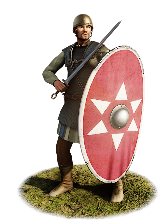
Class: heavy · Category: infantry · Men per unit: 40
Reforms: Unlocked by Bosporan Military Reform
Description
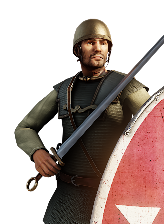
After centuries of development, Bosporan infantry has evolved into the perfect mix of hoplites and Roman legionaries, taking on some additional Sarmatian influences along the way. Heavily armoured swordsmen form the backbone of the Bosporan army, which has to contend with its nomadic neighbours, rebellious Taurians and Sindians, or usurpers to the royal throne. Scale or chainmail cuirasses protect their bodies, while the long sleeves of their chitones keep out the merciless cold during the winter. Trousers attest ‘barbarian’ influences, while the belts and boots are of the standard types found across the Greek world. Their main weapon is a straight, long Sarmatian sword with a ring pommel, while similarly looking daggers are worn as a decoration. Perhaps the mightiest arm of the Bosporan swordsman is his gigantic oval or hexagonal shield, made of thick wood reinforced with metal and a big iron boss. Specific for the Bosporan Kingdom are the one-piece conical metal helmets, while others resemble the Roman imperial type known as the Coolus Mannheim. Artistically painted laurel wreaths, symbolising the monarchy’s relationship to Rome, and the bright stars of the Mithridatic dynasty adorn their shields. These men of iron are a formidable force, hard to break even for the bravest foe.
Historical background
"There is nowhere for us to flee. This is our land." – Maks Levin
In 110 BC, the Royal Scythians besieged Chersonesos, the colony of Herakleia Pontike on the western side of Crimea. The Chersonites sent to Pontos for help, and its young king, Mithridates VI, immediately dispatched a force that would defeat the Scythians. After the victory, the Pontic army under the strategos Diophantos marched east to negotiate with Pairisades V of the Bosporan Kingdom, but a rebellion broke out, in which the king was killed (IPE I² 352, Strab. 7.4.3C309). Diophanthos immediately took over the Bosporan realm and integrated it into the Mithridatic kingdom. This had major consequences for the region. It was now part of one of the largest states of the day and would be involved in the wars of Mithridates, soon to be known as ‘the Great’, against Bithynia, Cappadocia, the Seleucids, and Rome. When he fell, his son Pharnakes secured the Bosporan throne for himself in 62 BC – and was acknowledged by Rome as an amicus populi Romani, a “friend of the Roman people” (App. 16.113). From this point onwards, the Bosporan Kingdom remained in an allied, but sometimes plagued relationship with the Roman Empire. After Pharnakes’ death in 47 BC, Caesar appointed his supporter Mithridates of Pergamon as the new monarch, but the Bosporan fleet under their leader Asandros defeated the newcomer and, soon after, Asandros himself was crowned as Pharnakes’ successor (Strab. 13.4.3 C625). He married Dynamis, the daughter of Pharnakes and granddaughter of Mithridates (Cass. Dio 54.24.4), and she became the truly decisive figure in Bosporan politics over the next half century.
Asandros ruled successfully for three decades before a man called Scribonius successfully rebelled against him in 17 BC and took Dynamis as his own wife (Cass. Dio 54.24.4-5). The Romans preferred Polemon I of Pontos as the successor, however, and helped the latter to eventually become king himself by 14 BC – upon which Polemon also wed Dynamis (Cass. Dio 54.24.5–6). The Bosporans, in turn, were unhappy with this Roman candidate, and so may have been Dynamis, and in 9 BC another rebellion led to the death and overthrow of Polemon (Strab. 11.2.11C495). Next, Dynamis reigned on her own until she finally passed away in 7/8 AD. She was probably married to or helped by Aspourgos, the commander of the victorious rebels, for he succeeded her after her demise (MacDonald, Coinage of the Kingdom of the Bosporus (2005), p. 54). Aspourgos defeated the Royal Scythians and Taurians in a devastating campaign and established a new dynasty with his wife Gepaipyris and his two sons Kotys and Mithridates (CIRB 39, 40 = IOSPE II, 36). The Bosporan Kingdom was still a Roman ally at this point, but given Aspourgos’ Sarmatian background, the Thracian origin of his queen, and the survival of a Greek identity, it also remained a unique place with a unique military tradition.
When the two brothers Kotys I and Mithridates III fought a civil war over the Bosporan throne in 49 AD, with Romans, Sarmatians, and Scythians variously supporting either side, Tacitus claims that the royal infantry was wearing Roman style armour ( Tac. Ann. 12.15-16). This certainly suggests chainmail and would fit the long-term alliance between the Bosporans and Rome. The Polish military historian Mariusz Mielczarek dated the introduction of these cuirasses even further back, however – to the time of Mithridates the Great (Mielczarek, Army of the Bosporan Kingdom (1999), p. 74). The Pontic king controlled the Kimmerian Bosporos for roughly four decades, and Imitation Legionaries are attested in his army (App. Mithr. 69, Plut. Lucullus 7). But even if chainmail and possibly straight swords were adopted this early, the visual evidence illustrates that other elements of the Bosporan heavy infantry of the imperial period were only introduced over the following century or two.
Most Bosporan troops in the imperial period were a citizen militia or even standing troops: the pressure of the neighbouring peoples had increased, and the kings could no longer solely rely on allies and mercenaries (Gajdukevič,, Das Bosporanische Reich (1971), p. 420). Grave stelae from this time often depict citizens as soldiers – if on horse, they wield straight swords and gorytos, if on foot, rectangular or oval shields with round umbos in a circle (as on the Stele of Dionysios, Son of Nikandros, 2nd century), but all of these are parade uniforms, since they lack helmets and body armour (Gajdukevič (1971), p. 418, fig. 112-115). A painting from the southern wall of Stasov’s catacomb, a royal tomb in Pantikapaion erected in the 2nd century AD, depicts two infantrymen behind a cataphract. They wear almost unidentifiable helmets, oval shields, chainmail, and spears (Gajdukevič (1971), fig. 133). Similar soldiers are depicted in a niche in the same tomb (idem, fig. 134), but only two of them are protected by chainmail (or scale cuirasses?), while some have muscle (or scale?) cuirasses. The helmets are conical and somewhat resemble pilos helmets, something more obvious on other depictions (Mielczarek (1999), pls. XXI, XXIV). These also show that the neck guards are made of leather plates, sometimes of braids of mail armour, and that some have cheek pieces. Only the Stele of Rhodon, the son of Helios (Mielczarek (1999), p. 96, pl. XV) has a different, exceptional helmet, perhaps a Sarmatian framed helmet, while the strategos Tryphon (163 AD; Mielczarek (1999), pl. XVIII) wears a helmet made out of a single piece of metal.
A limestone figure found on the shore of Akhtanizovskii liman near ancient Tyrambe from much earlier, the beginning of the first century BC, wears a chlamys, possibly scale or mail armour, trousers, military boots, spear, and an oval shield (Mielczarek (1999), pl. X), indicating that the development from the thureophoroi and machairophoroi (see their descriptions) to the later heavy swordsmen and spearmen units had already begun well before the Roman interventions in the northern Black Sea area. Cultural exchange with the world of the nomads was certainly vital, and is also attested by the Sarmatian swords with their circular pommels and bar-shaped crosshairs, which are commonly found in the Bosporan Kingdom in the imperial period. A spectacularly well-kept copy from the 1st century AD necropolis of Nymphaia can be found in the State Hermitage in St Petersburg (tildacdn-15__76-211). Daggers with ring pommels were worn alongside the swords mainly as a decoration:
"Such weapons, in conjunction with scabbards with side projections, are depicted on some funerary stelae stored at the Kerch (Pantikapaion) Museum. Such a dagger is to be seen on the Chrestion’s stele (first century AD, Kerch). The dagger with a bar guard is attached to the thigh, the pommel is fastened to a strap on the hip. The scabbard is provided with side projections." – (OIbrycht, Daggers in Parthian Iran (2020), p. 240).
Swords, body armour, helmets, and clothes are rounded off with some Celtic torques around the necks of the warriors. These can be seen on several Bosporan statues from the 2nd and 3rd centuries AD (Heinen, Antike am Rand der Steppe (2006), pp. 43-48). They were probably symbols of wealth and bravery, and fit the diverse blend of cultural influences reflected in the armament of the Bosporan infantry in the 1st to 3rd century AD. Sarmatian, Scythian, Greek, Roman, Celtic, and Pontic elements come together to create the soldiers of a kingdom which was both on the edges of the Greco-Roman world and at the crossroads of civilisations. They did a good job, for the Bosporan Kingdom thrived throughout this time and we hear of no major crisis after the death of Kotys I in 68/69 AD. Centuries of warfare had taught the Bosporans how to survive.
Stats
| Rank in roster | ||
|---|---|---|
| Men per unit | 40 | ███······· 30% |
| Attack | 10 | ██········ 19% |
| Charge bonus | 14 | ██████···· 60% |
| Defence | 52 | ██████████ 98% |
| · armour | 16 | █████████· 90% |
| · defence skill | 29 | █████████· 91% |
| · shield | 7 | █████████· 91% |
| Morale | 14 | ████████·· 79% |
| Discipline | Normal | |
| Training | Highly trained | |
| Recruitment cost | 2,816 dn | ████████·· 79% |
| Upkeep per turn | 1,031 dn | █████████· 90% |
| Turns to recruit | 4 |
Weapons
| Primary | Secondary | Primary | Secondary | Primary | Secondary | Primary | Secondary | ||||
|---|---|---|---|---|---|---|---|---|---|---|---|
| Attack | 10 | — | Charge bonus | 14 | — | Type | melee · blade | — | Damage | piercing | — |
Defence
| Primary | Secondary | Primary | Secondary | Primary | Secondary | Primary | Secondary | ||||
|---|---|---|---|---|---|---|---|---|---|---|---|
| Total | 52 | — | Armour | 16 | — | Defence skill | 29 | — | Shield | 7 | — |
Condition and terrain
| Hit points | 1 | Ground: scrub / sand / forest / snow | 0 / -2 / 0 / -2 | Charge distance | 30 | Formations | Square |
Technical stats
| Time between blows (primary / secondary) | 2.5 s / — | Extra fatigue in hot climates | 5 | Collision mass per man (1.0 is normal) | 1.38 | Spacing between men: close / loose | 1 × 1.2 m / 2 × 2.4 m |
| Default ranks | 5 |
In battle: Can sap · Good stamina
Who can recruit it
A core roster unit for one faction, which can raise it anywhere it holds the right building:
Exactly what a settlement must have, route by route (2)
| Building | Also requires | Building | Also requires | ||||
|---|---|---|---|---|---|---|---|
| Direct Rule | Tier 3 Military Industrial Complex · Bosporan Military Reform · Tier 2 Colony | Homeland | Tier 2 Military Industrial Complex · Bosporan Military Reform |