
Bosporan Machairophoroi
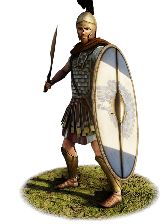
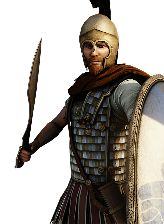
Class: heavy · Category: infantry · Men per unit: 40
Description
These heavy infantrymen are machairophoroi, named after their primary weapon, the machaira. This curved, single-edged sword is the most popular weapon in the Bosporan kingdom. The machairophoroi combine their sword with typical thureophoroi equipment: thureos shields, linothorakes – some with metal scales common in Scythia – cloaks, bronze greaves, and Chalcidian helmets. The metal scales and greaves make them a bit heavier than Thureophoroi, and in turn they do not carry javelins, but specialise in melee. As proud citizens of the Greek cities of the Kimmerian Bosporos, they have a high morale, as they would rather die in honour than live in shame.
Historical background
The Kingdom of the Kimmerian Bosporos encompassed a number of sizable Greek city states on either side of the strait (now the Strait of Kerch). On the western side, Phanagoreia and Nymphaion were the largest cities, with Kimmerikon to the south being a smaller settlement. In the 4th century BC, the wealthy and well fortified city of Theodosia further west was conquered in a lengthy and arduous war in which Herakleia Pontike and Chersonesos supported Theodosia and inflicted heavy losses upon the Bosporan armies (Burstein, The War between Heraclea Pontica and Leucon I of Bosporus (1974)). On the eastern shores of the Kimmerian Bosporos, Phanagoreia was the political and economic centre of Greek settlement, with Hermonassa to its south and Gorgippia further southeast – in the territory of the Sindians – as other notable towns. In the Classic period in particular, many Ionian Greeks from cities like Miletos, Mytilene, or Teos came to the northern shores of the Pontos Euxeinos, the ‘friendly sea’ to start a new life (for their arrival cf. Ustinova, The Supreme Gods of the Bosporan Kingdom (1999), p. 61). The fertile plains of the Taurian peninsula (Crimea) in particular allowed the Bosporan Greeks to quickly amass incredible riches, and the grain exports of the kingdom soon became vital in keeping major Greek city states in the south and their overseas dominions afloat (Moreno, Ex PONTO: The Athenian Grain Supply and Black Sea Archaeology (2007)).
As elsewhere in the Greek world, the Hellenes on the Kimmerian Bosporos became citizens of poleis and were ready to defend their political rights in war. In the wars against Greek enemies like Herakleia Pontike or Chersonesos, they fought as hoplites (Polyaen. 6.9.4). However, archaeological finds show that the Bosporan Kingdom, like many other Hellenic states, adopted the thureos shield on a large scale by the middle of the 3rd century BC (Mielczarek, Bosporan Army (1999), pp. 39-41). Thureophoroi became the standard Greek infantry of the time and were especially useful against the mobile enemies whom the Bosporan Greeks would face on the outskirts of the Eurasian steppes. While many Thureophoroi primarily fought with spears, others preferred using their swords, the most common of which was the machaira. The machaira was already known in Greece during the Geometric Period, but only found widespread use in two waves, first in the 6th and then in the 4th and 3rd centuries BC (Mödlinger, Barbarische Einflüsse (2015), p. 260). Five different types are attested, with the single-edged blades sometimes being straight, but often curved, with a length between 40 and 70 cm (Schmitt, Angriffswaffen (2007)). Various machaira swords were found in Bosporan graves dating to the 3rd century BC, attesting the common use of these weapons (Mielczarek (1999), pp. 46-47).
In addition to the machaira and the thureos, the Machairophoroi bear Chalcidian helmets. A 4th century BC Chalcidian helmet was found in the kurgan of Kurdzhips on the Kuban (Rabinovich, Shlemy skifskogo perioda (1941), p. 144) and another had been buried with Scythian arrow-heads and a sword in the Kukuvatskii kurgan in Crimea (id., pp. 124-143). Bronze greaves were also well-known in the Bosporan Kingdom and thus protect the legs of the machairophoroi (Mielczarek (1999), pp. 53-54; p. 57 for the first centuries BC). However, no muscle cuirasses were found in the area, hence they have been given linothorakes with scales and chainmail (like the thorakitai in other Hellenistic armies they correspond to, cf. Mielczarek (1999), pp. 52-53 for the archaeological evidence). Similar troops with thureos shields remained a part of Bosporan armies well into the period when the Kingdom was a dependent ally of Rome. The steles of clearly Greek warriors like Rhodon, son of Helios, from the early 1st c. AD, or Staphilos, son of Glaukias and Kleon, son of Kleon, from the 2nd century AD, are ample evidence for this (Mielczarek (1999), various plates). Since none of the stelae depict javelins, these machairophoroi are melee units only. Last but not least, their cheek guards depict Achilles besting Paris during the Trojan War, as the Bithynian orator Dio Chrysostom mentions two temples for Achilles on the river Borysthenes (Dnieper) (Dio Chrys. 36.9).
Stats
| Rank in roster | ||
|---|---|---|
| Men per unit | 40 | ███······· 30% |
| Attack | 12 | █████····· 48% |
| Charge bonus | 14 | ██████···· 60% |
| Defence | 42 | ████████·· 80% |
| · armour | 12 | ███████··· 69% |
| · defence skill | 25 | ███████··· 74% |
| · shield | 5 | ██████···· 57% |
| Morale | 12 | ██████···· 57% |
| Discipline | Normal | |
| Training | Highly trained | |
| Recruitment cost | 1,988 dn | █████····· 49% |
| Upkeep per turn | 728 dn | ███████··· 70% |
| Turns to recruit | 3 |
Weapons
| Primary | Secondary | Primary | Secondary | Primary | Secondary | Primary | Secondary | ||||
|---|---|---|---|---|---|---|---|---|---|---|---|
| Attack | 12 | — | Charge bonus | 14 | — | Type | melee · blade | — | Damage | slashing | — |
Defence
| Primary | Secondary | Primary | Secondary | Primary | Secondary | Primary | Secondary | ||||
|---|---|---|---|---|---|---|---|---|---|---|---|
| Total | 42 | — | Armour | 12 | — | Defence skill | 25 | — | Shield | 5 | — |
Condition and terrain
| Hit points | 1 | Ground: scrub / sand / forest / snow | 0 / -1 / 0 / -1 | Charge distance | 30 | Formations | Square |
Technical stats
| Time between blows (primary / secondary) | 2.5 s / — | Extra fatigue in hot climates | 3 | Collision mass per man (1.0 is normal) | 1.28 | Spacing between men: close / loose | 1 × 1.2 m / 2 × 2.4 m |
| Default ranks | 5 |
In battle: Can hide in long grass · Can sap · Very good stamina
Who can recruit it
A core roster unit for one faction, which can raise it anywhere it holds the right building:
Exactly what a settlement must have, route by route (2)
| Building | Also requires | Building | Also requires | ||||
|---|---|---|---|---|---|---|---|
| Direct Rule | Tier 3 Military Industrial Complex · Tier 2 Colony | Homeland | Tier 2 Military Industrial Complex |