
Cappadocian Heavy Skirmisher Cavalry
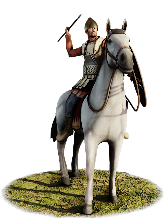
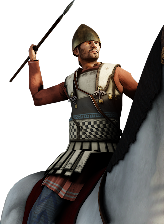
Class: missile · Category: cavalry · Men per unit: 30
Reforms: Unlocked by Cappadocian Military Reforms
Description
As a Cappadocian noble might have stated: "Beloved king, the one who brings peace to Cappadocia. The people praise you, and the gods are on your side. But to preserve the peace, we must prepare for war. Reports have come to us that our light horsemen suffer many losses, and great numbers of Cappadocian mothers weep for their sons. Now is the time to change this! We, the richest nobles of the land, have personally bought linen cuirasses, shields, and helmets for your skirmisher cavalry. Now they are much better protected than before, and Cappadocia's sons shall live to see victory!"
Prolonged campaigns and devastating losses against our more heavily armoured neighbours have shown us how exposed our skirmishers are to missile volleys and sudden counter-charges. To protect these highly valuable horsemen, the Cappadocian kings and wealthy nobles have outfitted their best men at their own expense. These reformed Cappadocian Heavy Skirmisher Cavalry mostly wear linen cuirasses (linothorakes), with some having adopted a traditional Persian leather cuirass, and carry round Pelte shields decorated with native Anatolian motifs. To protect their heads, these men have been given bronze helmets, such as pilos, konos, but also Persian conical helmets. When on the attack, they carry bundles of heavy javelins, as well as lances, and sidearm daggers. These men are capable of pelting enemy formations from medium range, while their armour allows them to withstand incoming enemy missiles and endure melee fights for a longer time. Still, they remain skirmishers at heart, and should avoid prolonged close-quarters combat against dedicated heavy shock cavalry or dense infantry lines.
Historical background
Cappadocia’s long-standing reputation as "the land of the beautiful horses" provided the ideal economic foundation for maintaining strong mounted forces, as the country’s cavalry strength long remained significant (Strabo, 11.525; cf. Xenophon, Cyropaedia 2.1.5; Arrian; Diodorus, 18.16; Plutarch, Eumenes 4). Indeed, the quality of Cappadocian horses was already well-recognised during the Achaemenid era, when the region was required to pay an annual tribute in horses directly to the Persian Great King to supply the royal armies: “The reports on the tributes paid agree with the size and the power of the country; for Cappadocia paid the Persians yearly, in addition to the silver tax, fifteen hundred horses, two thousand mules, and fifty thousand sheep” (Strabo, 11.13.8).
This cavalry tradition allowed local rulers to field massive cavalry contingents. In 322 BC, the satrap Ariarathes I mobilised an impressive force of 15,000 mounted soldiers to defend his realm against the Macedonian invasion (Diodorus Siculus, 18.16.2). Ariarathes “had amassed a great sum of money from the revenues and had formed a large body of native troops and mercenaries. He was thus ready to enter the lists against Perdikkas in defence of his kingdom with thirty thousand infantry and fifteen thousand cavalry. Perdikkas joined battle with him, and, defeating him in the conflict, slew men to the number of four thousand and took captive more than five thousand, among them Ariarathes himself”.
The transition to a more heavily armoured Cappadocian skirmisher cavalry variant is supported by local numismatics. On third-century BC coinage minted under the Cappadocian rulers Ariaramnes and Ariarathes III (circa 280-230 BC), horsemen are explicitly depicted wearing helmets, protective cuirasses, and cloaks, while wielding a lance, with some coins even depicting metal headgear (chamfrons) for their mounts (e.g., H. Simonetta 6. SNG von Aulock 6357).
As Plutarch notes, the Macedonian satrap Eumenes of Kardia successfully raised 6,300 native horsemen by offering gifts, tax exemptions, distributing quality horses, and bestowing honours upon local elites who could equip themselves for battle (Plutarch, Eumenes 4.3–4). These armoured skirmishing horsemen were part of the core of the mobile defence network in Cappadocia (Weiskopf, "CAPPADOCIA", in: Encyclopaedia Iranica IV [1990]), holding scattered estate fortresses across Mazaca and Tomisa, patrolling important mountain passes, and protecting the kingdom's borders throughout the Diadochi conflicts, Seleucid alliances, and the Mithridatic Wars (Strabo, 12.535, 12.537, 12.539; Livy, 37.40; Appian, Civil War 2.49).
Stats
| Rank in roster | ||
|---|---|---|
| Men per unit | 30 | █········· 8% |
| Attack | 12 | █████····· 48% |
| Charge bonus | 22 | ████████·· 77% |
| Defence | 25 | ███······· 28% |
| · armour | 7 | ████······ 42% |
| · defence skill | 14 | ██········ 18% |
| · shield | 4 | █████····· 48% |
| Morale | 11 | ████······ 39% |
| Discipline | Normal | |
| Training | Highly trained | |
| Recruitment cost | 1,815 dn | ████······ 39% |
| Upkeep per turn | 731 dn | ███████··· 70% |
| Turns to recruit | 3 |
Weapons
| Primary | Secondary | Primary | Secondary | Primary | Secondary | Primary | Secondary | ||||
|---|---|---|---|---|---|---|---|---|---|---|---|
| Attack | 12 | 8 | Charge bonus | 22 | 28 | Type | thrown · archery | melee · blade | Damage | piercing | piercing |
| Projectile | javelin | — | Range | 50 | — | Ammunition | 6 | — | Properties | Thrown | — |
Defence
| Primary | Secondary | Primary | Secondary | Primary | Secondary | Primary | Secondary | ||||
|---|---|---|---|---|---|---|---|---|---|---|---|
| Total | 25 | — | Armour | 7 | — | Defence skill | 14 | — | Shield | 4 | — |
Condition and terrain
| Hit points | 1 | Mount | medium horse | Ground: scrub / sand / forest / snow | -1 / -1 / -5 / -1 | Charge distance | 40 |
| Formations | Square |
Technical stats
| Time between blows (primary / secondary) | 2.5 s / 2.5 s | Extra fatigue in hot climates | 1 | Spacing between men: close / loose | 2.2 × 5.2 m / 3.96 × 7.28 m | Default ranks | 5 |
In battle: Can form Cantabrian circle · Very good stamina
Who can recruit it
A core roster unit for one faction, which can raise it anywhere it holds the right building:
Exactly what a settlement must have, route by route (3)
| Building | Also requires | Building | Also requires | Building | Also requires | ||
|---|---|---|---|---|---|---|---|
| Indirect Rule | Tier 2 Military Industrial Complex · Cappadocian Military Reforms · Tier 1 Colony · Requires resource horses or horses supplied factionwide | Direct Rule | Tier 2 Military Industrial Complex · Cappadocian Military Reforms · Tier 1 Colony · Requires resource horses or horses supplied factionwide | Homeland | Tier 2 Military Industrial Complex · Cappadocian Military Reforms |