
Cappadocian Temple Servants
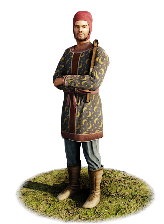
Class: light · Category: infantry · Men per unit: 60
Description
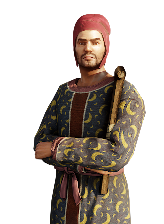
These warriors are madmen. They are driven by the craze of the bloody deities of the Anatolian skies. Chief among them is Ma, the brutal goddess of melee. Armed with simple clubs, the temple servants rather impress with their colourful dress and headgear as well as beautifully crafted belts. Crescents are especially prominent on their clothes, as these lunar symbols are associated with multiple heavenly creatures and especially the Perasian Artemis in Kastabala, an important sanctuary on the border of Kilikia Tracheia (“Rough Cilicia”) and Cappadocia. The enemy may not fear the equipment of these men, but they should not fail to cower before the all-powerful gods and goddesses behind them!
Historical background
Ma was a solar Anatolian goddess whom the Greeks equated with Enyo, the deity of bloody melee (Blok, The Early Amazons (2015), p. 60). Her home was in Komana in Cappadocia, though there was a second Komana, in Pontos, which itself was traditionally part of Cappadocia. Both were described by Strabo of Amaseia (ca. 63 BC-25 AD), the historian and geographer from Pontos. His great grandfather had been high priest of Pontic Komana (Strab. 12.3.33C557) and Strabo’s family belonged to the elite of the Pontic kingdom. He was thus best-placed to describe both sanctuaries. First, this is what Strabo wrote about the ‘original’ Komana in Cappadocia:
“In the Antitauros are deep and narrow valleys, in which are situated Komana and the temple of Enyo, whom the people there call "Ma". It is a considerable city; its inhabitants, however, consist mostly of the divinely inspired people and the temple-servants who live in it. Its inhabitants are Cataonians, who, though in a general way classed as subject to the king, are in most respects subject to the priest. The priest is master of the temple, and also of the temple-servants, who on my sojourn there were more than six thousand in number, men and women together. Also, considerable territory belongs to the temple, and the revenue is enjoyed by the priest. He is second in rank in Cappadocia after the king; and in general the priests belonged to the same family as the kings” (Strab. 12.2.3C535).
Strabo visited the sanctuary in Cataonia (southern Cappadocia) at a time when much of Anatolia had fallen under Roman rule, but even at this time Komana remained an impressive autonomous temple-state. It is conceivable that the acolytes (‘hierodules’ in Greek) were even more than 6,000 in earlier days, and that they might sacrifice their own lives should the temple ever be attacked. These servants lived on the estate of the sanctuary and were under the total command of the priests, contributing to the maintenance of the buildings as well as to the daily affairs. Receiving only board and lodging, they were a cheap workforce. Some were even considered sacred, functioning as temple prostitutes (Casabonne, Kataonia, Melitene, Kummanni, and the problem of Komana [2009]). The situation in Pontic Komana was similar:
“Above Phanaroia is the Pontic Komana, which bears the same name as the city in Greater Cappadocia, having been consecrated to the same goddess and copied after that city; and I might almost say that the courses which they have followed in their sacrifices, in their divine obsessions, and in their reverence for their priests, are about the same, and particularly in the times of the kings who reigned before this, I mean in the times when twice a year, during the "exoduses" of the goddess, as they are called, the priest wore a diadem and ranked second in honour after the king” (Strab. 12.3.32C557).
Since Pontos was culturally part of Cappadocia, it is no surprise that the cult of Ma also spread north. Originating in native Anatolian traditions, it probably predated the Persian conquest of the region (Canepa, The Iranian Expanse (2020), p. 190). Not only the high priests of both Komanas occupied high positions in the two kingdoms, however:
“In (the Cappadocian province of) Morimenê, at Venasa, is the temple of the Venasian Zeus, which has a settlement of almost three thousand temple-servants and also a sacred territory that is very productive, affording the priest a yearly revenue of fifteen talents. He, too, is priest for life, as is the priest at Komana, and is second in rank after him” (Strab. 12.2.6C537).
The power of the temple rulers is thus reflected by the number of their acolytes, and the hierarchy doesn’t end there: “The third in rank is the priesthood of Zeus Dakieos, which, though inferior to that of Ma, is noteworthy. At this place (also in Morimenê) there is a reservoir of salt water which has the circumference of a considerable lake; it is shut in by brows of hills so high and steep that people go down to it by ladder-like steps” (Strab. 12.2.5C537).
In Zela in northwestern Cappadocia, the temple state of Anahita was created only in the Achaemenid period (Canepa (2020), p. 190). According to Strabo, a Persian victory over the Saka led to its establishment: “The Persian commanders established the temple of Anaïtis and the gods who share her altar – Omanos and Anadatos, Persian deities; and they instituted an annual sacred festival, the Sakaia, which the inhabitants of Zela continue to celebrate to the present day” (Strab. 11.8.4C512). Here, too, temple servants played an important role: “It was inhabited by the multitude of temple-servants, and by the priest, who had an abundance of resources; and the sacred territory as well as that of the priest was subject to him and his numerous attendants” (Strab. 12.3.37C559-560).
Under Mithridatic rule, the moon god Men (of Pharnakes) was promoted at Ameria near Kabeira. The cult related to royal ideology, and each new Pontic king had to take his inaugural oath at the sanctuary of Men in Ameria (Canepa (2020), pp. 190-191). Strabo wrote that “Kabeira (...) also (has) the temple of Mên of Pharnakes (...) the village-city Ameria, which has many temple-servants, and also a sacred territory, the fruit of which is always reaped by the ordained priest” (Strab. 12.3.31C557). Finally, there may have been temple servants at Kastabala in the northern extremity of Kilikia Tracheia: “At Kastabala is the temple of the Perasian Artemis, where the priestesses, it is said, walk with naked feet over hot embers without pain” (Strab. 12.2.7C537).
Many of these deities appeared strange to the Greeks and the Romans, and they thus equated them with their own gods and goddesses, like Zeus and Artemis, to make them more comprehensible. Anahita was a water goddess who was described as “a beautiful and strong maiden clad in beaver skins” (Zoroastrian hymn Aban Yasht 5.3), the followers of Ma, the mother of all men, were not allowed to eat pork (Strab. 12.8.9C575), and the priestesses of Perasia, equated with Artemis, walked on fiery coals – surely all of this was madness? Thus, our temple servants wear colourful clothes with lunar and solar symbols, simple clubs, but elaborate headgear worn by Cappadocian kings on 3rd century BC coins which resemble Bashlik hats (e.g., silver issue of Ariarathes II, ca. 301-280 BC [Hoover 805, Simonetta² 2a]). They are not supposed to be a very useful unit, but their number and their wrath symbolise the might of the ancient deities behind them.
Stats
| Rank in roster | ||
|---|---|---|
| Men per unit | 60 | █████████· 87% |
| Attack | 7 | █········· 6% |
| Charge bonus | 7 | ███······· 29% |
| Defence | 20 | ██········ 19% |
| · armour | 1 | █········· 0% |
| · defence skill | 19 | ████······ 44% |
| · shield | 0 | █········· 0% |
| Morale | 7 | █········· 10% |
| Discipline | Impetuous (may charge without orders) | |
| Training | Untrained | |
| Recruitment cost | 1,399 dn | █········· 13% |
| Upkeep per turn | 512 dn | ██········ 22% |
| Turns to recruit | 2 |
Weapons
| Primary | Secondary | Primary | Secondary | Primary | Secondary | Primary | Secondary | ||||
|---|---|---|---|---|---|---|---|---|---|---|---|
| Attack | 7 | — | Charge bonus | 7 | — | Type | melee · blade | — | Damage | blunt | — |
Defence
| Primary | Secondary | Primary | Secondary | Primary | Secondary | Primary | Secondary | ||||
|---|---|---|---|---|---|---|---|---|---|---|---|
| Total | 20 | — | Armour | 1 | — | Defence skill | 19 | — | Shield | 0 | — |
Condition and terrain
| Hit points | 1 | Ground: scrub / sand / forest / snow | 0 / 0 / 0 / 0 | Charge distance | 30 | Formations | Square |
Technical stats
| Time between blows (primary / secondary) | 2.5 s / — | Extra fatigue in hot climates | 0 | Collision mass per man (1.0 is normal) | 0.83 | Spacing between men: close / loose | 1 × 1.2 m / 2 × 2.4 m |
| Default ranks | 5 |
In battle: Can sap · Very good stamina
Who can recruit it
A core roster unit for one faction, which can raise it anywhere it holds the right building:
Exactly what a settlement must have, route by route (3)
| Building | Also requires | Building | Also requires | Building | Also requires | ||
|---|---|---|---|---|---|---|---|
| Indirect Rule | Garrison Building or Tier 1 Military Industrial Complex · Tier 1 Colony | Direct Rule | Garrison Building or Tier 1 Military Industrial Complex · Tier 1 Colony | Homeland | Garrison Building or Tier 1 Military Industrial Complex |