
Dardanian Pikemen
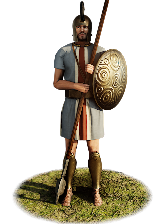
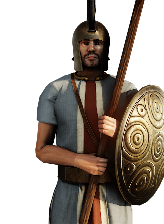
Class: spearmen · Category: infantry · Men per unit: 60
Reforms: Unlocked by Dardanian Pikemen Reform
Description
Dardanian Pikemen are a recent evolution of their kingdom’s military. They are armed with the long Sarissa, as well as machaira swords, both weapons adopted from experience battling Alexander and Philip V’s Macedonians (Parović-Pešikan, Grčka mahajra, 1982). These warriors are protected by a pelte shield, bronze greaves, and Illyrian helmets, but wear no body armour. This should, however, not prove to be a major problem, as their phalanx formation makes their front almost impenetrable.
Historical background
The Dardanians were in constant contact with the Macedonians, either via raiding or as mercenaries. Thukydides (IV.125.1) later described them as a "warrior people”. The Illyrians and Dardanians had a fearsome reputation, not only as opportunistic raiders, but in actual military terms too. Justin (30.4) claimed: "the Illyrians, Thracians, Dardanians, and other barbarous nations, who were of wavering faith and perfidious dispositions, and whom, if they should all rebel at once, it would be utterly impossible to resist”. The Dardanians were evolving and adopting effective systems for both their economy and their military from the 4th century onwards. Their subjects, the Damastini, minted silver coinage in 395 BC, along the lines of the currency of the Chalcidian League. Another mining town, perhaps located in Metohija or Kosovo, also created similar currency in 365 BC (Lewis et al., The Cambridge Ancient History: Illyrians and North-west (1994), p. 429). Both of these varieties of coins were later found in the northern Balkans, in routes that were far removed from normal Greek trading areas. This helps to highlight how the Dardanians were organising their economy, quite often optimising in a similar way to their Greek and Macedonian neighbours.
In terms of Dardanian military development, there is compelling evidence of them having adopted the pike and the phalanx formation. Their adoption of pikes can be inferred from the Lindian Chronicle. It describes how, when Philip V defeated people likely to be Dardanians and possibly the Thracian Maidoi in the late 3rd century BC, he made a dedication of ten pelte shields, ten sarissas, and ten helmets at Lindos on Rhodes (Lindian Chronicle no. 42, ll. 127-131). Philip certainly wanted to imitate Alexander the Great, who dedicated Persian weapons at Lindos, but it is conspicuous that his weapons were all the same as those used by the Macedonians themselves (Iliev, The Dedication of Philip V of Macedon (2022), pp. 77-78). Another interesting case is when the Dardanians were allied to Rome and their King Bato joined Rome’s attack on Macedon in 200 BC. The Dardanians proved highly effective in this invasion, defeating a cavalry ambush and managing to withdraw in good order (Wilkes (1996), p. 150). In a later cavalry attack, the Dardanian infantry were defeated, yet Livy states that despite unfavourable terrain "these troops do not leave their ranks impulsively but keep close order both in combat and in withdrawal" (Livy 31 .43). This indicates strongly that the Dardanians learnt from and adopted infantry formations from their experience fighting Greek and Hellenic enemies, and were now capable of forming ‘phalanx’ formations.
In part thanks to this military innovation, the Dardanians became a substantial regional power. In the year 279 BC, their King Monounios offered King Ptolemy Keraunos 20,000 men to help defeat the Celts who were ravaging Macedonia, but this offer was rejected with contempt. It is possible that King Monounios was of such influence that there were Macedonian-style coins minted with his name. It is a subject of academic debate whether at this time Dardanian power reached such an extent that they took over the Taulantii tribe and minted more coins in King Monounios’ name at Dyrrhachion, although it is equally possible there was another Illyrian of this name ruling there (Wilkes (1996), p. 146). Further indications of Dardanian military prowess can be seen in 179 BC, when the Dardanians were beset by multiple enemies including the Bastarnai, the Skordiskoi and Thracians, due to Macedonian politicking and instigation under their new King Perseus (Philip V’s son). These invaders besieged the Dardanians in their strongholds but made little progress, eventually only the Bastarnai remained. The Dardanians, sensing a change in their fortunes, sallied and defeated the Bastarnai, who fled, losing many troops and horses in their rout (Wilkes (1996), pp. 152-153). Around this time, the reputation of the Dardanians was such that Justin (30.4) referred to the Macedonians as "a prey to the Dardanians”.
Stats
| Rank in roster | ||
|---|---|---|
| Men per unit | 60 | █████████· 87% |
| Attack | 19 | █████████· 92% |
| Charge bonus | 2 | █········· 11% |
| Defence | 19 | ██········ 17% |
| · armour | 3 | ██········ 21% |
| · defence skill | 13 | █········· 13% |
| · shield | 3 | ████······ 37% |
| Morale | 10 | ███······· 29% |
| Discipline | Normal | |
| Training | Highly trained | |
| Recruitment cost | 1,815 dn | ████······ 39% |
| Upkeep per turn | 664 dn | ██████···· 57% |
| Turns to recruit | 3 |
Weapons
| Primary | Secondary | Primary | Secondary | Primary | Secondary | Primary | Secondary | ||||
|---|---|---|---|---|---|---|---|---|---|---|---|
| Attack | 19 | 9 | Charge bonus | 2 | 4 | Type | melee · blade | melee · blade | Damage | piercing | slashing |
| Properties | Long spear (bonus against cavalry, penalty against infantry) · +8 attack against cavalry · very long pike (phalanx) | — |
Defence
| Primary | Secondary | Primary | Secondary | Primary | Secondary | Primary | Secondary | ||||
|---|---|---|---|---|---|---|---|---|---|---|---|
| Total | 19 | — | Armour | 3 | — | Defence skill | 13 | — | Shield | 3 | — |
Condition and terrain
| Hit points | 1 | Ground: scrub / sand / forest / snow | -4 / 0 / -6 / 0 | Charge distance | 0 | Formations | Square · Phalanx |
Technical stats
| Time between blows (primary / secondary) | 2.5 s / 2.5 s | Extra fatigue in hot climates | 0 | Collision mass per man (1.0 is normal) | 0.91 | Spacing between men: close / loose | 1 × 1 m / 2 × 2.4 m |
| Default ranks | 5 |
In battle: Can hide in long grass · Can sap · Very good stamina
Who can recruit it
A core roster unit for one faction, which can raise it anywhere it holds the right building:
Exactly what a settlement must have, route by route (3)
| Building | Also requires | Building | Also requires | Building | Also requires | ||
|---|---|---|---|---|---|---|---|
| Indirect Rule | Tier 2 Military Industrial Complex · Dardanian Pikemen Reform · Tier 1 Colony | Direct Rule | Tier 2 Military Industrial Complex · Dardanian Pikemen Reform · Tier 1 Colony | Homeland | Tier 2 Military Industrial Complex · Dardanian Pikemen Reform |