
Foreign Thureophoroi
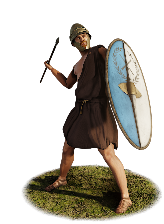
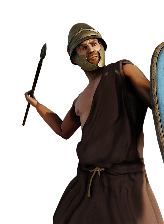
Class: spearmen · Category: infantry · Men per unit: 40
Reforms: No longer recruitable after The Great Reforms of Philopoimen · Becomes a newer unit with The Great Reforms of Philopoimen
Description
These light Thureophoroi are better protected than the average unit of skirmishers. Armed with a Thureos shield, a thrusting spear, and javelins; as well as wearing military boots and Linothorakes (though not everyone could afford them), these skirmishers can also hold their own in melee. As the main troops of the Achaian federal army in the middle of the 3rd century BC, they fulfil an important role on the battlefield, but need to be backed up by the Hoplites of the League’s Poleis to withstand stronger enemy attacks. On their shields, a goat stands above the letters Alpha and Chi. While the letters are simply an abbreviation of Achaia, the goat may be an allusion to a myth according to which Zeus was fed by the goat Amaltheia as a baby (Hes. Theog. 484), since Zeus Homarios was the chief deity of the Achaian League.
Historical background
Before the Hellenistic period, the Achaian League had never been a major player in Greek politics. It was dissolved at the end of the 4th century BC and only refounded in 281/280 BC, when the western Achaian poleis Tritaia, Dyme, Pharai and Patrai (which took the leading position) set up a new confederation Polyb. II, 41). In the 270s, they managed to either convince or force the pro-Macedonian tyrants of Aigion, Bura, Karyneia, Lention, Aigeira and Pellene to abdicate. In supporting Pyrrhos of Epeiros and subsequently joining Athens, Sparta and the Ptolemaic Empire in the Chremonidean War (267-261 BC) against Antigonid Macedon, they soon became a bigger player on the international stage than they had ever been before.
This new situation resulted in an increased need for soldiers. Probably in the 270s BC, the Achaian League was among the first Greek states to adopt the Thureos shield. Inspired by the Gauls who had invaded Hellas in 280/279 BC and aware of similar shields used by some of the Thracian and Illyrian tribes who had supplied mercenaries to Hellenic armies for generations, many Greek realised that the large Thureos shield provided good protection and could be used both in melee and while skirmishing. Pausanias (VIII, 50, 1) remarks that the Achaian Thureoi also resembled the Persian γέρρον shields, oval wicker shields covered with hide, and thus they may even have been used by single soldiers at least at a much earlier date than the 270s BC.
Though the koinon of the Achaians was already expanding at this stage, this happened mainly through diplomacy and political bargaining. Therefore the main use of the federal troops was in border defence and small scale operations. Even during the (267-261 BC), when the Achaians supported Athens and Sparta in their attempt to break Antigonid control over Greece, we hear nothing of Achaian troops in the field battles, and the defeat of the Ptolemaic-backed alliance seems to have had no major effects on the Achaian League, in difference to Athens and Sparta. While it is certainly possible and even likely that they sent some troops to support the armies of their allies in the field battles and sieges against the Macedonians, the federal army was probably not big enough at this point to make a huge difference. Its existing Hoplites may still have been attached to their individual city states rather than the Achaian army at this point. In fact, the Thureophoroi were almost exclusively mercenaries, a standing force at the disposal of the League’s strategoi, as is attested by the later decree of 217 BC (Polyb. V, 91, 6). While Polybios speaks of 8,000 men at this point, the need for the decree means that their number must have been considerably smaller from the 270s to 217 BC. Such a small force could hardly be used for large scale operations in the field.
This would explain why the Achaians used smaller Thureoi than other Greek states, which only covered part of the body (Plut. Philopoimen 9, 1). While Thureophoroi could be used both instead of Hoplites as line infantry and instead of Peltasts as skirmishers, the Achaian Thureophoroi seem to have been deployed mainly in the latter role (Sekunda, Military Forces 2007, p. 341). The smaller and lighter shields afforded them greater speed and mobility, but were an obvious disadvantage in melee.
Stats
| Rank in roster | ||
|---|---|---|
| Men per unit | 40 | ███······· 30% |
| Attack | 11 | ███······· 34% |
| Charge bonus | 7 | ███······· 29% |
| Defence | 37 | ██████···· 64% |
| · armour | 3 | ██········ 21% |
| · defence skill | 29 | █████████· 91% |
| · shield | 5 | ██████···· 57% |
| Morale | 11 | ████······ 39% |
| Discipline | Normal | |
| Training | Trained | |
| Recruitment cost | 1,668 dn | ███······· 30% |
| Upkeep per turn | 610 dn | █████····· 45% |
| Turns to recruit | 2 |
Weapons
| Primary | Secondary | Primary | Secondary | Primary | Secondary | Primary | Secondary | ||||
|---|---|---|---|---|---|---|---|---|---|---|---|
| Attack | 11 | 10 | Charge bonus | 7 | 9 | Type | thrown · archery | melee · blade | Damage | piercing | piercing |
| Projectile | javelin | — | Range | 50 | — | Ammunition | 6 | — | Properties | Thrown | Light spear (braced against cavalry charges from the front) · +8 attack against cavalry |
Defence
| Primary | Secondary | Primary | Secondary | Primary | Secondary | Primary | Secondary | ||||
|---|---|---|---|---|---|---|---|---|---|---|---|
| Total | 37 | — | Armour | 3 | — | Defence skill | 29 | — | Shield | 5 | — |
Condition and terrain
| Hit points | 1 | Ground: scrub / sand / forest / snow | 0 / 0 / -1 / 0 | Charge distance | 30 | Formations | Square |
Technical stats
| Time between blows (primary / secondary) | 2.5 s / 2.5 s | Extra fatigue in hot climates | 0 | Collision mass per man (1.0 is normal) | 0.96 | Spacing between men: close / loose | 1 × 1.2 m / 2 × 2.4 m |
| Default ranks | 5 |
In battle: Can sap · Very good stamina
Who can recruit it
A core roster unit for one faction, which can raise it anywhere it holds the right building:
Exactly what a settlement must have, route by route (3)
| Building | Also requires | Building | Also requires | Building | Also requires | ||
|---|---|---|---|---|---|---|---|
| Indirect Rule | Garrison Building or Tier 1 Military Industrial Complex · not The Great Reforms of Philopoimen · Tier 1 Colony | Direct Rule | Garrison Building or Tier 1 Military Industrial Complex · not The Great Reforms of Philopoimen · Tier 1 Colony | Homeland | Garrison Building or Tier 1 Military Industrial Complex · not The Great Reforms of Philopoimen |