
Gortynian Aspidophoroi
Class: heavy · Category: cavalry · Men per unit: 30
Reforms: Unlocked by Gortynian Reforms
Description
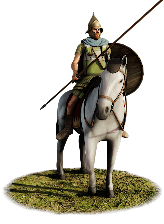
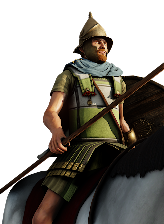
Gortynian cavalry has since long fought with the Aspis shield, well before other Greeks adopted it. Now that the elite of the city has adopted the equipment of the Xystophoroi, a professional corps of other citizens has been formed to fight like the Aspidophoroi in the rest of the Greek world. Equipped with flat, rimless Aspis shields – a Cretan variant –, linothorakes, javelins, spears, and a mix of Boiotian and Konos helmets, they are the perfect dual-purpose cavalry unit. Gortyn is regularly fighting wars with or against its neighbour Knossos, and these Aspidophoroi will prove a useful addition to its army.
Historical background
Gortynian cavalry must have played an important role in the great conflicts of the 3rd and 2nd century BC, the Chremonidean War (267-261 BC), the Lyttian War (221-215), the Cretan War (205-200 BC), the Knosso-Gortynian War (200-188 BC), the Kydonian War (188-184 BC), the Apollonian War (170-168 BC), and the Rhaukian War (168 BC). A need for additional cavalry forces may have led to the establishment of a newly formed corps of Aspis bearing cavalry, though this is only suggested and not proven by stelae from the Archaeological Museum of Heraklion. One tomb at the shrine of Glaukos and Kounabi in Eltyna (between Knossos and Gortyn, nearer to Knossos) from the late 3rd, or, more likely, the early 2nd century BC depicts a rider with a flat, rimless Aspis. He wears a spear for melee, javelins, a linothorax and either a Konos or a Boiotian helmet. The various successive wars make it hard to pin down an exact date when such horsemen may have been introduced in the Gortynian army, and the emergence of Aspidophoroi across the Greek world did not take place at one fixed point in time (see the description of the generic Aspidophoroi). We can be certain that Aspidophoroi existed by the time of the Rhaukian War, however, and they will thus have featured during the last century of Gortyn’s independence.
To the west of Gortyn lay Phaistos, an ancient Minoan stronghold, where the mysterious Disc of Phaistos was found, an object that was only ever deciphered by Goofy in a Mickey Mouse comic. Phaistos’ relations with its mighty neighbour in the Mesara plain had not always been good, but they had coexisted for over a millennium. Around 150 BC, however, the Gortynians decided that Phaistian independence was not to be tolerated any longer: Phaistos was assaulted and subsequently annexed (Chaniotis, Das antike Kreta (2004), p. 83). Even though Gortyn and Knossos, with their extended territories, had now become two of the largest poleis in the whole Greek world, they just could not let go: in 121 BC, Lato and Olous in eastern Crete had a conflict over the tiny island of Pyrrha as well as a cliff and an almost unknown sanctuary next to it. Gortyn and Knossos took sides and a fight between Hierapytna and Itanos in Eastern Crete also became embroiled in the war (Chaniotis (2004), p. 84). The Knossians eventually prevailed, and once again the Cretan Koinon was re-assembled. It then ruled over the island until the Romans began suspecting Cretan participation in the great threat of piracy furthered by Mithridates VI of Pontus. Marcus Antonius, father of Kleopatra’s lover, was sent to Crete to invade the island and kill all pirates he could find. This time, the Cretans showed unexpected unity, and their fleet won a quick and crushing victory over the Romans. While some of Antonius’ troops managed to land on the island, they were quickly surrounded and eventually agreed to a humiliating peace deal (Diod. 40.1.1). Disgraced, Antonius returned to Rome, where he received the mocking nickname ‘‘Creticus’’ (Plut. Antony 1.1).
The Cretan Koinon subsequently dispatched envoys to Rome to renew its old alliance with the Republic. The senators were easily won over by their arguments, but the charismatic Publius Cornelius Lentulus Spinther successfully vetoed the deal (Diod. 40.1.2-3). Instead, the Romans now sent their own officials to Crete and asked the Cretans to hand over all pirate ships and pay 4000 talents of silver for a new alliance (Konstant. Porphyr. Emb. 7). Enraged, the Cretans rejected the terms and faced a fresh invasion led by Quintus Caecilius Metellus. Metellus defeated a combined Knosso-Kydoniat army off Kydonia and made good progress on the island in 70/69 BC (Konstant. Porphyr. Emb. 8). Yet, heavy losses prevented further progress for a while until Metellus finally encircled Knossos. The Knossians now asked Pompey the Great for help, offering him a submission of sorts because of his well-known clemency. Absurdly, Pompey's army soon landed on Crete and fighting broke out between the two Roman forces (Konstant. Porphr. Emb. 8; Seager, Pompey the Great (2008), p. 46). Somehow, Crete still became a Roman province and Gortyn its capital. The cities seem to have retained much freedom, and Marc Antony, son of Creticus, re-established the Cretan Koinon, which would continue to exist for centuries: it was only renamed Koinon of the Cretans under Tiberius (Chaniotis (2015), p. 385). Thus, Gortyn had prevailed: the island was now finally at peace, and both Crete and Cyrenaica were governed from Gortyn.
Stats
| Rank in roster | ||
|---|---|---|
| Men per unit | 30 | █········· 8% |
| Attack | 16 | ████████·· 80% |
| Charge bonus | 24 | ████████·· 81% |
| Defence | 30 | ████······ 43% |
| · armour | 10 | █████····· 54% |
| · defence skill | 15 | ██········ 24% |
| · shield | 5 | ██████···· 57% |
| Morale | 12 | ██████···· 57% |
| Discipline | Normal | |
| Training | Highly trained | |
| Recruitment cost | 2,089 dn | █████····· 53% |
| Upkeep per turn | 841 dn | ████████·· 81% |
| Turns to recruit | 3 |
Weapons
| Primary | Secondary | Primary | Secondary | Primary | Secondary | Primary | Secondary | ||||
|---|---|---|---|---|---|---|---|---|---|---|---|
| Attack | 16 | 11 | Charge bonus | 24 | 29 | Type | thrown · blade | melee · blade | Damage | piercing | piercing |
| Projectile | javelin | — | Range | 50 | — | Ammunition | 2 | — | Properties | Used just before charging into combat | — |
Defence
| Primary | Secondary | Primary | Secondary | Primary | Secondary | Primary | Secondary | ||||
|---|---|---|---|---|---|---|---|---|---|---|---|
| Total | 30 | — | Armour | 10 | — | Defence skill | 15 | — | Shield | 5 | — |
Condition and terrain
| Hit points | 1 | Mount | medium horse | Ground: scrub / sand / forest / snow | 0 / -1 / -4 / -1 | Charge distance | 40 |
| Formations | Square |
Technical stats
| Time between blows (primary / secondary) | 2.5 s / 2.5 s | Extra fatigue in hot climates | 2 | Spacing between men: close / loose | 2.2 × 5.2 m / 3.3 × 7.8 m | Default ranks | 5 |
In battle: Very good stamina
Who can recruit it
A core roster unit for one faction, which can raise it anywhere it holds the right building:
Exactly what a settlement must have, route by route (3)
| Building | Also requires | Building | Also requires | Building | Also requires | ||
|---|---|---|---|---|---|---|---|
| Indirect Rule | Tier 2 Military Industrial Complex · Gortynian Reforms · Tier 1 Colony · Requires resource horses or horses supplied factionwide | Direct Rule | Tier 2 Military Industrial Complex · Gortynian Reforms · Tier 1 Colony · Requires resource horses or horses supplied factionwide | Homeland | Tier 2 Military Industrial Complex · Gortynian Reforms |