
Knossian Aspidophoroi
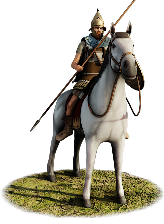
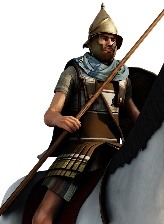
Class: heavy · Category: cavalry · Men per unit: 30
Reforms: Unlocked by Knossian Reforms
Description
Knossian cavalry has since long fought with the Aspis shield, centuries before the Greeks outside Crete adopted it. Now that the elite of the city has adjusted their equipment to match that of foreign Xystophoroi, a professional corps of other citizens has been formed to fight like the Aspidophoroi in the rest of the Greek world. Equipped with flat, rimless Aspis shields – a Cretan variant –, linothorakes, javelins, spears, and a mix of Boiotian and Konos helmets, they are the perfect dual-purpose cavalry unit. Knossos regularly fights wars with or against its neighbours Gortyn and Lyttos, and these Aspidophoroi will prove a useful addition during such conflicts.
Historical background
Knossian cavalry must have played an important role in the great conflicts of the 3rd and 2nd century BC, the Chremonidean War (267-261 BC), the Lyttian War (221-215), the Cretan War (205-200 BC), the Knosso-Gortynian War (200-188 BC), the Kydonian War (188-184 BC), the Apollonian War (170-168 BC), and the Rhaukian War (168 BC). Being located near the coast, the Knossians could deploy horsemen on at least some open ground. A need for additional cavalry forces may have led to the establishment of a newly formed corps of Aspis-bearing cavalry, though this is only suggested and not proven by stelae from the Archaeological Museum of Heraklion. One tomb, erected at the shrine of Glaukos and Kounabi in Eltyna (between Knossos and Gortyn, nearer to Knossos) from the late 3rd, or, more likely, the early 2nd century BC, depicts a rider with a flat, rimless Aspis. He wears a spear for melee, javelins, a linothorax, and either a Konos or a Boiotian helmet. The various successive wars make it hard to pin down an exact date when such horsemen may have been introduced in the Knossian army, and the emergence of Aspidophoroi across the Greek world did not take place at one fixed point in time (see the description of the generic Aspidophoroi). We can be certain that Aspidophoroi existed by the time of the Rhaukian War, however, and they will thus have featured during the last century of Knossos’ independence.
Gortyn and Knossos had become two of the largest poleis in the whole Greek world by the mid 2nd century BC, and were keen to preserve their hegemonic positions. In the 140s BC, another major war raged on the island, an event we are ill-informed about (Chanitios, Die Veträge zwischen kretischen Poleis (1996), p. 310). What we do know is that Hierapytna, the foremost city-state of southeastern Crete, attacked and destroyed its rival Praisos in northeastern Crete, annexing all of its chora (territory). The domain of Hierapytna now bordered on that of Itanos in eastern Crete, which had been a Ptolemaic base for over a century (in detail: Spyridakis, Ptolemaic Itanos (1970)). At this point, the Hierapytnians claimed that the island Leuke, which had once been owned by Praisos, and the area called Eleia, south of the sanctuary of Zeus Diktaios, should be theirs, too (Chaniotis (1996), p. 340). The Hierapytnian-Itanian War only ended in 140 BC, when a Roman embassy under Servius Sulpicius Galba brokered a peace deal (CI 3, 49). The Romans had suggested restoring the status quo ante bellum, which Hierapytna agreed to for the time being, but not in the long term: the ink had only just dried when they concluded an alliance with Knossos against Itanos (CI 3, 50). The war against Itanos was renewed, and it seems as if, this time, Hierapytna was able to capture and retain Leuke and Eleia, though the fragmented sources also allow for the possibility that Knossos had already fought in the first war (Chaniotis (1996), pp. 310-315).
In any case, the battle for eastern Crete had only just begun. In 121 BC, Lato and Olous, two neighbours of Hierapytna and Itanos, attacked each other for the possession of another tiny island (called Pyrrha), a cliff and a very small sanctuary (Chaniotis, Das antike Kreta (2004), p. 84). Knossos and Itanos entered the conflict on the side of Lato, while Gortyn and Hierapytna sided with Olous (CI 3, 51-52; Chaniotis (1996), p. 315). Lyttos, too, allied with Olous, but did not send any troops (IC 3, 53). After several years of fighting and another Roman intervention, the Knossian coalition eventually prevailed and Lato secured possession of the lands it had desired. Lato now sought an alliance with its erstwhile enemy Hierapytna to secure its new position (IC 3, 59). A few years later, a Knossian embassy motivated Lato and Olous to bury the hatred and accept the outcome of the war once and for all. After initially signing a friendship treaty, both poleis eventually joined the Cretan Koinon as mutual allies (IC 3, 61).
The Cretan Koinon was largely under Knossian control until the Roman conquest of the island. In the 70s BC, Cretan pirates had participated in raiding Roman provinces, supported by Mithridates VI of Pontos. Marcus Antonius, father of Kleopatra’s lover, was sent to Crete to invade the island and kill all pirates he could find. This time, the Cretans showed unexpected unity, and their fleet won a quick and crushing victory over the Romans. While some of Antonius’ troops managed to land on the island, they were quickly surrounded and eventually agreed to a humiliating peace deal (Diod. 40.1.1). Disgraced, Antonius returned to Rome, where he received the mocking nickname "Creticus’’ (Plut. Antony 1.1).
The Cretan Koinon subsequently dispatched envoys to Rome to renew its old alliance with the republic. The senators were easily won over by their arguments, but the charismatic Publius Cornelius Lentulus Spinther ultimately succeeded in vetoing the deal (Diod. 40.1.2-3). Instead, the Romans now sent their own officials to Crete and asked the Cretans to hand over all pirate ships and pay 4000 talents of silver for a new alliance (Konstant. Porphyr. Emb. 7). Enraged, the Cretans rejected the terms and faced a fresh invasion led by Quintus Caecilius Metellus. Metellus defeated a combined Knosso-Kydoniat army off Kydonia and made good progress on the island during the years 70-69 BC (Konstant. Porphyr. Emb. 8). Yet, heavy losses prevented further progress for a while until Metellus finally encircled Knossos. The Knossians now asked Pompey the Great for help, offering him a submission of sorts because of his well-known clemency. Absurdly, Pompey's army soon landed on Crete and fighting broke out between the two Roman forces (Konstant. Porphr. Emb. 8, Seager, Pompey the Great (2008), p. 46). Somehow, Crete still became a Roman province, but the choice of Gortyn as capital was a major blow for Knossos. In the time of Augustus, Knossos received a settlement of veterans from Capua who would live in Colonia Iulia Nobilis Cnosus (Cass. Dio. 49.14.5; Strab. 10.4.9C477). Not least due to this influx of new people, Knossos was now once again the largest city on Crete (Strab. 10.4.9C476). Against traditional ideas of Romanisation, more recent research has proven beyond doubt that most coloniae in the Greek East were Hellenised after one or two generations (an idea forwarded by Benjamin Isaac in: Limits of Empire. The Roman Army in the East (1990)). In Knossos and Gortyn, Italic terracotta became very popular, but both cities largely stuck to their pre-Roman laws, an autonomous internal policy, the Greek language, and specifically Cretan offices (Bowsky, Colonia Iulia Nobilis Cnosus, the first 100 years (2011)). Knossos’ heritage would never be forgotten, and today it is arguably one of the most well known cities of antiquity and Crete’s most frequented visitor attraction.
Stats
| Rank in roster | ||
|---|---|---|
| Men per unit | 30 | █········· 8% |
| Attack | 16 | ████████·· 80% |
| Charge bonus | 24 | ████████·· 81% |
| Defence | 30 | ████······ 42% |
| · armour | 10 | █████····· 54% |
| · defence skill | 15 | ██········ 23% |
| · shield | 5 | ██████···· 57% |
| Morale | 12 | ██████···· 57% |
| Discipline | Normal | |
| Training | Highly trained | |
| Recruitment cost | 2,089 dn | █████····· 53% |
| Upkeep per turn | 841 dn | ████████·· 81% |
| Turns to recruit | 3 |
Weapons
| Primary | Secondary | Primary | Secondary | Primary | Secondary | Primary | Secondary | ||||
|---|---|---|---|---|---|---|---|---|---|---|---|
| Attack | 16 | 11 | Charge bonus | 24 | 29 | Type | thrown · blade | melee · blade | Damage | piercing | piercing |
| Projectile | javelin | — | Range | 50 | — | Ammunition | 2 | — | Properties | Used just before charging into combat | — |
Defence
| Primary | Secondary | Primary | Secondary | Primary | Secondary | Primary | Secondary | ||||
|---|---|---|---|---|---|---|---|---|---|---|---|
| Total | 30 | — | Armour | 10 | — | Defence skill | 15 | — | Shield | 5 | — |
Condition and terrain
| Hit points | 1 | Mount | medium horse | Ground: scrub / sand / forest / snow | -2 / -1 / -7 / -1 | Charge distance | 40 |
| Formations | Square |
Technical stats
| Time between blows (primary / secondary) | 2.5 s / 2.5 s | Extra fatigue in hot climates | 2 | Spacing between men: close / loose | 2.2 × 5.2 m / 3.3 × 7.8 m | Default ranks | 5 |
In battle: Very good stamina
Who can recruit it
A core roster unit for one faction, which can raise it anywhere it holds the right building:
Exactly what a settlement must have, route by route (3)
| Building | Also requires | Building | Also requires | Building | Also requires | ||
|---|---|---|---|---|---|---|---|
| Indirect Rule | Tier 2 Military Industrial Complex · Knossian Reforms · Tier 1 Colony · Requires resource horses or horses supplied factionwide | Direct Rule | Tier 2 Military Industrial Complex · Knossian Reforms · Tier 1 Colony · Requires resource horses or horses supplied factionwide | Homeland | Tier 2 Military Industrial Complex · Knossian Reforms |