
Kyrenaian Kleruchoi Phalangites
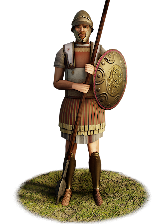
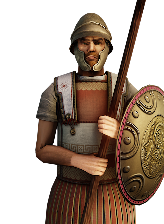
Class: spearmen · Category: infantry · Men per unit: 60
Description
Klerouchoi and katoikoi are landowners and settlers, primarily of Greek and Macedonian descent, who have been given portions of land to settle in return for military service. Though not professional soldiers in the sense of a standing army, they are included in all the major campaigns of the kingdom and are therefore to be considered as experienced fighters. Their armour and weaponry consists of a small shield (pelte), leg guards (knemides), linothorax armour, and helmets. As with all phalanxes, the primary strength behind theirs is simple: cohesion and maintaining a solid formation. When they fight, they are usually unaware of what is going on around them and behind their position. Because of this, they need to be protected from attacks against their flanks or their rear, or they will lose their formation and may run from the battlefield.
Historical background
The city of Kyrene was founded in 631 BC during the Archaic period by settlers from Thera (today’s Santorini). Kyrene went on to establish sub-colonies in the broader region of Cyrenaica: Apollonia, Ptolemais and Taucheira. Apollonia itself over time became the port of Kyrene. In later times, the Cyrenaica was sometimes referred to as the 'Pentapolis', the 'Five Cities', these five being Kyrene, Apollonia, Ptolemais, Taucheira and Euhesperides (Fage & Oliver (eds.), The Cambridge History of Africa – Vol. 2, 1975). In the late 4th century BC, the region became part of the Ptolemaic empire. The local governor Ophellas however, ruled like a king and tried to loosen all ties with Alexandria. In 301 BC, he was assassinated by Agathokles, tyrant of Syracuse, during the latter’s campaign against the Carthaginians in North Africa, and subsequently Ptolemy I sent his stepson Magas to Kyrene to bring it back under Ptolemaic control. Magas had been born by 320 BC at the latest as the son of a Philippos and Berenike, the later wife of Ptolemy I (Ameling, s.v. Magas, in: DNP). Magas recaptured the province of Kyrene for Ptolemy I shortly after 301 and became its new governor.
For geographical reasons alone, his position must have been largely autonomous, and after the death of Ptolemy I, Magas completely broke away from the Ptolemaic Kingdom (probably between 279 and 274 BC), assumed the title of king, and married Apama, daughter of Antiochos (Ameling, id.). He sought an alliance with various Cretan city states to weaken the Ptolemaic position on the island (StV III 468; koinón of the Oreioi, Gortyn; cf. on Antiochos StV III 486) and forged ties with the Seleucid king Antiochos I. In 274 BC Magas and Antiochos attacked the Ptolemies together from both sides. The plan was that the Seleucids would invade Ptolemaic Palestine from Syria and Magas would march from Libya in direction of Alexandria, but the attempt failed as the Seleucids under Antiochos I were stopped in Palestine by Ptolemaic forces under Ptolemy II himself. Magas could not attack, as he had to deal with a rebellion by the Marmaridai, a group of Libyan nomads. He did, however, manage to retain his independence until his death in 250 BC. He had betrothed his daughter Berenike II to Ptolemy III Euergetes, the son of Ptolemy II, as a way to seal an alliance between the two realms and to secure the independence of Kyrene. After the death of Magas, Apama II broke the marital alliance between her daughter Berenike II and Ptolemy III and proposed her daughter and the throne to Demetrios the Fair, son of the Antigonid king Demetrios I Poliorketes. Demetrios accepted and became the new king of Kyrene. This gave the Antigonids strategic control of the western side of the Ptolemaic Kingdom. Soon after, Demetrios was assassinated by Berenike for sleeping with her mother Apama, however, upon which Berenike returned to Egypt to finally marry her original fiancé, Ptolemy III Euergetes, and bring back the Cyrenaica under Ptolemaic control.
Not much is known about the army of Kyrene under Magas, but since the city was an important and fertile Greek city under Ptolemaic control, it will have largely consisted of Ptolemaic forces with some units typical of Greek city-states. Polybios mentions that during the Battle of Raphia in 217 BC, 3,000 Libyans fought as pikemen on the side of the Ptolemies under the command of Ammonios of Barke (Polybius V,65,8). It is not clear if these Libyans were Kleruchoi from Greek cities in Cyrenaica or native Libyans trained in the Macedonian fashion, but we decided for the second option since it seemed more plausible. After all, cleruchs from Kyrene were one of the largest contingents in the Ptolemaic phalanx (Bagnall, Origins of Ptolemaic Cleruchs, 1984) and there would have been no reason for Polybios to single them out. Since many Ptolemaic phalangites hailed from Kyrene, the unit is almost identical with the Ptolemaic Kleruchoi Phalangites.
Stats
| Rank in roster | ||
|---|---|---|
| Men per unit | 60 | █████████· 87% |
| Attack | 19 | █████████· 92% |
| Charge bonus | 1 | █········· 4% |
| Defence | 24 | ███······· 26% |
| · armour | 10 | █████····· 54% |
| · defence skill | 11 | █········· 6% |
| · shield | 3 | ████······ 37% |
| Morale | 10 | ███······· 29% |
| Discipline | Normal | |
| Training | Highly trained | |
| Recruitment cost | 1,843 dn | ████······ 41% |
| Upkeep per turn | 675 dn | ██████···· 61% |
| Turns to recruit | 3 |
Weapons
| Primary | Secondary | Primary | Secondary | Primary | Secondary | Primary | Secondary | ||||
|---|---|---|---|---|---|---|---|---|---|---|---|
| Attack | 19 | 4 | Charge bonus | 1 | 1 | Type | melee · blade | melee · simple | Damage | piercing | piercing |
| Properties | Long spear (bonus against cavalry, penalty against infantry) · +8 attack against cavalry · very long pike (phalanx) | — |
Defence
| Primary | Secondary | Primary | Secondary | Primary | Secondary | Primary | Secondary | ||||
|---|---|---|---|---|---|---|---|---|---|---|---|
| Total | 24 | — | Armour | 10 | — | Defence skill | 11 | — | Shield | 3 | — |
Condition and terrain
| Hit points | 1 | Ground: scrub / sand / forest / snow | -5 / -1 / -8 / -1 | Charge distance | 0 | Formations | Square · Phalanx |
Technical stats
| Time between blows (primary / secondary) | 2.5 s / 2.5 s | Extra fatigue in hot climates | -1 | Collision mass per man (1.0 is normal) | 1.09 | Spacing between men: close / loose | 1 × 1 m / 2 × 2.4 m |
| Default ranks | 5 |
In battle: Can sap · Good stamina
Who can recruit it
A core roster unit for one faction, which can raise it anywhere it holds the right building:
Exactly what a settlement must have, route by route (3)
| Building | Also requires | Building | Also requires | Building | Also requires | ||
|---|---|---|---|---|---|---|---|
| Indirect Rule | Tier 2 Military Industrial Complex · Tier 1 Colony | Direct Rule | Tier 2 Military Industrial Complex · Tier 1 Colony | Homeland | Tier 2 Military Industrial Complex |