
Massaliote General's Bodyguard
Class: spearmen · Category: infantry · Men per unit: 20
Description
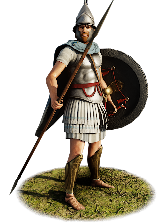
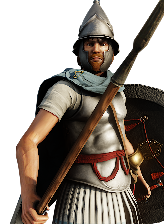
The Massaliote General’s Bodyguard is formed from Massalia’s finest and most honourable citizens, entrusted with the vital task of protecting the army’s strategos. These elite warriors are heavily armed and armoured, fighting in the disciplined formation of a hoplite phalanx. They wear bronze muscle cuirasses, greaves, and bronze helmets, while carrying aspis shields adorned with the symbols of their city, such as the lion. Their primary weapon is the dory spear, typical for the hoplite phalanx, with a xiphos sword as secondary weapon for close combat. Being the urban elite of Massalia, these men are distinguished by their fine cloaks, crests, and sashes, resulting in a striking and imposing appearance. These troops are best positioned behind the main battle line, guarding the general. They should only be committed to combat in the most critical moments, when the tactical situation grows dire.
Historical background
“A bitch once asked a shepherd, when she was big with young, for a place to bring forth her puppies; having obtained it, she requested again that she might be allowed to bring them up in the same place; and at last, when her young were grown up, and she could depend upon their support, she claimed possession of the place as her own. […] the people of Massalia, who are now regarded as your tenants, will one day become masters of your territory.”
Persuaded by the analogy in the fable, the Ligurian leader Comanus, King of the Segobrigii, decided to try to put an end to the colony founded under his father’s reign (Justin 43.4).
Massalia was founded around 600 BC by Ionian colonists from Phocaea. It quickly rose to become the most important emporion in the Western Mediterranean. The Roman historian Justin explains that this caused tension with the surrounding ‘barbarians’: “The Ligurians, jealous of the growing greatness of the city, harassed the Greeks with continual war; but they, repelling their attacks, rose to such a degree of strength, that they conquered their enemies and planted several colonies in the lands which they captured” (Justin 43.3). Thus it seems likely that the colonists, those who formed the elite of the city, fighting in a phalanx formation, could hold their own against their opponents. Massalia’s hoplite force was never huge, possibly counting around 6,000 men at its high point in the 1st century BC (Dietler, Archaeologies of Colonialism (2015), p. 180), so it seems likely that they would have preferred quality over quantity.
The Massaliote oligarchy strictly upheld its traditional Ionian laws over the centuries since the foundation of the city around 600 BC. Aristotle states that at one point, the oligarchy of the few was replaced by a broader participation of the city elite in its governance (Aristot. Pol. 5.1305b). From that point on, the only way to become a respectable lifetime member of the ruling council of 600, the Timouchoi (Τιμοῦχοι), was to have children, thus securing the Greek future, and to be the son of someone who had been a citizen of Massalia for over three generations (Strab. IV.1.4). It is in this group that many of the bodyguards would be found. The Greek term of the council is derived from timē (τιμή), meaning "honour". These ‘honourable’ men were probably a mix of aristocrats and rich merchants in charge of administrative, judicial, and military affairs. It is likely that from time to time they had to show their honour, much like the lions depicted on their coinage, on the battlefield in times of need. And why, then, not keep a close eye on the strategos, who was most likely elected for one year, as his bodyguard? A fine way to keep him in check (Moore, Aristotle and Xenophon on Democracy and Oligarchy? (1975), p. 55).
Further evidence for hoplite generals can be found in the works of Aristotle. He explicitly states that Massalia was a ‘polity’, in this case meaning a political system midway between an oligarchy and a democracy, with its ruling class being composed of hoplites who could afford considerable private expenses, but not the most expensive and large estates needed to raise and maintain a stock of horses (Reeve (ed. trans.) Aristotle, Politics (1998), pp. 39, 146). This was likely reinforced by the fact that the strip of land around Massalia was unsuitable for breeding horses.
Military tradition is another clue why the bodyguard would have fought on foot. Massaliote culture, known for its conservatism and geographic isolation from military advancements in mainland Greece, provides little indication that its commanders prioritised cavalry over infantry leadership (Lomas, ‘Hellenism’, in: Lomas (ed.), Greek Identity in the Western Mediterranean (2004), pp. 479-481). Greek military doctrine, both before and after the rise of Macedonian cavalry tactics, remained predominantly focused on infantry. This tradition of infantry-centric leadership extended even to elite units, such as the Spartan hippeis. Despite their name translating to "cavalry", the hippeis served as the Spartan kings' royal guard and fought exclusively on foot, exemplifying the central role of infantry in Greek warfare.
Demonstrating this traditional combat style, the Massaliote hoplite is armed with a muscle cuirass, an aspis - a round shield bearing the Massaliote lion -, and greaves. As offensive weapons, they rely on the trusty hoplite dory, a 2-3m (6-10 ft) spear weighing around 2kg (4.4lb). It has an iron leaf-pattern spearhead on the front and a butt-spike for counterbalance on the other side (McNab, A History of the World in 100 Weapons (2014), p. 37). The helmets of this unit are not all in the Greek tradition. While some wear Greek bronze Konos helmets, many wear Gallic iron helmets, which are modelled after helmets found in Monterenzio and Gottolengo in northern Italy, in what was then Gallic territory (Bernade et al., Monterenzio, (prov. De Bologne). La nécropole Celto-étrusque de Monterenzio Vecchia (2007), pp. 238–245; inv. ST52745; Brescia, Santa Giulia Museo della città, Gottolengo (BS), campi vascina Lumaghina, 1925).
Massaliote and Roman history became closely intertwined. Justin, in the second century AD, emphasised the theme of the longstanding Massaliote -Roman friendship: “In the time of King Tarquinus, a company of Phocaeans from Asia, sailing up the Tiber, formed an alliance with the Romans, and proceeding from thence to the inmost part of the gulf of Gaul, built the city of Massalia amidst the Ligurians and the savage Gallic tribes […]” (Justin 43.3). After Eumenes III of Pergamon was taken prisoner in 129 BC, the people of Massalia sent ambassadors to Rome to intercede in favour of Phocaea, their mother city. The Roman senate had ordered Phocaea to be destroyed because it had taken up arms against the Roman people twice (Justin 37.1). The delegation successfully got a pardon, highlighting how well relations were kept with both their ancestors and the Roman senate. By the second half of the 2nd century BC, Massalia increasingly called for Roman assistance in its wars, resulting in the establishment of the Roman province of Gallia Narbonensis in 118 BC (Cic. Font. 5, 13; Vell. Pat. I, 15, 5). Massalia, still independent, received a buffer zone along the coast, while the Romans controlled the hinterland. During the civil war between Pompey and Caesar, the conservative timouchoi unsurprisingly sided with the Senate, thereby provoking a lengthy siege by Caesar in 49 BC (Caes. Civ. 2, 22). Massalia was overcome after a long fight; the city became a civitas foederati, allowing it to keep its own laws, but no independent foreign and military policy (Strab. IV, 1, 5). The Timouchoi, thus stripped of political power, were not actively needed anymore for active military duty. They would henceforth contribute financially to pay for Roman military protection rather than serve on the battlefield themselves.
Stats
| Rank in roster | ||
|---|---|---|
| Men per unit | 20 | █········· 7% |
| Attack | 16 | ████████·· 80% |
| Charge bonus | 17 | ███████··· 71% |
| Defence | 56 | ██████████ 100% |
| · armour | 12 | ███████··· 69% |
| · defence skill | 37 | ██████████ 99% |
| · shield | 7 | █████████· 91% |
| Morale | 15 | █████████· 91% |
| Discipline | Normal | |
| Training | Highly trained | |
| Recruitment cost | 14,568 dn | ██████████ 100% |
| Upkeep per turn | 200 dn | █········· 6% |
| Turns to recruit | 4 |
Weapons
| Primary | Secondary | Primary | Secondary | Primary | Secondary | Primary | Secondary | ||||
|---|---|---|---|---|---|---|---|---|---|---|---|
| Attack | 16 | — | Charge bonus | 17 | — | Type | melee · blade | — | Damage | piercing | — |
| Properties | Light spear (braced against cavalry charges from the front) · +8 attack against cavalry | — |
Defence
| Primary | Secondary | Primary | Secondary | Primary | Secondary | Primary | Secondary | ||||
|---|---|---|---|---|---|---|---|---|---|---|---|
| Total | 56 | — | Armour | 12 | — | Defence skill | 37 | — | Shield | 7 | — |
Condition and terrain
| Hit points | 1 | Ground: scrub / sand / forest / snow | -1 / -2 / -4 / -2 | Charge distance | 30 | Formations | Square |
Technical stats
| Time between blows (primary / secondary) | 2.5 s / — | Extra fatigue in hot climates | 4 | Collision mass per man (1.0 is normal) | 1.35 | Spacing between men: close / loose | 1 × 1.2 m / 2 × 2.4 m |
| Default ranks | 5 |
In battle: A unit suitable for a general · Good stamina
Who can recruit it
A core roster unit for one faction, which can raise it anywhere it holds the right building:
Exactly what a settlement must have, route by route (2)
| Building | Also requires | Building | Also requires | ||||
|---|---|---|---|---|---|---|---|
| Direct Rule | Tier 3 Military Industrial Complex · Tier 2 Colony | Homeland | Tier 2 Military Industrial Complex |