
Mercenary Cypriote Tarentine Cavalry
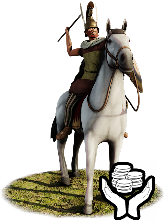
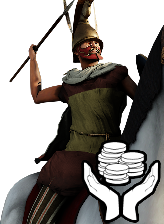
Mercenary. Hired from a regional pool, not recruited from a building.
Class: missile · Category: cavalry · Men per unit: 30
Description
These light cavalrymen are equipped in the Tarantine fashion, with javelins and machaira swords, supplemented by round aspis shields for defence that often bear a fearsome gorgoneion head. Their mobile role on the battlefield is to harass the enemy wherever possible: to strike from range, withdraw, and exploit exposed flanks. The Cypriote Tarantine Cavalry wear a varied mix of headgear, most commonly Phrygian helmets or caps, but also konos and pilos helmet types. Some helmets bear side projections or feather fittings, adding both distinction and display. Their clothing also reflects Cyprus’ cultural crossroads. Many wear Greek tunics and Macedonian cloaks, while others display eastern garments and trousers in the Anatolian or Persian style. Armour is rare among these men, though a few riders are protected by linothorakes. This diversity gives the unit both flexibility and speed, but their light armour means that these men should avoid sustained melee or concentrated missile fire.
Historical background
The appearance of Cypriote Tarantine-style cavalry is known primarily from terracotta votive figurines found in sanctuaries across Cyprus, especially at the temple of Apollo Hylates at Kourion in the south. These figures, dating from the late 4th to mid-3rd century BC, depict mounted warriors armed with javelins and small shields, clearly performing the skirmishing role commonly associated with Tarantine cavalry in the Hellenistic world. Several examples carry aspis shields decorated with gorgoneia and wear Phrygian helmets, confirming both their Greek equipment and eastern stylistic elements (Cesnola Collection, MET inv. 74.51.1784; 74.51.1659). Other figurines from Kourion and Idalion (near modern Dali in the district of Nicosia) show riders in the act of throwing javelins, reinforcing their identification as light missile cavalry (Young and Young (1955), pp. 104–106; MET inv. 74.51.1656).
Cyprus in the Hellenistic period was a meeting point of Greek and Near Eastern traditions, and this is reflected in its cavalry’s appearance. While many riders wear Greek tunics and cloaks, others display eastern dress such as trousers and head-scarves comparable to Anatolian or Persian attire (Karageorghis et al., The Cesnola Collection of Cypriot Art: Terracottas (2016), no. 285, pp. 167–77, p. 262). Such variation likely mirrors the island’s mixed population and long Achaemenid heritage, as well as the continued exchange with neighbouring Anatolia and the Levant. The Phrygian helmet itself, common among the figurines, was widely used across the eastern Mediterranean, and became a hallmark of Hellenistic light troops.
Cyprus was caught up in the unravelling of the Empire of Alexander the Great. Ptolemy took a special interest in the island, as it was crucial for naval dominance (Petrides, Introduction to the History of Cyprus (2013), pp. 22-24). It fell under definitive Ptolemaic control in 294 BC, and the island was largely Hellenised thereafter. Under Ptolemaic rule, Cyprus was a key naval and military base, and local cavalry would have served both the island’s defence and expeditionary forces. The adoption of the Tarantine style, light horsemen specialising in javelin skirmishing, fits the wider Hellenistic trend of employing agile cavalry for screening, scouting, ambushing, and harassing roles on the battlefield. This Cypriote variant, however, retains distinctive local features, notably the gorgoneion shields and eastern garments, marking them as products of Cyprus’ unique cultural and military environment.
The first Roman intervention in Cyprus happened in 168 BC, when Popillius Laenas forced Antiochus IV to retreat his forces from Cyprus. In 58 BC Rome laid a more direct claim on the island, after Clodius Pulcher was kidnapped off its coast (Petrides (2013), p. 52). Stabo (XIV, 6) paints a vivid picture of how little things can have far-reaching consequences:
“Publius Claudius Pulcher; for the latter, having fallen into the hands of the bands of pirates, the Cilicians then being at the height of their power, and, being asked for a ransom, sent a message to the king (Ptolemy of Cyprus was the king of Cyprus c. 80 BC – 58 BC. He was the younger brother of Ptolemy XII Auletes, king of Egypt) begging him to send and rescue him. The king indeed sent a ransom, but so utterly small that the pirates disdained to take it and sent it back again, but released him without ransom. Having safely escaped, he remembered the favour of both; and, when he became tribune of the people, he was so powerful that he had Marcus Cato sent to take Cyprus away from its possessor.”
Stats
| Rank in roster | ||
|---|---|---|
| Men per unit | 30 | █········· 8% |
| Attack | 11 | ███······· 34% |
| Charge bonus | 23 | ████████·· 80% |
| Defence | 20 | ██········ 19% |
| · armour | 3 | ██········ 21% |
| · defence skill | 12 | █········· 9% |
| · shield | 5 | ██████···· 57% |
| Morale | 12 | ██████···· 57% |
| Discipline | Normal | |
| Training | Untrained | |
| Upkeep per turn | 701 dn | ███████··· 67% |
Weapons
| Primary | Secondary | Primary | Secondary | Primary | Secondary | Primary | Secondary | ||||
|---|---|---|---|---|---|---|---|---|---|---|---|
| Attack | 11 | 10 | Charge bonus | 23 | 25 | Type | thrown · archery | melee · blade | Damage | piercing | slashing |
| Projectile | javelin | — | Range | 60 | — | Ammunition | 7 | — | Properties | Thrown | — |
Defence
| Primary | Secondary | Primary | Secondary | Primary | Secondary | Primary | Secondary | ||||
|---|---|---|---|---|---|---|---|---|---|---|---|
| Total | 20 | — | Armour | 3 | — | Defence skill | 12 | — | Shield | 5 | — |
Condition and terrain
| Hit points | 1 | Mount | light horse | Ground: scrub / sand / forest / snow | 0 / -1 / -3 / -1 | Charge distance | 40 |
| Formations | Square |
Technical stats
| Time between blows (primary / secondary) | 2.5 s / 2.5 s | Extra fatigue in hot climates | -2 | Spacing between men: close / loose | 2.2 × 5.2 m / 3.96 × 7.28 m | Default ranks | 5 |
In battle: Can form Cantabrian circle · Very good stamina
Where to hire it
Mercenaries are hired from a regional pool, not recruited from a building. This unit is offered by 1 pool covering 4 regions, at 4,526 dn to hire and 2 experience.
Mercenary pool: Cyprus
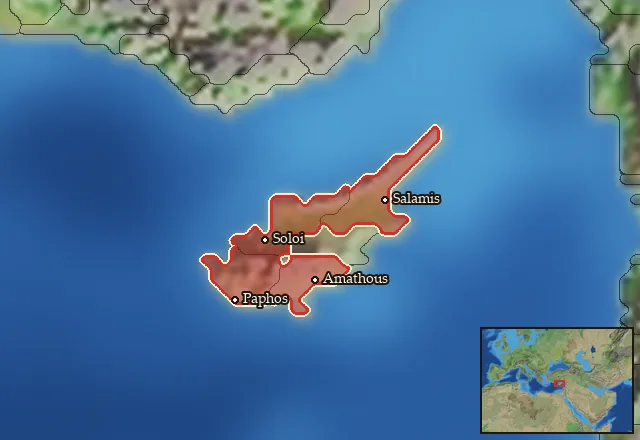
At least one of those pools sells to any faction that has an army in range, with no faction restriction.
The 4 regions where this unit appears in a mercenary pool
Aipeia · Amathousia · Paphia · Salamina