
Mercenary Gortynian Agelai
Mercenary. Hired from a regional pool, not recruited from a building.
Class: missile · Category: infantry · Men per unit: 40
Description
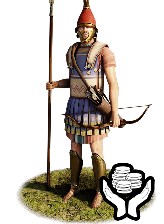
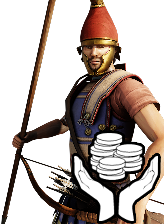
This archer unit is a so-called agela (literally "herd”) and consists of teenagers who have sworn their life to their leader, a young man from the elite of Gortyn. The unit was founded by the son of a prominent citizen when he ritually abducted a boy from the lower classes, who was joined by his friends. After a staged defeat, they began hunting wild goats in the barren mountains of Crete together. This institution forces the sons of Gortynian citizens to learn how to survive in the wild and how to fight with bow, sling and spear. Somewhat similar to the Spartan Krypteia, it forms male Cretans into warriors at a young age. In battle, they fight as archers and use the superior Cretan composite bow, but they are also skilled in defending themselves in melee with spear and round pelte shield. Though some of these teenage boys only wear a chiton (tunic) or exomis (half tunic), others (like the erastes himself) can afford a linothorax (linen cuirass) and all are additionally protected by Phrygian helmets as well as greaves. They are thus much better armed and better prepared for battle than other Ephebes in the Greek world.
Historical background
Ancient Crete, pretty much like modern Crete, was a land of old and peculiar traditions. One of these traditions was the ritual kidnapping of young men, which fulfilled an important role in forging networks and binding the different classes of Cretan society together. A young man from the highest class, the erastes or philetor (literally "lover”), chose a younger boy from the lower classes, the kleinos (“the famous”) or parastathentes (“by-stander”), for his virtuous, honest and brave character (Strab. 10.4.21C483 = Ephoros FGrHist 70 F149.21). Both the boy and his friends would usually be 17 years old at this point (Hesych. s.v. apagelos). If family and friends of the kleinos considered the erastes honourable enough, they decided that the boy’s mates would only offer token resistance (Dynes and Donny, Homosexuality in Ancient Greece (1992), p. 129). The erastes took his ‘victim’ to the mountains and spent time with him to forge a relationship with him that often involved drinking, hunting and sex. Eventually, the kleinos received as presents an ox, a drinking cup and a soldier’s cloak (Aristot. fr. 611.15; Dynes/Donny (1992), p. 129). Afterwards, the friends of the kleinos would join the pair and, once the kleinos had sacrificed the oxen to the gods and given the meat to his erastes and companions, they would form a hunting party together (Seelentag, Der Abschluß der Ephebie (2009), p. 157).
Their usual prey were wild goats, the most popular target for Cretans ever since the Minoan period (Eiring, The Knossos Hunt, 2004). The Ptolemaic poet Kallimachos of Kyrene (Epigr. 62/63) even goes as far as claiming that Cretan hunters had brought the goats on holy Delos to near extinction in the 3rd century BC! Thus, the teenagers learned to fight with spear and bow and formed a bond: later in life, the boy and his mates would follow the former erastes as their leader, fighting as both archers and hoplites (Ael. De Nat. An. 4.1, Ephoros F149.21; Chrimes, Ancient Sparta (1999), pp. 224-226). The erastes was a member of the Hippeis class and could fight on horseback (Chrimes (1999), p. 227), but while they were young, the whole band would fight as infantry (Perlman, Imagining Crete (2005), p. 308). Their regiments were called agelai (“herds”) and each agela was commanded by the erstwhile erastes (Chaniotis, Age of Conquest (2018), p. 331). The boys would still return to their hetaireia, the family group of their fathers, at the end of the two year-experience, in order to complete their education. Carolyn Schofield aptly sums up the whole training process (Kretan cult and customs (2011), p. 154): ‘The boys were enrolled into agelai, and brought up accustomed to physical hardship and fighting, practising archery, war-dances and songs, wearing military dress, and bearing arms.’
In Gortyn, we also have evidence from several inscriptions, including the famous 5th century BC Gortyn code, that orphans could be adopted by a hetairos and thus introduced into his hetaireia. The adoptive father had to pay for an oxen and a jug of wine, which the boy would then hand over to his new hetaireia as a gift. After the ceremony was completed, the teenagers were available for the agela process, too, and could thus become respected citizens and soldiers (Seelentag, Das archaische Kreta (2015), p. 303). As the place where Zeus brought the Phoenician princess Europa and slept with her – beneath a sycamore tree, which I saw with my own eyes – Gortyn had a claim to being one of the oldest cities in Europe and one of the literal birthplaces of the continent’s name. While its ancient enemy Phaistos, which was eventually conquered in the 2nd century BC (Chaniotis, Das antike Kreta (2004), p. 83), and its arch rival Knossos made similar claims, the Gortynians had succeeded in convincing most Greeks that their story was the accurate one (cf. Thonemann/Price, The Birth of Classical Europe (2010), pp. 1-2). This mythical background and the city’s impressive legal code alone would have been enough to fill the hearts of its sons with pride, but the polis also expanded successfully in the Hellenistic period, annexing not only Phaistos, but also many other smaller cities like Apollonia or Rhaukos (Chaniotis (2004), pp. 82-83).
During the so-called Lyttian War (ca. 221-216 BC), however, the agelai turned against their elders. Gortyn had entered the war as an ally of Knossos, hell bent on destroying Lyttos, the third major power on the island, but the youngsters felt that destroying Lyttos was not right. The older citizens managed to expel them with Knossian help, but Lyttos and its allies eventually managed to secure the support of Macedon and Achaia. With these powerful allies on their side, they captured Phaistos and then reconquered Gortyn: the kids had won the day (Polyb. 4.53.6, 55.1-6). Throughout most of Gortyn’s history, however, the agelai would fight as military units inside the hetaireia, together with their fathers, uncles and grandfathers.
Since the members of the agela trained while hunting, we have designed them as a mixed archer/light hoplite unit, with Cretan composite bows, Phrygian and Attic helmets, linothorakes, round pelte shields, spears and brazen greaves. Various depictions of Cretan youths at war are known and help to inspire this unit, among them an ephebe from the 1st century BC who mourns the death of his comrades (now in the Archaeological Museum of Heraklion) and a fallen Knossian archer from the 5th century BC, who is depicted on his grave stela in heroic nudity (also in the Archaeological Museum of Heraklion). Therefore, some of the soldiers of the Agela in RIS wear a chiton, some only an exomis, but considering that they were still somewhat of an elite corps, a few are also protected by the linen cuirasses.
Stats
| Rank in roster | ||
|---|---|---|
| Men per unit | 40 | ███······· 30% |
| Attack | 9 | █········· 13% |
| Charge bonus | 1 | █········· 4% |
| Defence | 25 | ███······· 28% |
| · armour | 7 | ████······ 42% |
| · defence skill | 16 | ███······· 28% |
| · shield | 2 | ███······· 25% |
| Morale | 6 | █········· 6% |
| Discipline | Low | |
| Training | Untrained | |
| Upkeep per turn | 508 dn | ██········ 21% |
Weapons
| Primary | Secondary | Primary | Secondary | Primary | Secondary | Primary | Secondary | ||||
|---|---|---|---|---|---|---|---|---|---|---|---|
| Attack | 9 | 4 | Charge bonus | 1 | 1 | Type | missile · archery | melee · blade | Damage | piercing | piercing |
| Projectile | arrow | — | Range | 170 | — | Ammunition | 25 | — |
Defence
| Primary | Secondary | Primary | Secondary | Primary | Secondary | Primary | Secondary | ||||
|---|---|---|---|---|---|---|---|---|---|---|---|
| Total | 25 | — | Armour | 7 | — | Defence skill | 16 | — | Shield | 2 | — |
Condition and terrain
| Hit points | 1 | Modifier against mounts | horse +1 · chariot +1 · camel +1 | Ground: scrub / sand / forest / snow | 0 / 0 / 0 / 0 | Charge distance | 30 |
| Formations | Square |
Technical stats
| Time between blows (primary / secondary) | 2.5 s / 2.5 s | Extra fatigue in hot climates | 0 | Collision mass per man (1.0 is normal) | 0.97 | Spacing between men: close / loose | 1.2 × 2.8 m / 2.16 × 5.04 m |
| Default ranks | 5 |
In battle: Very good stamina
Where to hire it
Mercenaries are hired from a regional pool, not recruited from a building. This unit is offered by 1 pool covering 11 regions, at 3,787 dn to hire and 0 experience.
Mercenary pool: Crete
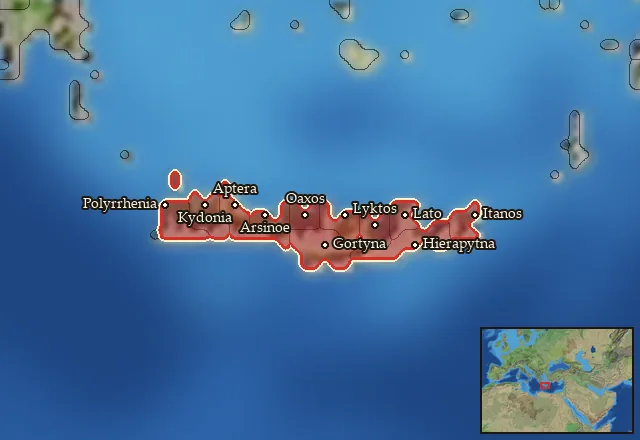
At least one of those pools sells to any faction that has an army in range, with no faction restriction.