
Mercenary Illyrian Thureophoroi Cavalry
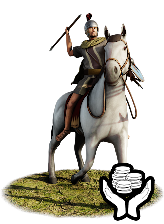
Mercenary. Hired from a regional pool, not recruited from a building.
Class: light · Category: cavalry · Men per unit: 30
Description
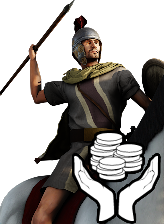
Illyrian Thureophoroi Cavalry are professional warriors. They have ridden their horses to war with sufficient success to be able to afford fine Celtic equipment including the Thureos shield, with its large oval that can protect most of the body, and Montefortino helmets, bronze or iron helmets that offer good coverage of the head and optionally cheeks and neck if cheek guards are added. They are still Illyrians at heart, however, and use the weapons of their ancestors, the Sibyna spear and a clutch of javelins, to rampage through enemy lines after disrupting them with a hail of missiles. These men lack body armour, trusting instead in their agility, skills at arms, and large shields to avoid most harm.
Historical background
Illyrians is a catch-all term for the people that lived in Illyria, not a name chosen by themselves or even particularly provable through material goods. Archaeology shows no clearly definitive groups or material goods to prove existence of one overarching ethnic or social group of Illyrians (Wilkes, The Illyrians (1996), p. 65). In fact, the initial idea of ‘the Illyrians’ was essentially yet another barbarian trope of the Greeks and Romans, to describe a people unlike them, a convenient ‘other’ that need not be respected or treated to the standards of a civil society (Dzino, Constructing Illyrians - Prehistoric Inhabitants of the Balkan Peninsula (2014), p. 1). Dio Cassius (49.36.2) describes these poor wretches and their shortcomings in detail, writing in this case about the Delmatae as pitifully “not well off as regards either soil or climate; they cultivate no olives and produce no wine except to a very slight extent and a wretched quality at that”.
One of the initial ideas of Illyrian social development, and especially horse riding, was that North Illyria was influenced in its nascent stages by horse and cart-rider “Thraco-Cimmerians”, but this idea is seemingly false, as it has no real evidence to support it (Wilkes (1996), p. 41). What is known, aside from the ancient stereotypes, is that they followed social dynamics similar to other early Iron Age societies, that changed over time as the power of tribal chiefs peaked and was then challenged by centralised societies in nearby regions (Wilkes (1996), p. 66). These tribal societies were often built around protecting herds of livestock, which required armed men riding horses to do so. As time went on these horse riders and their social groups grew in size and complexity, they started fighting and winning more wealth, until eventually they were buried as elites in tumuli with weapons and occasionally horses or riding gear, too (Hammond, The Cambridge Ancient History X - Illyrians And North-West Greeks (1994), p. 428). Illyrian chiefs were often part of a greater band of warriors, who were oath-bound or had other sacred ties to local big-men or elites (Dzino, Contesting Identities of pre-Roman Illyricum (2012), p. 73). Even when agriculture and basic forms of urbanism became a key part of Illyrian life, the loyalty to their tribal structure remained a cornerstone as well (Wilkes (1996), p. 126). Thus, horsemen and cavalry, too, have always been a key facet of Illyrian society and warmaking.
Illyrian Thureophoroi Cavalry meld the elite martial culture of the Illyrians with the influence and equipment of Celtic La Tene material culture. The Celtic invasion of Illyria and Pannonia was a significant event and settlements by the Scordisci reached as far south as modern Serbia. The influence of La Tene culture there can be found from the fourth century BC to the first century AD (Lazic, The Celts and the Scordisci within the Territory of Serbia (2017), p. 71). The number of La Tene sites found in the Balkans from 350 BC to AD 25 peaked during the second phase of the culture, from 156BC - roughly 8 AD, with up to 479 sites found compared to the phase one La Tene cultural period of 350-156BC, which only counts up to 116 sites (Lazic (2017), p. 73). This highlights that by the start date of RIS in 270 BC, La Tene culture was in full swing in Illyria. The use of La Tene weapons and armour by the Illyrians, especially by the Central Dalmatian and Iapodean cultures, shows a significant exchange of ideas and materials. However, rather than representing a complete replacement of Illyrian culture, it represents the Illyrians taking what works and improving what they have (Dzino (2012), p. 81) After all, what kind of warrior society would not want to have access to better weapons and armour? There is a reasonable amount of evidence for Illyrian cavalry even in in pre-Roman times. For example, the epitaph of one Alkenos from Corcyra, dated between 250–200 BC, memorialises him and directly attributes his death to ‘Illyrians who fight on horses’ ( IG 9² 1 4, 929; SEG 51. 665). The helmets and shields of these cavalrymen come from a couple of sources. Firstly, the art on belt mounts found in graves at a tumulus complex in Velje Ledine, Gostilj, Montenegro show Illyrian cavalrymen using Celtic style Thureos shields and Montefortino helmets (Dzino (2012), pp. 85-6). Secondly, Thureos shields in Illyrian hands, likewise, are depicted on situlas, as well as on an Iapodian burial-chest from Ribic, Bosnia (Wilkes (1996), p. 199). Since these men are warrior elites but not necessarily wealthy, they put on their iconic shortened tunics that often feature in situla art of Illyrians (Drnic, Segestica And Siscia (2020), p. 97) and Illyrian cloaks, as is the quintessential Illyrian habit when heading to war (Wilkes (1996), p. 227). These particular Illyrian items of clothing were famous enough for their quality that even Emperor Claudius was gifted them in a tribute including “ten Dalmatian striped tunics, one Dardanian great-coat, one Illyrian mantle, one hooded-cloak” (SHA, Vita Claudii, 17.6). Further keeping in Illyrian battle tradition, these men wield javelins and use the Sibyna spear as a lance, which allows them to perform the role of light shock cavalry.
Stats
| Rank in roster | ||
|---|---|---|
| Men per unit | 30 | █········· 8% |
| Attack | 15 | ███████··· 72% |
| Charge bonus | 19 | ███████··· 73% |
| Defence | 23 | ███······· 25% |
| · armour | 3 | ██········ 21% |
| · defence skill | 15 | ██········ 24% |
| · shield | 5 | ██████···· 57% |
| Morale | 9 | ███······· 26% |
| Discipline | Normal | |
| Training | Untrained | |
| Upkeep per turn | 601 dn | ████······ 41% |
Weapons
| Primary | Secondary | Primary | Secondary | Primary | Secondary | Primary | Secondary | ||||
|---|---|---|---|---|---|---|---|---|---|---|---|
| Attack | 15 | 8 | Charge bonus | 19 | 25 | Type | thrown · blade | melee · blade | Damage | piercing | piercing |
| Projectile | javelin | — | Range | 50 | — | Ammunition | 2 | — | Properties | Used just before charging into combat | — |
Defence
| Primary | Secondary | Primary | Secondary | Primary | Secondary | Primary | Secondary | ||||
|---|---|---|---|---|---|---|---|---|---|---|---|
| Total | 23 | — | Armour | 3 | — | Defence skill | 15 | — | Shield | 5 | — |
Condition and terrain
| Hit points | 1 | Mount | light horse | Ground: scrub / sand / forest / snow | 0 / 0 / -4 / 0 | Charge distance | 40 |
| Formations | Square |
Technical stats
| Time between blows (primary / secondary) | 2.5 s / 2.5 s | Extra fatigue in hot climates | 0 | Spacing between men: close / loose | 2 × 4.8 m / 3 × 7.2 m | Default ranks | 5 |
In battle: Very good stamina
Where to hire it
Mercenaries are hired from a regional pool, not recruited from a building. This unit is offered by 1 pool covering 46 regions, at 3,661 dn to hire and 1 experience.
Mercenary pool: Illyrians
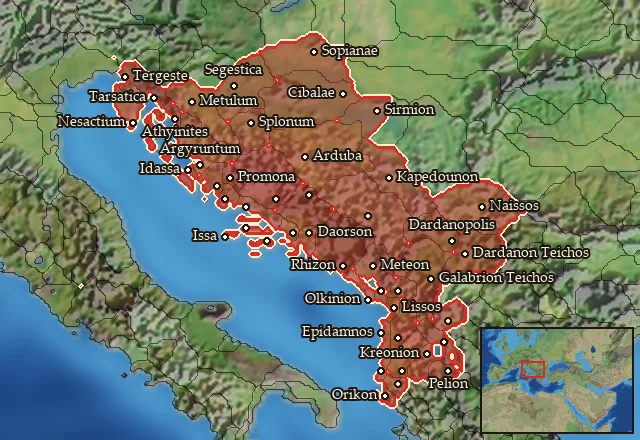
At least one of those pools sells to any faction that has an army in range, with no faction restriction.
The 46 regions where this unit appears in a mercenary pool
Akrokeraunia · Amantinia · Anatolike Dardania · Andizetia-Azalia · Ardiaia · Autariataia · Basilike Dassaretia · Boreia Labeataia · Breucia · Byllionia-Amantia · Daesitiatia · Daorsia · Dardania · Dassaretia · Delmatia · Ditionia · Epetia-Salonitis · Epidamnia · Galabria · Gylakeia · Hesperos Skordiskia · Histria · Histria Septentrionalis · Iapodia · Illyria · Issa · Kaouia · Labeataia · Liburnia · Liburnia Orientalis · Liburnia Septentrionalis · Liburnonesoi · Maezaeia · Mania · Melaina Korkyra · Naissitania · Narensia · Olkinia · Orestike Dassaretia · Parthinia
…and 6 more.