
Mercenary Marrucini Spearmen
Mercenary. Hired from a regional pool, not recruited from a building.
Class: spearmen · Category: infantry · Men per unit: 40
Description
"The Marrucini, and their rivals the Frentani, gathered too, bringing the men of Corfinium, and great Teate. All these bore a pike to war, a sling that had downed many a bird, and for armour wore bear-skins, spoils of the hunt." – Silius Italicus (Punica 8.518–521)
Levied from an Oscan-Sabellian tribe in the central Apennines around Teate, these Marrucini Spearmen serve as disciplined, heavy line infantry. Considered by observers to possess a warlike disposition equal to their Samnite, Marsic, and Paelignian neighbours, the Marrucini march to war ready to pelt their enemies with javelins, to then close in with sharp spears. For defence, they carry a large oval thureos shield featuring central vertical barleycorn spines and geometric or sunburst patterns. Most of these men have been able to afford armour and go into battle protected by a triple-disc-cuirass or composite linothorakes, as well as a single greave on the left leg, and crested Montefortino or Italic bronze helmets. Like the other tribes of the Apennines, these men are reputed for their ferocity and skill in battle.
Historical background
The Marrucini were an Oscan-Sabellian mountain people located along the Adriatic coast on the lower course of the River Aternus (modern Pescara), occupying a central Apennine territory in the Abruzzi surrounding their capital at Teate (modern Chieti) (Ptol. Geog. 3.1.20; Liv. 8.29.3–5; Roller, ‘Strabo and Italian Ethnic Groups’, in: Farney and Bradley (eds.), The Peoples of Ancient Italy (2017), p. 31). Bordered by the Marsi, Paeligni, Vestini, and Frentani, the Marrucini belonged to a group of small central-Italian ethnic groups related to the Samnites who enjoyed a reputation as hardy mountaineers and renowned warriors (Strab. 5.4.2; Diod. Sic. 37.1–2; Vell. Pat. 2.15; Roller (2017), p. 31). Originally allied with the Samnites during the Samnite Wars, the Marrucini, Marsi, Paeligni, and Frentani ratified a formal treaty of peace and alliance with Rome in 304 BC following Samnite defeats, an agreement that was renewed in 302 BC after a short-lived attempt to rebel (Liv. 9.45.18, 10.3.5).
Under the formula togatorum (a list maintained by the Romans for the purpose of determining the annual military contributions of the Italian allies), Marrucinian contingents were integrated into Roman field armies as autonomous allies (socii) obligated to supply specified troop numbers for Roman campaigns (Baronowski, 'The "Formula Togatorum"', in: Historia 33-2 (1984); Kent, 'The Italians in Roman Armies’, in: Farney and Bradley (eds.), The Peoples of Ancient Italy (2017), pp. 264–266). During the Battle of Asculum (279 BC), fought in Apulia between the forces of the Roman Republic and King Pyrrhos of Epirus, the Roman commanders divided their Italian allied contingents into four equal divisions and distributed them among the Roman legions across the battle line. As related by Dionysius of Halicarnassus (Roman Antiquities 20.1.5): “The Latins, Campanians, Sabines, Umbrians, Volscians, Marrucini, Peligni, Ferentani, and their other subjects they divided into four divisions and mingled them with the Roman legions, in order that no part of their lines might be weak”. This was done to ensure a uniform distribution of infantry strength, preventing Pyrrhos' phalanx or war elephants from exploiting a weak point or breaking a purely allied wing. However, it may also indicate that the Marrucini, along with the other Italic allies, were not as strong or heavily equipped as the Roman legions. It reflects the progressive subordination of Italian forces under Roman command.
Throughout the Middle Republic, Marrucinian cohorts fought in major Roman military campaigns across Italy and the Mediterranean (Liv. 28.45.12, 44.41). During the Second Punic War, the territory of the Marrucini suffered severe devastation when Hannibal Barca marched through Picenum, Marsic land, and the Abruzzi in 217 BC (Liv. 22.9). Despite their territories being devastated, numerous Marrucinian, Marsian, and Paelignian contingents volunteered to serve on board Scipio Africanus' fleet during the invasion of North Africa in 205 BC (Liv. 28.45). Decades later, at the Battle of Pydna in 168 BC, Marrucinian and Paelignian cohorts served in the advance guard of the Roman right, directly engaging the Macedonian phalanx at the start of the battle (Liv. 44.41; Plut. Aem. 20; Erdkamp, 'Polybius and Livy on the Allies in the Roman Army', in: De Blois and Lo Cascio (eds.), The Impact of the Roman Army (2007), pp. 47–74).
However, like the other Italic allies of Rome, despite their extensive military contributions, the Marrucini still experienced abuses of power, longer deployments, unequal distribution of plunder, and exclusion from politics compared to the Roman citizens (Kent (2017), pp. 264–266). This mounting friction eventually culminated in the Social War (91–89 BC), when the Marrucini revolted alongside the Picentes, Vestini, Marsi, Paeligni, Samnites, and Lucanians (Liv. Per. 72.e; Kent (2017), pp. 265–266). During this conflict, the Marrucinian commander Hierius Asinius was killed in action against Gaius Marius (Liv. Per. 71–75 [73.9]). Later, in 89 BC, the Roman commander Sulpicius slaughtered the Marrucini in battle and accepted the surrender of the entire region (Liv. Per. 76.e).
With the end of the Social War, the Marrucini were increasingly romanized, with the introduction of Latin gentilicia, and Oscan and Sabellian nomenclature being adapted to the Roman system by transforming endings into -ius and adopting traditional Roman praenomina. According to Maras, “this phenomenon was neither determined nor accompanied by an abandonment of the pride of families for their Italian origins: on the contrary they were often highlighted by adding ethnic cognomina to onomastic formulas (such as Picens, Marsus, and Umber). Incidentally, there is evidence that showing off an Italian (not-Roman) origin was even considered an “added value” in politics and success in political careers” (Maras, ‘Epigraphy and Nomenclature’ in: Farney and Bradley (2017), p. 83).
Stats
| Rank in roster | ||
|---|---|---|
| Men per unit | 40 | ███······· 30% |
| Attack | 16 | ████████·· 80% |
| Charge bonus | 10 | ████······ 35% |
| Defence | 37 | ██████···· 64% |
| · armour | 6 | ████······ 38% |
| · defence skill | 26 | ████████·· 78% |
| · shield | 5 | ██████···· 57% |
| Morale | 12 | ██████···· 57% |
| Discipline | Normal | |
| Training | Highly trained | |
| Upkeep per turn | 617 dn | █████····· 47% |
Weapons
| Primary | Secondary | Primary | Secondary | Primary | Secondary | Primary | Secondary | ||||
|---|---|---|---|---|---|---|---|---|---|---|---|
| Attack | 16 | 13 | Charge bonus | 10 | 13 | Type | thrown · blade | melee · blade | Damage | piercing | piercing |
| Projectile | javelin | — | Range | 50 | — | Ammunition | 2 | — | Properties | Used just before charging into combat | Light spear (braced against cavalry charges from the front) · +8 attack against cavalry |
Defence
| Primary | Secondary | Primary | Secondary | Primary | Secondary | Primary | Secondary | ||||
|---|---|---|---|---|---|---|---|---|---|---|---|
| Total | 37 | — | Armour | 6 | — | Defence skill | 26 | — | Shield | 5 | — |
Condition and terrain
| Hit points | 1 | Ground: scrub / sand / forest / snow | 0 / -1 / -1 / -1 | Charge distance | 30 | Formations | Square |
Technical stats
| Time between blows (primary / secondary) | 2.5 s / 2.5 s | Extra fatigue in hot climates | 1 | Collision mass per man (1.0 is normal) | 1.05 | Spacing between men: close / loose | 1 × 1.2 m / 2 × 2.4 m |
| Default ranks | 5 |
In battle: Can sap · Good stamina
Where to hire it
Mercenaries are hired from a regional pool, not recruited from a building. This unit is offered by 1 pool covering 9 regions, at 3,996 dn to hire and 2 experience.
Mercenary pool: Central Italy
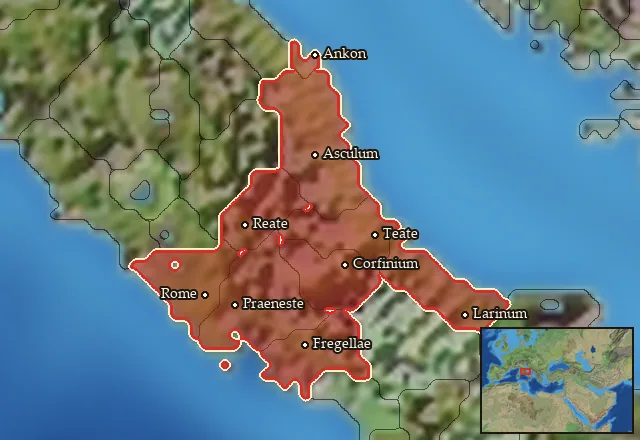
At least one of those pools sells to any faction that has an army in range, with no faction restriction.
The 9 regions where this unit appears in a mercenary pool
Ankon Petra · Frentania · Latium · Latium Novum · Marrucinia-Vestinia · Paelignia-Marsica · Picenum · Roma · Sabinia-Aequia