
Mercenary Paeligni Skirmishers
Mercenary. Hired from a regional pool, not recruited from a building.
Class: missile · Category: infantry · Men per unit: 40
Description
"The Paelignian cohort happened to be in closest touch with the enemy, and their commanding officer, Vibius Accaeus, snatched up a standard and flung it across the enemies' rampart, at the same time invoking a curse on himself and his cohort if the enemy got possession of the standard. He was the first to dash over fosse and rampart into the camp. Now the Paelignians were fighting inside the lines, and Valerius Flaccus, the commanding officer of the third legion, was rating the Romans for their cowardice in letting the allies have the glory of capturing the camp…" – Livy (History of Rome 25.14) on the Battle of Beneventum (212 BC) during the Second Punic War.
Recruited from an Oscan-speaking tribe in the central Apennines, these Paeligni Skirmishers are aggressive missile and shock infantry. Noted for their warlike disposition, the Paeligni and their central Italian neighbours are accustomed to a life of austerity and physical hardship in the mountains they call their home. Yet, their bravery often comes out on to! They enter combat armed with throwing javelins, kopis swords for close fighting, and large round shields featuring central vertical barleycorn spines and geometric designs. While most of these men fight unarmoured wearing nothing but short tunics, the more wealthy among them can afford to use linen armour (linothorakes) and even bronze Montefortino or Attic-Phrygian helmets, adorned with imposing horsehair crests or side feathers. They excel at harassing the enemy lines with javelin volleys before charging aggressively into the fray of combat.
Historical background
The Paeligni occupied a central mountainous territory in the Abruzzi and maintained strong cultural and linguistic ties to their Oscan-speaking neighbours, being noted, together with the Marsi, Marrucini, Paeligni, Vestini, and the Frentani for their warlike disposition (Scopacasa: 'Ethnicity', in: Farney and Bradley (eds.), The Peoples of Ancient Italy (2017), p. 113). Following the Samnite Wars, the Paeligni ratified a formal treaty of alliance with Rome in 304 BC, which was renewed in 302 BC after a short-lived attempt to rebel (Liv. 9.19.3–4; Letta, 'The Marsi', in: Farney and Bradley (2017), p. 512). Despite maintaining their autonomous tribal identity and preserving their native Oscan language with little Latin influence well into the 1st century BC, the Paeligni were fully integrated into the Roman military system as allied contingents (socii) obligated under the formula togatorum (a list maintained by the Romans for the purpose of determining the annual military contributions of the Italian allies – Baronowski, 'The "Formula Togatorum"', in: Historia 33-2 [1984]).
Paelignian cohorts gained a reputation for bravery and taking the initiative in Roman field armies all over the Mediterranean, being noted for their presence in several battlefields throughout Rome’s history (Liv. 25.14, 28.45.12, 44.41). During the Second Punic War at the Battle of Beneventum in 212 BC, the Paelignian cohort formed the advance guard against the Carthaginian camp commanded by Hanno, son of Bomilcar (Liv. 25.14). When Roman forces hesitated before the enemy ramparts, the Paelignian commanding officer, Vibius Accaeus, hurled his unit's standard over the Carthaginian rampart and led the assault into the camp, inspiring the rest of the army to follow and turn the battle into a decisive victory (Liv. 25.14). Accaeus and his Paelignian cohort were subsequently rewarded by the consuls for their crucial role in capturing the camp: “Those to whose exertions the capture of the camp was due were rewarded, especially Accaeus the Paelignia’’ (Liv. 25.14). Later, in 205 BC, numerous contingents of the Paeligni volunteered to serve on board Scipio Africanus' fleet for the invasion of North Africa (Liv. 28.45.12). Their distinguished military service in Roman armies continued and decades later, at the Battle of Pydna (168 BC), the Paelignian cohort served in the advance guard, aggressively charging the Macedonian phalanx at the start of the engagement and suffering the majority of the Roman casualties on that day (Liv. 44.41). During the Jugurthine War, a "cohort of Paelignians" is recorded as being part of a reinforcing army sent by Marius to Bocchus I, the king of Mauretania. These men are noted for wearing "light armour for the sake of speed", making them suitable to face the enemy army, which also consisted of light infantry. Later, when Volux, the son of Bocchus, begged Sulla to flee, Sulla is quoted as having said that: "he did not fear the Numidian whom he had so often routed and that he had absolute trust in the valour of his men" (Sallust, Jugurthine War, 105-106).
Despite their extensive military contributions, the Paeligni remained politically subordinate to Rome and, like many other Roman allies, were subjected to unequal treatment, such as receiving reduced pay and longer service deployments compared to citizen legionaries (Kent, 'The Italians in Roman Armies’, in: Farney and Bradley (2017), pp. 264–266). Perhaps most telling regarding the status of non-citizen soldiers in Roman armies is an episode from 193 BC, when Roman legionaries were discharged, but the Italians were ordered to assemble alongside a new army that was being gathered with no break in service to combat the Ligurians (Livy 34.56.12). These increasing abuses and exclusion from Roman citizenship culminated in the Social War in 91 BC, when the Paeligni revolted alongside the Picentes, Vestini, Marsi, Marrucini, Samnites, and Lucanians (Liv. Per. 72.e; Kent (2017), pp. 265–266). During this conflict, the Paeligni metropolis Corfinium served as the new capital of the "Italians", even establishing its own senate. As Strabo tells us: "They decreed that Corfinium, the metropolis of the Peligni, should be the capital for all the Italians instead of Rome: made it their place d'armes, and new-named it Italica. Then, having convoked deputies from all the people friendly to their design, they created consuls and praetors, and maintained the war for two years, until they had obtained the rights for which they struggled" (Strabo 5.4.2). Eventually, Servius Sulpicius defeated the Paeligni in battle (Liv. Periochae, 73.5), and the proconsul Gnaeus Pompeius ultimately accepted the surrender of the Paelignians and Vestinians in 89 BC (Liv. Per. 76.e). However, not without granting them what they had fought for, that is, Roman citizenship.
Stats
| Rank in roster | ||
|---|---|---|
| Men per unit | 40 | ███······· 30% |
| Attack | 13 | ██████···· 57% |
| Charge bonus | 3 | ██········ 16% |
| Defence | 24 | ███······· 27% |
| · armour | 4 | ███······· 33% |
| · defence skill | 16 | ███······· 28% |
| · shield | 4 | █████····· 48% |
| Morale | 8 | ██········ 19% |
| Discipline | Normal | |
| Training | Trained | |
| Upkeep per turn | 406 dn | ██········ 15% |
Weapons
| Primary | Secondary | Primary | Secondary | Primary | Secondary | Primary | Secondary | ||||
|---|---|---|---|---|---|---|---|---|---|---|---|
| Attack | 13 | 7 | Charge bonus | 3 | 6 | Type | thrown · archery | melee · blade | Damage | piercing | slashing |
| Projectile | javelin | — | Range | 60 | — | Ammunition | 7 | — | Properties | Thrown | — |
Defence
| Primary | Secondary | Primary | Secondary | Primary | Secondary | Primary | Secondary | ||||
|---|---|---|---|---|---|---|---|---|---|---|---|
| Total | 24 | — | Armour | 4 | — | Defence skill | 16 | — | Shield | 4 | — |
Condition and terrain
| Hit points | 1 | Ground: scrub / sand / forest / snow | 8 / 0 / 8 / 0 | Charge distance | 30 | Formations | Square |
Technical stats
| Time between blows (primary / secondary) | 2.5 s / 2.5 s | Extra fatigue in hot climates | 0 | Collision mass per man (1.0 is normal) | 0.94 | Spacing between men: close / loose | 1.1 × 2.6 m / 1.98 × 4.68 m |
| Default ranks | 5 |
In battle: Very good stamina
Where to hire it
Mercenaries are hired from a regional pool, not recruited from a building. This unit is offered by 1 pool covering 9 regions, at 2,552 dn to hire and 0 experience.
Mercenary pool: Central Italy
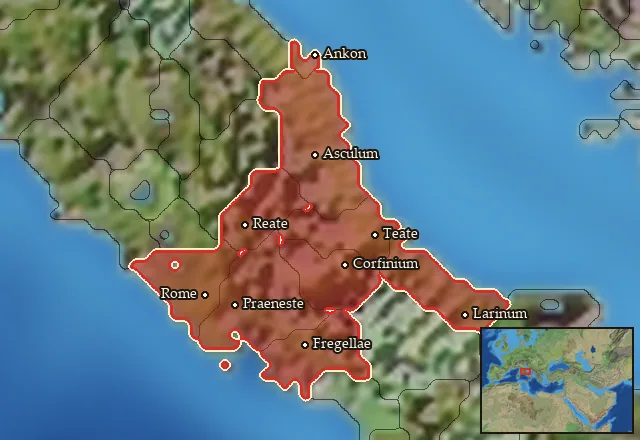
At least one of those pools sells to any faction that has an army in range, with no faction restriction.
The 9 regions where this unit appears in a mercenary pool
Ankon Petra · Frentania · Latium · Latium Novum · Marrucinia-Vestinia · Paelignia-Marsica · Picenum · Roma · Sabinia-Aequia