
Mercenary Paphlagonian Skirmisher Cavalry
Mercenary. Hired from a regional pool, not recruited from a building.
Class: light · Category: cavalry · Men per unit: 30
Description
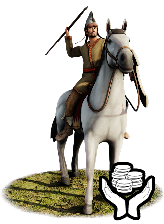
Where the Paphlagonian Cavalry act as the capable anchor on the wings, these skirmishers’ main goal is to harass and frustrate the enemy. Recruited from the rugged, mountainous terrain of their homeland, these men ride mountain ponies and are skilled javelin-throwers, firing their missiles from a safe distance to avoid being dragged into a melee with their enemies. While Paphlagonian Skirmisher Cavalry make use of small shields as well as wearing the traditional Phrygian cap, these men have traded armour for freedom of movement, relying entirely on the speed and agility of their native mounts to stay out of harm's way.
Historical background
Historically, Paphlagonian cavalry was highly valued across the ancient world, being widely used as elite mercenaries by the Greeks and the Spartokid dynasty of the Bosporus. John Ma writes that the Paphlagonian riders were skirmishers with small shields first, and then cavalry (Mysians on the Çan Sarcophagus (2008), p. 250). Re-evaluating the iconography of the Çan Sarcophagus, a painted 4th-century BC polychrome tomb discovered in 1998 near Çan (northwestern Turkey, ancient Mysia) that depicts an elite Persian aristocrat on horseback striking down an armed opponent, Ma "paints" a different perspective. While the original archaeologists assumed that the fighters represented a basic "Persian vs. Greek" binary, Ma argues that the figures actually represent regional Anatolian ethnic soldiers, specifically Mysians and their neighbours, operating within the Achaemenid imperial system. To prove this, he looks at the evolutionary pipeline of Anatolian regional troop types. He notes that if you compare the descriptions in Herodotus (writing about the early 5th century BC) to Xenophon (writing about the turn of the 4th century BC), it is possible to observe a clear tactical shift. First, the Early Era (Herodotus), where the Paphlagonians and Mysians are predominantly categorised as foot-skirmishers, mountain warriors, or light infantry carrying small, traditional shields (pelte or bucklers) and javelins. And the Later Era (Xenophon/Çan Sarcophagus), where, under Achaemenid satrapal influence and regional development, these groups increasingly adapted their skills to horseback, transitioning into the renowned, light-to-medium cavalry arms that Xenophon later praised so enthusiastically.
Indeed, in the opening book of the Anabasis, Xenophon notes that a substantial contingent of 1,000 Paphlagonian horsemen fought as crucial allies under Cyrus the Younger during his rebellion. At the Battle of Cunaxa (401 BC), they were trusted to anchor the extreme right wing of Cyrus’s army, deployed right next to Klearchos and the elite Greek hoplites along the river Euphrates (Anabasis, 1.8.5). When the stranded Greek mercenaries (the Ten Thousand) fought their way back to Greece, they carefully avoided open conflict while crossing Paphlagonia, then ruled by the prince Corylas. Xenophon openly warned his men against provoking the Paphlagonians, praising both their terrain and military might. When responding to an arrogant foreign emissary who threatened the Greeks, he states: “As to the threat you uttered, that if you thought best you would enlist Corylas and the Paphlagonians as allies against us, we on our side are quite ready to make war with you both if it be necessary; for we have made war ere now with others who were many times your numbers. But we think it best to make a friend of the Paphlagonian” (Anabasis, 5.5.22–23).
Xenophon further noted that the country possessed an exceptionally strong cavalry and a formidable army. He describes the terrain of Paphlagonia as ideal for horsemen and emphasizes that they are too powerful to provoke needlessly: “Nevertheless, I must say what I believe; for I am acquainted with both the country of the Paphlagonians and their power. Their country possesses these two things, the fairest plains and the loftiest mountains” and “Secondly, I know that they have plains and a cavalry which the barbarians themselves regard as superior to the whole of the King's cavalry. Indeed, only now these Paphlagonians have failed to present themselves when the King summoned them, for their ruler is too proud to obey” (Anabasis, 6.6 and 5.6.8).
However, things did not go well at first between the Greeks and the Paphlagonians, as Xenophon tells us: “While they delayed at Cotyora, some of the men lived by purchasing from the market and others by pillaging the territory of Paphlagonia. The Paphlagonians, however, were extremely clever in kidnapping the stragglers, and at nighttime they tried to inflict harm upon such of the Greeks as were quartered at some distance from the rest; consequently, they and the Greeks were in a very hostile mood towards one another.” The animosity between the two groups was then resolved by Corylas, who “sent ambassadors to the Greeks, with horses and fine raiment, bearing word that Corylas was ready to do the Greeks no wrong and to suffer no wrong at their hands.”
The Greeks proceeded to host the Paphlagonian ambassadors at a great banquet, featuring elaborate Greek martial dances (Anabasis, Book 5, Chapter 5, Section 7 [5.5.7]; Book 5, Chapter 6, Section 8 [5.6.8]; and Book 6, Chapter 1, Sections 1–14 [6.1.1–14]). From these banquet dances, we have a funny story, as “the Mantineans and some of the other Arcadians arose, arrayed in the finest arms and accoutrements they could command, and marched in time to the accompaniment of a flute playing the martial rhythm and sang the paean and danced, just as the Arcadians do in their festal processions in honour of the gods. And the Paphlagonians, as they looked on, thought it most strange that all the dances were under arms.” This continued some more, and “thereupon the Mysians, seeing how astounded they were, persuaded one of the Arcadians who had a dancing girl to let him bring her in, after dressing her up in the finest way he could and giving her a light shield. And she danced the Pyrrhic with grace. Then there was great applause, and the Paphlagonians asked whether women also fought by their side. And the Greeks replied that these women were precisely the ones who put the King to flight from his camp. Such was the end of that evening”.
Finally, peace was settled between the two proud nations, and Xenophon relates how on the next day, the Greeks “introduced the ambassadors to the army, and the soldiers passed a resolution to do the Paphlagonians no wrong and to suffer no wrong at their hands. After this the ambassadors departed, and the Greeks, in as much as it seemed that vessels enough were at hand, embarked and sailed for a day and a night with a fair wind, keeping Paphlagonia on the left.”
Stats
| Rank in roster | ||
|---|---|---|
| Men per unit | 30 | █········· 8% |
| Attack | 13 | ██████···· 57% |
| Charge bonus | 22 | ████████·· 77% |
| Defence | 22 | ██········ 23% |
| · armour | 2 | █········· 13% |
| · defence skill | 18 | ████······ 38% |
| · shield | 2 | ███······· 25% |
| Morale | 11 | ████······ 39% |
| Discipline | Normal | |
| Training | Highly trained | |
| Recruitment cost | 2,694 dn | ████████·· 76% |
| Upkeep per turn | 723 dn | ███████··· 69% |
| Turns to recruit | 2 |
Weapons
| Primary | Secondary | Primary | Secondary | Primary | Secondary | Primary | Secondary | ||||
|---|---|---|---|---|---|---|---|---|---|---|---|
| Attack | 13 | 9 | Charge bonus | 22 | 28 | Type | thrown · blade | melee · blade | Damage | piercing | piercing |
| Projectile | javelin | — | Range | 60 | — | Ammunition | 7 | — | Properties | Thrown | — |
Defence
| Primary | Secondary | Primary | Secondary | Primary | Secondary | Primary | Secondary | ||||
|---|---|---|---|---|---|---|---|---|---|---|---|
| Total | 22 | — | Armour | 2 | — | Defence skill | 18 | — | Shield | 2 | — |
Condition and terrain
| Hit points | 1 | Mount | light horse | Ground: scrub / sand / forest / snow | 0 / 0 / -4 / 0 | Charge distance | 40 |
| Formations | Square |
Technical stats
| Time between blows (primary / secondary) | 2.5 s / 2.5 s | Extra fatigue in hot climates | 0 | Spacing between men: close / loose | 2.2 × 5.2 m / 3.3 × 7.8 m | Default ranks | 5 |
In battle: Very good stamina
Who can recruit it
A core roster unit for one faction, which can raise it anywhere it holds the right building:
Exactly what a settlement must have, route by route (3)
| Building | Also requires | Building | Also requires | Building | Also requires | ||
|---|---|---|---|---|---|---|---|
| Indirect Rule | Garrison Building or Tier 1 Military Industrial Complex · Tier 1 Colony | Direct Rule | Garrison Building or Tier 1 Military Industrial Complex · Tier 1 Colony | Homeland | Garrison Building or Tier 1 Military Industrial Complex |
Where to hire it
No mercenary pool on the campaign map offers this unit, so it cannot be hired. It can only be recruited from a building, as below.