
Mercenary Taurian Skirmishers
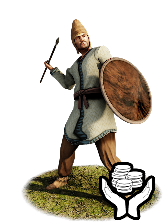
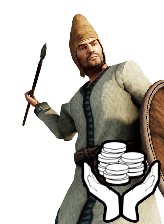
Mercenary. Hired from a regional pool, not recruited from a building.
Class: missile · Category: infantry · Men per unit: 40
Description
These skirmishers hail from the land of Taurike, girted by the wine red waves of the Euxine Sea. Where intrepid Hellenes meet wild Scythians, the ancient Taurians dwell. Wearing Scythian tunics with simple belts, thick trousers, and long sleeves that keep them warm in the winter, they wander about on their Scythian boots. Headbands or pointy caps suffice to protect their heads; helmets and armour are eschewed in favour of dexterity and speed. Shields will do: either the Greek pelte, adopted from the neighbouring Bosporans, or the rounded square shields popular among the Scythians who live on Taurike and on its frontier towards the endless steppe. Most Taurians prefer to fight from a distance, and they have trained since youth to be able to hurl a javelin far and wide. In melee, however, they prefer the cold iron of a sword. The most popular type found among them is the Scythian akinakes, but Hellenic designs like the xiphos and the machaira are now becoming attractive alternatives. Thus armed, the Taurian skirmishers are reliable javelinmen, who fight in the name of their maiden goddess, whom the Greeks equate with Artemis the huntress.
Historical background
To end these miseries, wherein I reel
Through Hellas, mad, lashed like a burning wheel;
And thou didst bid me seek . . . what land but this
Of Taurike where thy sister Artemis
Her altar hath, and seize on that divine
Image which fell, men say, into this shrine
From heaven.
– Orestes (Euripides, Iphigenia in Tauris, vv. 83-89)
The fertile peninsula on the northern shores of the Black Sea, which is now known as Crimea, was called Chersonesos Taurike by the ancient Greeks, as it was named after the Taurians – its native population. According to the version of Nikandros of Kolophon (2nd century BC), Iphigeneia, the protagonist of the famous play, was saved when a bull (Greek: tauros) was sacrificed at the altar of Artemis in her stead, giving the people of this country their name (Hard, The Routledge Handbook of Greek Mythology (2004), p. 513). Artemis, the huntress, had been identified with similar native and Scythian goddesses from the earliest contacts onwards (cf. Hdt. 4.103; Soph. Ajax 135; Kallim. Artem. 172). Her character fits the native Taurians, who mainly fought as archers and javelinmen (see below). In the late 1st century BC, Diodorus summed up their ways thus: “For it is customary among the barbarians who inhabit this land to sacrifice to Artemis Tauropolos the strangers who put in there, and it is among them, they say, that at a later time Iphigeneia became a priestess of this goddess and sacrificed to her those who were taken captive” (Diod. 4.44.7).
Despite this negative account, relations between the Taurians and the Greek settlers in the Bosporan Kingdom, Olbia, and Chersonesos were not always violent, and they largely coexisted for centuries. Unlike their Scythian neighbours, the Taurians were sedentary agriculturalists, with some relying on animal husbandry or fishing (Encyclopedia of Ukraine, s.v. Tavry (Taurians), vol. 5 [1993]). And yet, many Greco-Roman authors identified the Taurians as Scythians, too, among them (Pseudo-)Apollodoros, a 1st century Greek author (Ps.-Apoll. Ep. 6.26), the Pontic geographer Strabo of Amaseia (ca. 63BC-25AD; Strab. 7.4.5C311), or the Roman official Pliny the Elder (23/24-79 AD; Plin. NH 4.26). However, not only the Taurian way of life, but Pliny himself seems to contradict this assessment when he speaks of Tauroscythians (Plin. NH 4.85) to emphasise the Scythian influence on the Taurians (Von Bredow, Iris, s.v. Tauroi, in: DNP online). Instead, Herodotus’ version is to be preferred (as more likely), according to whom the Taurians lived in Scythian lands without being Scythian (Hdt. 4.99.4; cf. von Bredow; Leskov, Die Taurer (1980), pp. 39-53). The Taurians were probably the descendants of those people represented by the Kizil-Koba culture in the foothills of the Crimean mountains, which dates from the 9th to the 3rd century BC (Kravchenko, Кизил-кобинська культура у Західному Криму (2010); Braund, Greek Religion and Cults in the Black Sea Region (2018), pp. 38-41).
Among the Kizil-Koba findings, bronze arrowheads are common, indicating that many Taurians hunted and fought as archers (Leskov, The Maikop treasure (2008), p. 230). Similarly important would have been javelins, as they were among the neighbouring Scythians and the Bosporan Greeks. Since Pseudo-Apollodoros and Strabo probably attest to increasing Scythian influences over time, and since many Taurians lived under the rule of the Bosporan Greeks, their fighting styles would have left a mark on the Taurians. In fact, some of them had already lived on the Kimmerian Bosporos in the 5th century BC. One grave stela from Pantikapaion was erected by a Taurian called Tychon who had moved to the capital of the kingdom as a mercenary or merchant (Treister, Archaic Pantikapaion (2007), p. 575).
Therefore, the Taurian skirmishers in RIS are armed with javelins and swords. The latter are a mix of the typical Scythian akinakes and the Greek xiphos and machaira types. The curved machaira, in particular, was the most popular sword in the royal Bosporan army (Mielczarek, Bosporan Army (1999), pp. 46-47). The javelinmen wear Scythian tunics with long sleeves, pointy Scythian caps or headbands, simple belts, trousers, and boots after the fashion of the steppe. All of these can be found on the 4th century Kul-Oba vase and the Solokha comb from the lower Dniepr area (Heinen, Antike am Rand der Steppe (2006), p. 25; Gajkudevič, Bosporanisches Reich (1971), p. 145 & fig. 11). They also show the rounded square shields of the Scythians, which may have found their way into Taurike. Some of the Taurian warriors in RIS wear these shields, some carry none at all, while others prefer the round Greek pelte, which is smaller, but reinforced with metal.
Stats
| Rank in roster | ||
|---|---|---|
| Men per unit | 40 | ███······· 30% |
| Attack | 10 | ██········ 19% |
| Charge bonus | 1 | █········· 4% |
| Defence | 14 | █········· 6% |
| · armour | 3 | ██········ 21% |
| · defence skill | 9 | █········· 3% |
| · shield | 2 | ███······· 25% |
| Morale | 4 | █········· 0% |
| Discipline | Low | |
| Training | Untrained | |
| Upkeep per turn | 287 dn | █········· 8% |
Weapons
| Primary | Secondary | Primary | Secondary | Primary | Secondary | Primary | Secondary | ||||
|---|---|---|---|---|---|---|---|---|---|---|---|
| Attack | 10 | 4 | Charge bonus | 1 | 9 | Type | thrown · archery | melee · blade | Damage | piercing | slashing |
| Projectile | javelin | — | Range | 60 | — | Ammunition | 7 | — | Properties | Thrown | Armour-piercing (counts only half the target's armour) |
Defence
| Primary | Secondary | Primary | Secondary | Primary | Secondary | Primary | Secondary | ||||
|---|---|---|---|---|---|---|---|---|---|---|---|
| Total | 14 | — | Armour | 3 | — | Defence skill | 9 | — | Shield | 2 | — |
Condition and terrain
| Hit points | 1 | Ground: scrub / sand / forest / snow | 8 / 0 / 8 / 0 | Charge distance | 30 | Formations | Square |
Technical stats
| Time between blows (primary / secondary) | 2.5 s / 2.5 s | Extra fatigue in hot climates | 0 | Collision mass per man (1.0 is normal) | 0.85 | Spacing between men: close / loose | 1.1 × 2.6 m / 1.98 × 4.68 m |
| Default ranks | 5 |
In battle: Can hide in long grass · Very good stamina
Where to hire it
Mercenaries are hired from a regional pool, not recruited from a building. This unit is offered by 1 pool covering 1 region, at 2,313 dn to hire and 0 experience.
Mercenary pool: Taurike
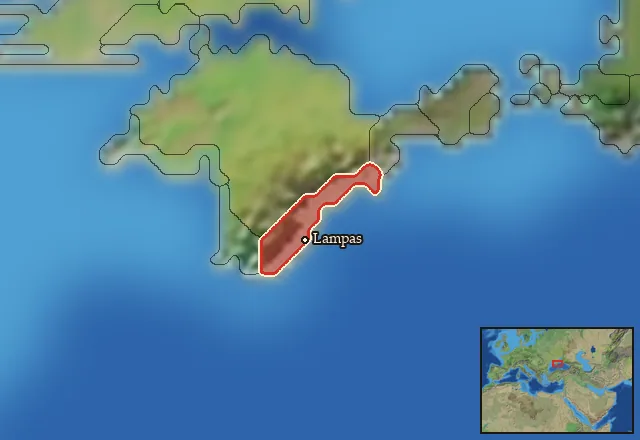
At least one of those pools sells to any faction that has an army in range, with no faction restriction.