
Neocretan Ephebes
Class: missile · Category: infantry · Men per unit: 40
Reforms: Unlocked by The Great Reforms of Philopoimen
Description
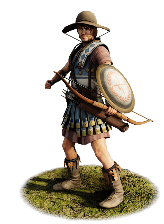
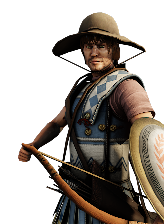
Reforms of the Achaian army have also introduced a new role for Ephebes and Neoi. Equipped with Cretan bows and Machaira swords for melee, these boys are excellent archers. Though they are protected by small Pelte shields on their arms and Linothorakes, they lack helmets, instead displaying the distinctive haircuts which identify them as members of the Ephebes. As they have been trained by Cretan officers, they are an effective force from a distance, but an able general should keep them away from the horrors of melee – something these teenagers have not yet experienced in their short lives.
Historical background
Before the Hellenistic period, the Achaian League had never been a major player in Greek politics. It was dissolved at the end of the 4th century BC and only refounded in 281/280 BC, when the western Achaian poleis Tritaia, Dyme, Pharai and Patrai (which took the leading position) set up a new confederation Polyb. II, 41). In the 270s, they managed to either convince or force the pro-Macedonian tyrants of Aigion, Bura, Karyneia, Lention, Aigeira and Pellene to abdicate. In supporting Pyrrhos of Epeiros and subsequently joining Athens, Sparta and the Ptolemaic Empire in the Chremonidean War (267-261 BC) against Antigonid Macedon, they soon became a bigger player on the international stage than they had ever been before.
This new situation resulted in an increased need for soldiers. As in almost every Greek polis or koinon, every young son of a citizen had to take part in the Ephebeia. This educational institution included military training either for one year (as e.g. in Athens or Kyzikos, CIG 3665, 2) or two (as in Apollonis, BCH, LXXXXVI, no. 6, 1, 4); on Chios it even lasted three years (SIG 959). Ephebes served as garrison troops in towers and fortresses, but also took part in religious processions and other official events of the city. At least in Pellene, a member city of the Achaian League, completion of the Ephebeia was a necessary precondition for citizenship (Paus. VII, 27, 5). For 220 BC, Polybios reports an Achaian levy from the Neaniskoi, the Ephebes who had just finished their training (Polyb. IV, 16, 6). Nabis, the ruler of Sparta from 207 to 192 BC, even kidnapped Ephebes from the then Achaian city of Mykene and brought them to Crete, where they were saved by a citizen of Gortyn (SIG³ 594; Oliva, Sparta 1972, p. 291). This goes to show how valuable the Ephebes as future citizens, politicians and military leaders were for a Greek community.
The military value of these teenagers, however, was usually negligible. They neither received heavy armour when on their patrol or garrison duty nor had experience of battles. During the Hellenistic period, when Greece became a constant battlefield, Hellenic leaders increasingly began to improve the training and equipment of the Ephebes, however, to form an additional corps of highly motivated troops. Given their physical inferiority to adult men, these boys seemed especially capable of fighting as archers – a role which also meant they were in less danger of being killed before coming of age. These so-called Neocretans probably existed in various forms: some were probably just Non-Cretans trained to be as good at archery as the Cretans, others may have been Cretan Neoi, young men who had just completed the Ephebeia (which usually happened at age 18, but could vary from 17 to 20). There are also theories that they were Cretan archers armed in a "new" way, carrying heavier equipment, or the Ephebes of other states such as the Achaian League trained in the way of or even by Cretan archers (See Du Plessis, Seleucid Army 2022, p. 117 for an overview of the contrasting views in current Classics and Ancient History).
There are only two things we can rather safely deduce from it all. Firstly, at Raphia the Cretan Archers and the Neocretans in the Ptolemaic army are grouped together in one formation (Polyb. V, 65, 7). This strongly suggests that Neocretans were archers and that their equipment cannot have differed much from ‘normal’ Cretan Archers. Secondly, Livy calls the Neocretans of the Achaian League Achaei iuventutis suae (Liv. XLII, 55, 10): therefore there is no doubt they were Neoi or Ephebes, and it is likely that they were Achaians, not Cretans. This would fit the general Hellenistic trend to make the Ephebes and Neoi (all young men between 15 and 20, depending on which polis it was) effective military units who could be used on campaigns abroad. And this is exactly the context in which Livy mentions them: they are sent to the Achaian ally Eumenes II (r. 197-159 BC), king of Pergamon, to assist him in his fight against the Seleucid king Antiochos III (r. 223-187 BC). The memory of their service lived on: in the 2nd century AD, the Ephebeia was still linked to past military exploits and remained an important part of civic identity (Kennell, Memory and Identity 2022).
Stats
| Rank in roster | ||
|---|---|---|
| Men per unit | 40 | ███······· 30% |
| Attack | 9 | █········· 13% |
| Charge bonus | 1 | █········· 4% |
| Defence | 20 | ██········ 19% |
| · armour | 6 | ████······ 38% |
| · defence skill | 12 | █········· 9% |
| · shield | 2 | ███······· 25% |
| Morale | 6 | █········· 6% |
| Discipline | Low | |
| Training | Untrained | |
| Recruitment cost | 1,373 dn | █········· 12% |
| Upkeep per turn | 503 dn | ██········ 20% |
| Turns to recruit | 2 |
Weapons
| Primary | Secondary | Primary | Secondary | Primary | Secondary | Primary | Secondary | ||||
|---|---|---|---|---|---|---|---|---|---|---|---|
| Attack | 9 | 6 | Charge bonus | 1 | 3 | Type | missile · archery | melee · blade | Damage | piercing | slashing |
| Projectile | arrow | — | Range | 170 | — | Ammunition | 25 | — |
Defence
| Primary | Secondary | Primary | Secondary | Primary | Secondary | Primary | Secondary | ||||
|---|---|---|---|---|---|---|---|---|---|---|---|
| Total | 20 | — | Armour | 6 | — | Defence skill | 12 | — | Shield | 2 | — |
Condition and terrain
| Hit points | 1 | Ground: scrub / sand / forest / snow | 0 / 0 / 0 / 0 | Charge distance | 30 | Formations | Square |
Technical stats
| Time between blows (primary / secondary) | 2.5 s / 2.5 s | Extra fatigue in hot climates | 0 | Collision mass per man (1.0 is normal) | 0.96 | Spacing between men: close / loose | 1.2 × 2.8 m / 2.16 × 5.04 m |
| Default ranks | 5 |
In battle: Very good stamina
Who can recruit it
A core roster unit for one faction, which can raise it anywhere it holds the right building:
Exactly what a settlement must have, route by route (3)
| Building | Also requires | Building | Also requires | Building | Also requires | ||
|---|---|---|---|---|---|---|---|
| Indirect Rule | Garrison Building or Tier 1 Military Industrial Complex · The Great Reforms of Philopoimen · Tier 1 Colony | Direct Rule | Garrison Building or Tier 1 Military Industrial Complex · The Great Reforms of Philopoimen · Tier 1 Colony | Homeland | Garrison Building or Tier 1 Military Industrial Complex · The Great Reforms of Philopoimen |