
Odrysian Hippakontistai
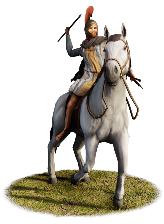
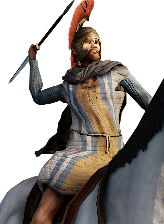
Class: missile · Category: cavalry · Men per unit: 30
Description
For most of the Classical and Hellenistic period, the Odrysians have been the most powerful people in Thrace, ruling over vast lands east of the Rhodope mountains. On these great valleys and plains, the Odrysian aristocracy rule from horseback over the fields surrounding their strongholds and hillforts. While their nobles and royal bodyguards are heavily armoured for close combat, most of the Odrysian cavalry and retinue fight as "hippakontistai" (mounted javelinmen). That fighting style allows them to scout, skirmish, raid, and harass enemy lines, but also to quickly retreat when confronted with heavily armed enemy units. They are equipped with Chalcidian helmets, crescent-shaped pelte shields, javelins, and xiphos swords. The poorer members of the cavalry wear Phrygian-style caps made out of felt or leather. Thanks to their shields, they are better protected than the Thracian Hippakontistai, though they should still stay out of combat with heavy cavalry and infantry units.
Historical background
While Thracians were already known to the Greeks by the time of Homer, the first large Thracian kingdom to be established was that of Teres the Odrysian (Thuk. II.29.2). According to the Athenian general and historian Thukydides (c. 454-396 BC), the Odrysians ruled over a great kingdom, surpassing all other powers in Europe and being second only to the Scythians in terms of manpower and resources (Thuk. II.97.5). The author Xenophon (c. 420s-350s BC), leader of the mercenary army of the Ten Thousand, recognised the skill of Odrysian cavalry and the importance of horses to Odrysian culture. In his handbook on horsemanship, he encourages his aristocratic readers to train their horses in hilly terrain, as ‘they may take comfort when they understand that the Persians and Odrysians all ride races down hill, and yet keep their horses just as sound as the Greeks’ (Xen. Horse. 8.6). When he and the commanders of the – much reduced – Ten Thousand were invited to dinner by the Odrysian sub-king Seuthes II, he witnessed how one of the Thracian aristocrats made a gift of a white horse to Seuthes II, saying: 'I drink your health, Seuthes, and present to you this horse; on his back pursuing you shall catch whomever you choose, and retreating you shall not fear the enemy' (Xen. Anab. VII.3.26). This explicit reference to the importance of mobility for Thracian horsemen on the battlefield appears time and again in Xenophon’s work (VII.3.40-47: Odrysian cavalry; VI.3.7: Bithynian hippakontistai harassing the Greeks and getting away quickly). After some of the Odrysian allied cavalry that king Medokos had sent to the Spartan commander Derkylidas had died in battle against the Bithynians, the Odrysians drank to their honour and organised horse races (before plundering the Bithynian countryside (Xen. Hell. III.2.5)). Two fifths of that Odrysian auxiliary force was made up of cavalry (200 horsemen and 300 peltasts, Xen. Hell. III.2.2). This ratio of infantry to cavalry was very large compared to Greek cities and states (usually, these fielded a 10:1 ratio of infantry to cavalry: Konijnendijk, Cavalry and the Character of Classical Warfare (2021), p. 190). This is taken to the extreme in Thukydides. When Athens called Sitalkes son of Teres for help in their war against the Peloponnesians, Sitalkes invaded the Macedonian kingdom of Perdikkas, an ally of the Peloponnesians, with an army of 150,000 men. A third of the army (50,000!) consisted of cavalry, primarily furnished by the Odrysians and Getai (Thuk. II.98.3-4). Roughly a century later, even after the shattering of the kingdom under different dynasts and the eventual annexation of the Odrysian Kingdom by Philip II of Macedon, the Odrysian rebel Seuthes took the field against Lysimachos, one of Alexander’s successors, with 20,000 infantry and 8,000 cavalry, so again a ratio of 5:2 of infantry to cavalry (Diod. Sic. XIII.14.2). In 171 BC, yet another century later, the Odrysian king Cotys, the son of Seuthes and king of the Odrysians, had come in with a picked force of 1,000 horse and about the same number of infantry (Liv. XLII.51.10).
The Odrysian cavalry, fighting as hippakontistai, was armed with javelins of cornel wood (Webber, Odrysian Cavalry Arms (2003), p. 549) and straight long xiphos swords (popular from the 3rd century BC, depicted on the Alexandrovo tomb: Webber (2003), p. 550; earlier, light cavalry only used knives: id., p. 551). Extra protection was offered by their crescent-shaped pelte shields (as on a 5th century BC red figure pelike from Sozopol: Webber (2003), fig. 1). It could be strapped to the back (Xen. Anab. VII.4.14), but from the 3rd century onwards, they also used the shields in battle (Webber (2003), p. 540 – contra Stoyanov (2015), p. 432: there is no reason to believe that Thracians and Greeks would not have used shields earlier). They wore Attic and Chalcidian helmets or Phrygian caps of leather and felt (Stoyanov, Warfare (2015), p. 430) and long mantles (as described by Xen. Anab. VII.4.4 and depicted on the Lukovit treasure) over tunics (reliefs depicting the mounted heros, like in the Teteven or Madara museum in Bulgaria).
Stats
| Rank in roster | ||
|---|---|---|
| Men per unit | 30 | █········· 8% |
| Attack | 10 | ██········ 19% |
| Charge bonus | 15 | ██████···· 64% |
| Defence | 17 | █········· 12% |
| · armour | 3 | ██········ 21% |
| · defence skill | 11 | █········· 6% |
| · shield | 3 | ████······ 37% |
| Morale | 8 | ██········ 19% |
| Discipline | Normal | |
| Training | Untrained | |
| Recruitment cost | 1,342 dn | █········· 11% |
| Upkeep per turn | 540 dn | ███······· 26% |
| Turns to recruit | 2 |
Weapons
| Primary | Secondary | Primary | Secondary | Primary | Secondary | Primary | Secondary | ||||
|---|---|---|---|---|---|---|---|---|---|---|---|
| Attack | 10 | 7 | Charge bonus | 15 | 15 | Type | thrown · archery | melee · blade | Damage | piercing | piercing |
| Projectile | javelin | — | Range | 60 | — | Ammunition | 7 | — | Properties | Thrown | — |
Defence
| Primary | Secondary | Primary | Secondary | Primary | Secondary | Primary | Secondary | ||||
|---|---|---|---|---|---|---|---|---|---|---|---|
| Total | 17 | — | Armour | 3 | — | Defence skill | 11 | — | Shield | 3 | — |
Condition and terrain
| Hit points | 1 | Mount | light horse | Ground: scrub / sand / forest / snow | 0 / 0 / -3 / 0 | Charge distance | 40 |
| Formations | Square |
Technical stats
| Time between blows (primary / secondary) | 2.5 s / 2.5 s | Extra fatigue in hot climates | 0 | Spacing between men: close / loose | 2.2 × 5.2 m / 3.96 × 7.28 m | Default ranks | 5 |
In battle: Can form Cantabrian circle · Very good stamina
Who can recruit it
A core roster unit for one faction, which can raise it anywhere it holds the right building:
Exactly what a settlement must have, route by route (3)
| Building | Also requires | Building | Also requires | Building | Also requires | ||
|---|---|---|---|---|---|---|---|
| Indirect Rule | Garrison Building or Tier 1 Military Industrial Complex · Tier 1 Colony | Direct Rule | Garrison Building or Tier 1 Military Industrial Complex · Tier 1 Colony | Homeland | Garrison Building or Tier 1 Military Industrial Complex |