
Pergamene General's Bodyguard
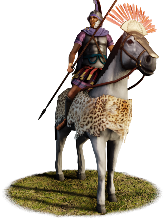
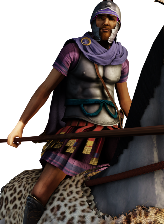
Class: heavy · Category: cavalry · Men per unit: 6
Description
Even though an elite cavalry unit is hardly ever mentioned in the sparse sources on Attalid history, a small corps of bodyguard cavalry must have been the first regular military unit under the command of Philetairos of Pergamon (Ca. 343-263) when he laid the foundations for Pergamene independence from the Seleucid Empire. Born as the son of a Macedonian called Attalos and his Paphlagonian wife Boa, he first appears as a eunuch in the service of the diadoch Dokimos towards the end of the 4th century BC. In 302 BC, Pergamon passed into the hands of Lysimachos and Philetairos was now officially confirmed as commander of the acropolis, which protected a treasure of 9,000 talents. When Lysimachos' wife Arsinoe II schemed against Philetairos in 282 BC, he joined the case of Seleukos, who would soon overcome Lysimachos (Paus. I, 181; 10, 4). Shortly thereafter, Seleukos was treacherously murdered by Ptolemaios Keraunos and Philetairos used his funds to buy the corpse of the great general and send it to his son and successor Antiochos I (App. Syr. 63, 335). The new Seleucid king rewarded him for his loyalty by making him the semi-autonomous ruler of the Kaikos valley around Pergamon. It was from this time until his death in 263 BC that Philetairos must have raised a small military force from among the citizens of Pergamon and possibly hired mercenaries to protect his own life and those of his nephews Attalos and Eumenes.
Since archaic Greek times, it had been normal practice for young nobles to serve as the retainers and bodyguards of a king or ruler. These so called σωματοφύλακες (somatophylakes = bodyguards) initially served the same role as e.g. the Ambacti in Celtic societies, but since the days of Alexander the Great they became increasingly influential figures within huge empires and many diadochs, important generals or ministers began their career as somatophylakes.
Armed with the best armour available, these Pergamene nobles are trained to defend the dynast (or king, depending on what year it is in your campaign). Well protected and capable of a terrible charge in the style of Alexander's Hetairoi, they are one of the best units in your army.
Stats
| Rank in roster | ||
|---|---|---|
| Men per unit | 6 | █········· 0% |
| Attack | 13 | ██████···· 57% |
| Charge bonus | 34 | ██████████ 96% |
| Defence | 39 | ███████··· 70% |
| · armour | 18 | ██████████ 97% |
| · defence skill | 21 | █████····· 54% |
| · shield | 0 | █········· 0% |
| Morale | 16 | ██████████ 98% |
| Discipline | Normal | |
| Training | Trained | |
| Recruitment cost | 5,184 dn | ██████████ 97% |
| Upkeep per turn | 78 dn | █········· 4% |
| Turns to recruit | 4 |
Weapons
Its secondary attack is the stronger one: 14 against 13.
| Primary | Secondary | Primary | Secondary | Primary | Secondary | Primary | Secondary | ||||
|---|---|---|---|---|---|---|---|---|---|---|---|
| Attack | 13 | 14 | Charge bonus | 34 | 29 | Type | melee · blade | melee · blade | Damage | piercing | slashing |
Defence
| Primary | Secondary | Primary | Secondary | Primary | Secondary | Primary | Secondary | ||||
|---|---|---|---|---|---|---|---|---|---|---|---|
| Total | 39 | — | Armour | 18 | — | Defence skill | 21 | — | Shield | 0 | — |
Condition and terrain
| Hit points | 1 | Mount | hetairoi horse | Ground: scrub / sand / forest / snow | -6 / -1 / -8 / -1 | Charge distance | 40 |
| Formations | Square · Wedge |
Technical stats
| Time between blows (primary / secondary) | 2.5 s / 2.5 s | Extra fatigue in hot climates | 5 | Spacing between men: close / loose | 2 × 4.8 m / 3 × 7.2 m | Default ranks | 5 |
In battle: A unit suitable for a general · Powerful charge
Who can recruit it
A core roster unit for one faction, which can raise it anywhere it holds the right building:
Exactly what a settlement must have, route by route (2)
| Building | Also requires | Building | Also requires | ||||
|---|---|---|---|---|---|---|---|
| Direct Rule | Tier 3 Military Industrial Complex · Tier 2 Colony | Homeland | Tier 2 Military Industrial Complex |