
Pontic Hetairoi
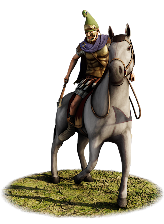
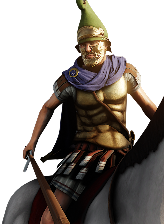
Class: heavy · Category: cavalry · Men per unit: 30
Reforms: Unlocked by Pontic Hellenistic Reforms
Description
These Hetairoi are the reformed shock cavalry of the Pontic kingdom, well-mounted on strong horses, and lavishly equipped with a metal cuirass, greaves, as well as a large colourful Phrygian or Phrygo-Boiotian helmet. Pontic Hetairoi wield a classic cavalry lance, the xyston, as primary armament, supplemented by a kopis sword for close combat. While not as potent as the Companions of Alexander’s successors that serve as their inspiration, these men are nevertheless able to deliver a devastating charge. Well-timed by a capable general, it might turn a battle in your favour!
Historical background
After Philip II and his son Alexander the Great had established heavy, lance-bearing cavalry as a vital part of the Macedonian army, such horsemen developed into a standard feature of all Hellenistic armies. Alexander’s heavy cavalry were trained to fight at close quarters with lance and sword, and were organised into squadrons (‘ilai’) which varied in size from 180 to 225 men (Fields, The Hydaspes 326 BC (2023), p. 36).
The history of the Pontic Kingdom as a military power is inseparably connected to its most successful monarch, Mithridates VI Eupator (r. 120 – 63 BC), '(son of a) Good (i.e. prestigious, well-reputed) Father', who extolled Greek and Iranian culture against the growing Roman influence in the region. Forced to flee the Pontic court dominated by his mother Laodike at young age, Mithridates travelled around Asia Minor, and eventually returned to depose his mother and take power into his own hands. Mithridates mainly adopted Greeks as his military subordinates, even though Greek, Asian, and Roman renegade were equally welcome at his court. His posing as the champion of Hellenism against the Roman advances into Asia should be interpreted as political opportunism (Simpson, s.v. Mithridates VI Eupator, Encyclopaedia Britannica).
This is perfectly illustrated by the events leading up to the massacre of Italians in Asia, instigated by Mithridates, who had first sought Roman recognition and alliance. After prolonged struggles around the thrones of Bithynia and Cappadocia from 101 BC onwards, the Romans disastrously provoked Mithridates in 90 BC. Encouraging the two financially broke kings of Bithynia and Cappadocia to invade Pontus in an attempt to repay the costs Rome had made for their restoration, Rome definitively turned the Pontic king into an enemy. By 89 BC, a series of major Pontic victories had secured control over most of Roman Asia. In response to the Roman declaration of war, in 88 BC Mithridates ordered the massacre of all Italian residents in what became known as the ‘Asiatic Vespers’. Ephesos, Pergamon, Adramytteion, Kaunos, Tralleis, Nysa, and Chios were the scene of major atrocities (Hind, ‘Mithridates’, in: Cambridge Ancient History, vol 9 (1992), pp. 140-149).
Little is known about Pontic cavalry and its equipment in this period. Contemporary descriptions of Mithridates’ army in action against Rome mention its use of a traditional phalanx, including units such as Chalkaspides, for instance at the Battle of Chaironeia against Sulla in 86 BC (Plut. Sulla 16.7). Mithridates’ control of the city of Pergamon and large parts of Greek Asia Minor, as well as his keenness to adopt innovations to his advantage, make it likely that he would have adopted Greek shock cavalry as part of the reformed Pontic army in this period (McGing, The Foreign Policy of Mithridates VI Eupator (1986)). At the Battle of Zela (67 BC), Mithridates VI successfully used his cavalry to charge into the rear of a Roman army under legate Gaius Valerius Triarius. Their charge broke the legions, winning the Pontic king a stunning victory. In the chaos of battle, a Roman centurion was able to run close to Mithridates himself, and wounded him in the thigh. This suggests that Mithridates and his cavalry were not fighting as cataphracts, but rather wore a cuirass after the style of Hellenistic Companions (App. Mithr. 13.89). In RIS, therefore, we have opted to include a variant of the classic Hellenistic hetairoi cavalry as part of the reformed Pontic army, in addition to its famed chariots and cataphracts.
Stats
| Rank in roster | ||
|---|---|---|
| Men per unit | 30 | █········· 8% |
| Attack | 13 | ██████···· 57% |
| Charge bonus | 35 | ██████████ 96% |
| Defence | 35 | ██████···· 57% |
| · armour | 15 | ████████·· 82% |
| · defence skill | 20 | █████····· 48% |
| · shield | 0 | █········· 0% |
| Morale | 13 | ███████··· 70% |
| Discipline | Normal | |
| Training | Highly trained | |
| Recruitment cost | 2,691 dn | ████████·· 75% |
| Upkeep per turn | 1,083 dn | █████████· 93% |
| Turns to recruit | 4 |
Weapons
| Primary | Secondary | Primary | Secondary | Primary | Secondary | Primary | Secondary | ||||
|---|---|---|---|---|---|---|---|---|---|---|---|
| Attack | 13 | 13 | Charge bonus | 35 | 27 | Type | melee · blade | melee · blade | Damage | piercing | slashing |
Defence
| Primary | Secondary | Primary | Secondary | Primary | Secondary | Primary | Secondary | ||||
|---|---|---|---|---|---|---|---|---|---|---|---|
| Total | 35 | — | Armour | 15 | — | Defence skill | 20 | — | Shield | 0 | — |
Condition and terrain
| Hit points | 1 | Mount | heavy horse | Ground: scrub / sand / forest / snow | -4 / -1 / -8 / -1 | Charge distance | 40 |
| Formations | Square · Wedge |
Technical stats
| Time between blows (primary / secondary) | 2.5 s / 2.5 s | Extra fatigue in hot climates | 4 | Spacing between men: close / loose | 2 × 4.8 m / 3 × 7.2 m | Default ranks | 5 |
In battle: Powerful charge
Who can recruit it
A core roster unit for one faction, which can raise it anywhere it holds the right building:
Exactly what a settlement must have, route by route (2)
| Building | Also requires | Building | Also requires | ||||
|---|---|---|---|---|---|---|---|
| Direct Rule | Tier 3 Military Industrial Complex · Pontic Hellenistic Reforms · Tier 2 Colony · Requires resource horses or horses supplied factionwide | Homeland | Tier 2 Military Industrial Complex · Pontic Hellenistic Reforms |