
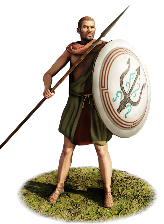
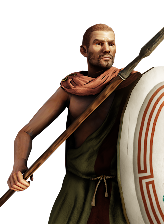
Description
These young men are the offspring of the citizens of Priene, a small, but important Greek polis in ancient Ionia. Originally founded by Carians, probably during the so called Dark Ages in the early first millennium BC, Priene became one of the most well-known and significant Greek cities in Asia Minor. By the time of the Peloponnesian War, a radical democracy had been established in Priene, which stood in opposition to the wealthy oligarchy of neighbouring Miletos. The youth of Priene was therefore educated as fierce democrats who would bravely defend the chora (territory) of their city. Armed with spears and javelins and carrying big Aspis shields, these Ephebes can be used both as ranged and melee units. Though they are protected by their shields, Phrygian caps or Pilos helmets, they lack body armour and will succumb to Hoplites, so that a good general should always keep a watchful eye on these youngsters.
Historical background
Priene was founded by Carians on the Milesian Gulf some point before the 8th century BC during the so called Dark Ages (Paus. 7.2.10). It was part of the Ionian League and, thanks to controlling the federal sanctuary, the Panionion, effectively became its capital (Strab. 8.7.2; 14.1.20). In 2004, a team from Ruhr Universität Bochum in Western Germany discovered the ancient Panionion in the Mykale mountains at 750 m above sea level. They found that the sanctuary had indeed once been set up by Carians, and they noted that it had been sacked by the Persians, possibly around the end of the failed Ionian Revolt in 494 BC (Lohmann, Survey in the Mycale (2006) & Lohmann, Forschungen in der Mykale, 2007). Priene quickly recovered from the defeat and joined the Delian League after the Athenian victories over the Persians in the 470s BC. During this period, a radical democracy was established in Priene, which would stand in strong opposition to the elitist oligarchy of Miletos in the south (Thonemann, Hellenistic Age (2018), p. 103). This survived the tests of time and was acknowledged, among others, by Alexander the Great (IPriene 1). In 277/276 BC, the Prienians defeated the Galatians (IPriene 17) and around 155 BC, they withstood an invasion by the Pergamene Attalids and the Cappadocians with Roman support (Polyb. 33.6).
The proud Prienians were eager to educate their sons both as brave warriors and passionate democrats. To accomplish this, they had to set an example: in the Late Hellenistic period, a great benefactor of Priene is even attested to have invited slaves and foreigners to a big breakfast, treating them as the equals of citizens (IPriene 113 = IPriene² 69). Such visions of equality were taught to the teenage sons of citizens, but they also had to learn how to fight. To this end, two gymnasia were erected in Priene after the city had been moved to a better position in the 4th century BC (Rumscheid, Priene, 1998). An inscription from the Hellenistic period describes how the Ephebes regularly trained in full armour in one of the gymnasia (I. Priene 112, l. 72-76). This must refer to a Hoplite-like equipment, and during the so called Kallihoplia, the Ephebes annually competed over the most beautiful panoply their city state could offer (Kah, Das hellenistische Gymnasion (2004), p. 66). While the inscription speaks about mystical sphairai (metal balls - shot put? catapult shooting?), their main weapons were javelins and bows (Kah (2004), p. 63). In RIS, we have therefore chosen to represent the Prienian Ephebes as light Hoplites with javelins.
The description could end here if there wasn't an inscription dated to 84 BC (IPriene 112) which talks about even stranger activities the Prienian ephebes were supposedly up to. During a festival organised by the magistrate Zosimos, one of Priene's first citizens who was also naturalised in Rome, our dear Prienian youngsters participated in a contest called "skillomachia", which translates to "a fight with squills". Squills, in case you are not aware, are a type of ... asparagus – though inedible and poisonous. Bremmer (Scapegoat Rituals (1983), p. 310) imagined that the boys would have pelted each other with the bulbs of the squills in a ritual battle – the winner in the age class of the ephebes received a bull calf (IPriene 112). Disappointingly, Rufilanchas (Zwei Agone (2000), pp. 91; 95-96) offers a rather convincing explanation that both sphairai and skilla were actually the names of specific boxing gloves, and thus a unit of communist Ionian teenagers throwing metal balls and the bulbs of poisonous asparagus-onion mutants never saw the light in RIS.
Stats
| Rank in roster | ||
|---|---|---|
| Men per unit | 60 | █████████· 87% |
| Attack | 12 | █████····· 48% |
| Charge bonus | 2 | █········· 11% |
| Defence | 27 | ████······ 35% |
| · armour | 1 | █········· 0% |
| · defence skill | 21 | █████····· 54% |
| · shield | 5 | ██████···· 57% |
| Morale | 7 | █········· 10% |
| Discipline | Low | |
| Training | Untrained | |
| Recruitment cost | 1,529 dn | ██········ 19% |
| Upkeep per turn | 560 dn | ███······· 31% |
| Turns to recruit | 2 |
Weapons
| Primary | Secondary | Primary | Secondary | Primary | Secondary | Primary | Secondary | ||||
|---|---|---|---|---|---|---|---|---|---|---|---|
| Attack | 12 | 4 | Charge bonus | 2 | 2 | Type | thrown · blade | melee · blade | Damage | piercing | piercing |
| Projectile | javelin | — | Range | 50 | — | Ammunition | 2 | — | Properties | Used just before charging into combat | — |
Defence
| Primary | Secondary | Primary | Secondary | Primary | Secondary | Primary | Secondary | ||||
|---|---|---|---|---|---|---|---|---|---|---|---|
| Total | 27 | — | Armour | 1 | — | Defence skill | 21 | — | Shield | 5 | — |
Condition and terrain
| Hit points | 1 | Modifier against mounts | horse +1 · chariot +1 · camel +1 | Ground: scrub / sand / forest / snow | 0 / 0 / 0 / 0 | Charge distance | 30 |
| Formations | Square |
Technical stats
| Time between blows (primary / secondary) | 2.5 s / 2.5 s | Extra fatigue in hot climates | 0 | Collision mass per man (1.0 is normal) | 0.95 | Spacing between men: close / loose | 1 × 1.2 m / 2 × 2.4 m |
| Default ranks | 5 |
In battle: Can sap · Very good stamina
Who can recruit it
A core roster unit for one faction, which can raise it anywhere it holds the right building:
Exactly what a settlement must have, route by route (3)
| Building | Also requires | Building | Also requires | Building | Also requires | ||
|---|---|---|---|---|---|---|---|
| Indirect Rule | Garrison Building or Tier 1 Military Industrial Complex · Tier 1 Colony | Direct Rule | Garrison Building or Tier 1 Military Industrial Complex · Tier 1 Colony | Homeland | Garrison Building or Tier 1 Military Industrial Complex |